


High-resolution metabolomics to discover potential parasite-specific biomarkers in a Plasmodium falciparum erythrocytic stage culture system
- PMID: 25889340
- PMCID: PMC4377044
- DOI: 10.1186/s12936-015-0651-1
High-resolution metabolomics to discover potential parasite-specific biomarkers in a Plasmodium falciparum erythrocytic stage culture system
Abstract
Background: Current available malaria diagnostic methods each have some limitations to meet the need for real-time and large-scale screening of asymptomatic and low density malaria infection at community level. It was proposed that malaria parasite-specific low molecular-weight metabolites could be used as biomarkers for the development of a malaria diagnostic tool aimed to address this diagnostic challenge. In this study, high resolution metabolomics (HRM) was employed to identify malaria parasite-specific metabolites in Plasmodium falciparum in vitro culture samples.
Methods: Supernatants were collected at 12 hours interval from 3% haematocrit in vitro 48-hour time-course asynchronized culture system of P. falciparum. Liquid chromatography coupled with high resolution mass spectrometry was applied to discover potential parasite-specific metabolites in the cell culture supernatant. A metabolome-wide association study was performed to extract metabolites using Manhattan plot with false discovery rate (FDR) and hierarchical cluster analysis. The significant metabolites based on FDR cutoff were annotated using Metlin database. Standard curves were created using corresponding chemical compounds to accurately quantify potential Plasmodium-specific metabolites in culture supernatants.
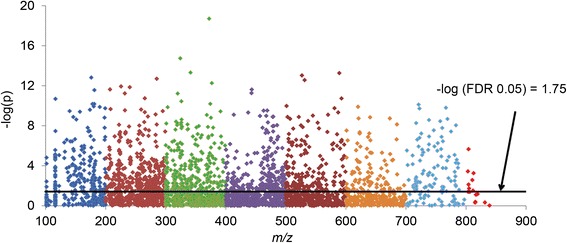
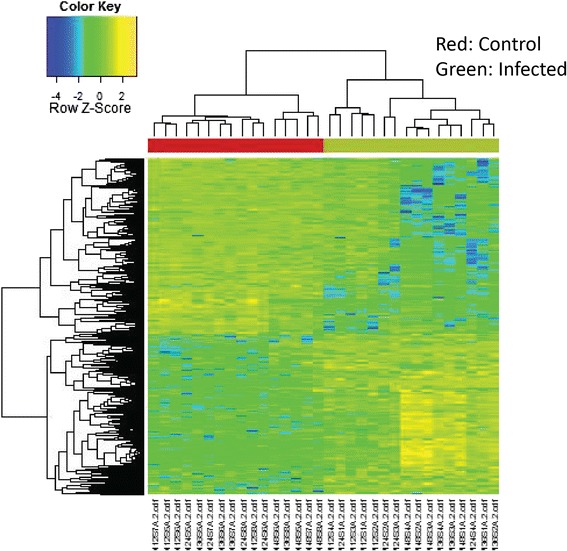
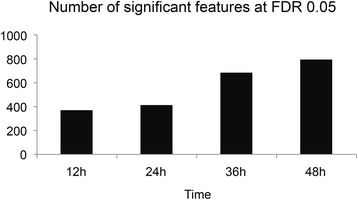
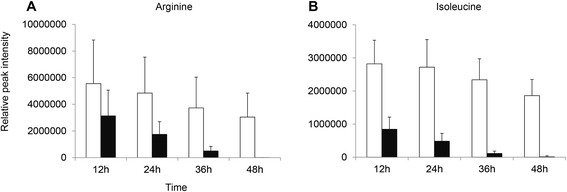
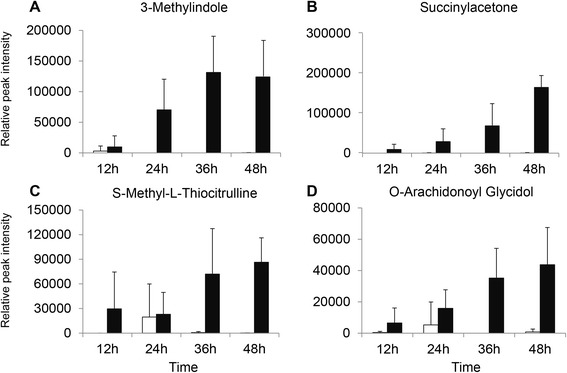
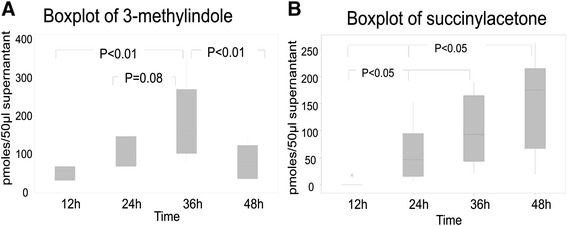
Results: The number of significant metabolite features was 1025 in the supernatant of the Plasmodium infected culture based on Manhattan plot with FDR q=0.05. A two way hierarchical cluster analysis showed a clear segregation of the metabolic profile of parasite infected supernatant from non-infected supernatant at four time points during the 48 hour culture. Among the 1025 annotated metabolites, the intensities of four molecules were significantly increased with culture time suggesting a positive association between the quantity of these molecules and level of parasitaemia: i) 3-methylindole, a mosquito attractant, ii) succinylacetone, a haem biosynthesis inhibitor, iii) S-methyl-L-thiocitrulline, a nitric oxide synthase inhibitor, and iv) O-arachidonoyl glycidol, a fatty acid amide hydrolase inhibitor, The highest concentrations of 3-methylindole and succinylacetone were 178 ± 18.7 pmoles at 36 hours and 157±30.5 pmoles at 48 hours respectively in parasite infected supernatant.
Conclusion: HRM with bioinformatics identified four potential parasite-specific metabolite biomarkers using in vitro culture supernatants. Further study in malaria infected human is needed to determine presence of the molecules and its relationship with parasite densities.
Figures
References
-
- CDC. http://www.cdc.gov/malaria/about/index.html, Centers for Disease Control and Prevention, Atlanta, GA, USA 2014.
-
- WHO . World Malaria Reports 2011. Geneva: World Health Organization; 2011.
-
- Harris I, Sharrock WW, Bain LM, Gray KA, Bobogare A, Boaz L, et al. A large proportion of asymptomatic Plasmodium infections with low and sub-microscopic parasite densities in the low transmission setting of Temotu Province, Solomon Islands: challenges for malaria diagnostics in an elimination setting. Malar J. 2010;9:254. doi: 10.1186/1475-2875-9-254. - DOI - PMC - PubMed
Publication types
MeSH terms
Substances
Grants and funding
LinkOut - more resources
Full Text Sources
Other Literature Sources
