


National trends in emergency room diagnosis of pulmonary embolism, 2001-2010: a cross-sectional study
- PMID: 25890024
- PMCID: PMC4391335
- DOI: 10.1186/s12931-015-0203-9
National trends in emergency room diagnosis of pulmonary embolism, 2001-2010: a cross-sectional study
Abstract
Background: Little is known about the United States diagnosis and burden of pulmonary embolism (PE) in the emergency department (ED), and their evolution over the past decade. We examined nationally representative data to evaluate factors associated with and trends in ED diagnosis of PE.
Methods: We conducted a cross-sectional study using National Hospital Ambulatory Medical Care Survey (NHAMCS) data from January 1, 2001 to December 31, 2010. We identified all ED patient visits where PE was diagnosed and corresponding demographic, hemodynamic, testing and disposition data. Analyses were performed using descriptive statistics and multivariable logistic regression.
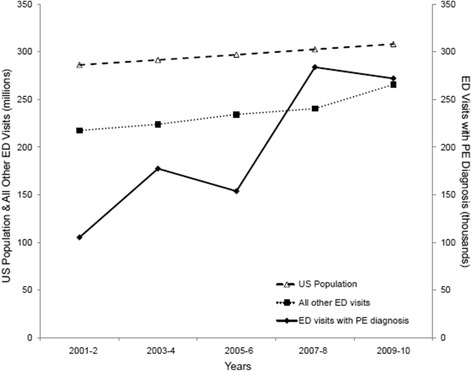
Results: During the study period 988,000 weighted patient visits with diagnosis of PE were identified. Among patients with an ED visit, the likelihood of having a diagnosis of PE per year increased significantly from 2001 to 2010 (odds ratio [OR] 1.091, 95% confidence interval [CI] 1.034-1.152, P = 0.002 for trend) when adjusted for demographic and hospital information. In contrast, when further adjusted for the use of computed tomography (CT) among patients in the ED, the likelihood of having a diagnosis of PE per year did not change (OR 1.041, 95% CI 0.987-1.097, P = 0.14). Overall, 75.1% of patients seen with a diagnosis of PE were hemodynamically stable; 86% were admitted with an in-hospital death rate under 3%.
Conclusions: The proportion of ED visits with a diagnosis of PE increased significantly from 2001 to 2010 and this rise can be attributed in large part to the increased availability and use of CT. Most of these patients were admitted with low in-hospital mortality.
Figures
References
MeSH terms
LinkOut - more resources
Full Text Sources
Other Literature Sources
Medical
Miscellaneous
