Review
. 2015 Jun;7(6):965-78.
doi: 10.1039/c4mt00332b.

The role of transition metal transporters for iron, zinc, manganese, and copper in the pathogenesis of Yersinia pestis

Affiliations
Review

The role of transition metal transporters for iron, zinc, manganese, and copper in the pathogenesis of Yersinia pestis

Robert D Perry et al. Metallomics. 2015 Jun.

Abstract

Yersinia pestis, the causative agent of bubonic, septicemic and pneumonic plague, encodes a multitude of Fe transport systems. Some of these are defective due to frameshift or IS element insertions, while others are functional in vitro but have no established role in causing infections. Indeed only 3 Fe transporters (Ybt, Yfe and Feo) have been shown to be important in at least one form of plague. The yersiniabactin (Ybt) system is essential in the early dermal/lymphatic stages of bubonic plague, irrelevant in the septicemic stage, and critical in pneumonic plague. Two Mn transporters have been characterized (Yfe and MntH). These two systems play a role in bubonic plague but the double yfe mntH mutant is fully virulent in a mouse model of pneumonic plague. The same in vivo phenotype occurs with a mutant lacking two (Yfe and Feo) of four ferrous transporters. A role for the Ybt siderophore in Zn acquisition has been revealed. Ybt-dependent Zn acquisition uses a transport system completely independent of the Fe-Ybt uptake system. Together Ybt components and ZnuABC play a critical role in Zn acquisition in vivo. Single mutants in either system retain high virulence in a mouse model of septicemic plague while the double mutant is completely avirulent.


Figures
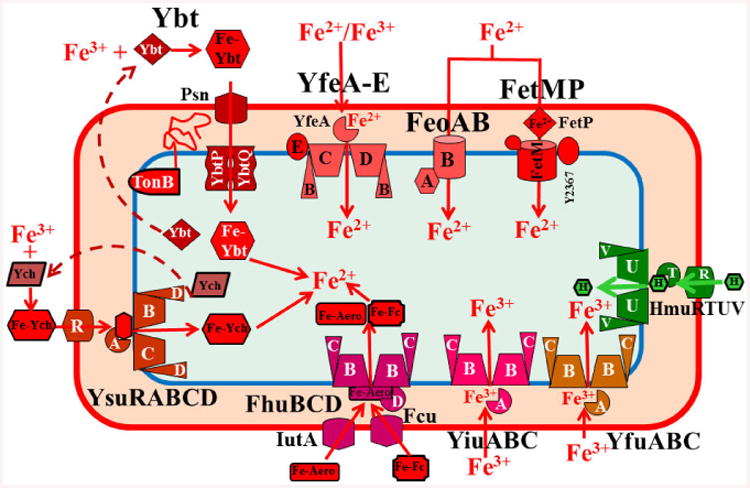
Fig. 1
Fig. 1
Y. pestis iron transport systems that are proven functional in vitro. These include a heme transporter (Hmu), three ferrous transporters (Yfe, Feo, and, Fet), three “ferric” transporters (Yfe, Yfu, and Yiu), one siderophore-dependent system (Ybt) fully functional in all Y. pestis biotypes, one system (Fhu/IutA/Fcu) capable of transporting, but not synthesizing aerobactin and ferrichrome bound to Fe (FeAero and FeFc). Finally, the Ysu system of Y. pestis CO92 (orientalis biotype) synthesizes and transports the Yersiniachelin (Ych) siderophore while Y. pestis KIM and Antiqua (medaevalis and antiqua biotypes) have a frameshift mutation that disrupts Ych synthesis. Although the fitABC and efeUOB loci are intact, their functionality remains to be tested. All OM receptors shown are TonB-dependent. FetMP requires one or more of the flp gene products (Y2363-Y2367) to be functional; for simplicity only Y2367 is shown. The Yfe ABC transporter can utilize ferric iron as a substrate, but its oxidation state during transport is undetermined. Dashed arrows in all figures indicate unknown components or unconfirmed steps.
Fig. 2
Fig. 2
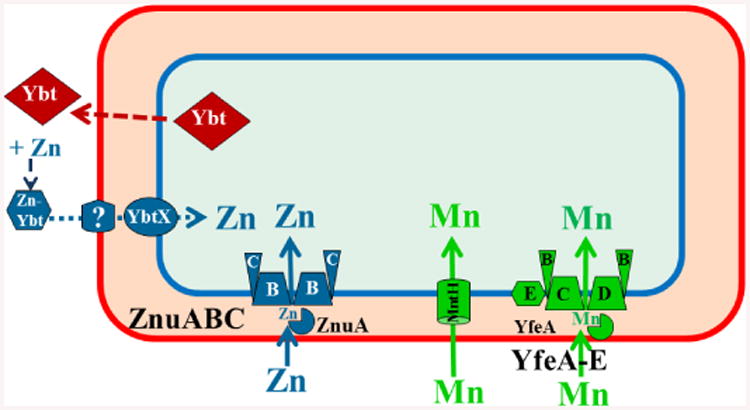
Y. pestis manganese and zinc transporters functional in vitro. Two widespread Mn transporters (MntH and Yfe/Sit) are functional in Y. pestis. The Znu and Ybt systems are also widespread with the Ybt siderophore and YbtX recently implicated in Zn uptake. Our model shows Zn bound to Ybt. However, this has not been demonstrated and the role of Ybt in Zn acquisition may be indirect.
Fig. 3
Fig. 3
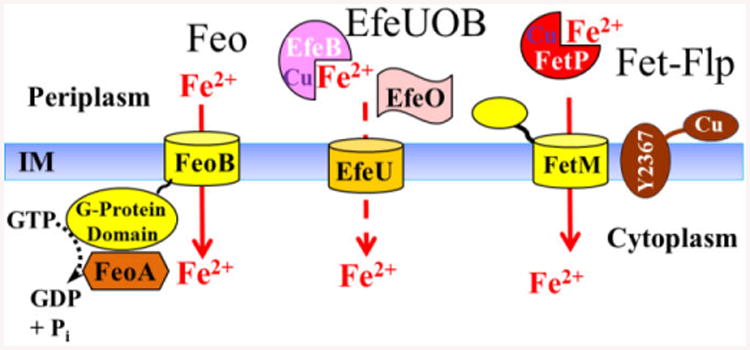
Ferrous transporters of Y. pestis. The Yfe ABC transporter is depicted in Fig. 1 and 5. Y. pestis FeoAB is typical of Gram-negative Feo systems. Both FeoA and FeoB are required with FeoB proposed to serve as the permease with its G-protein domain and FeoA acting to help hydrolyze GTP to energize transport. FeoC has been proposed or shown to affect levels of FeoB,, however, a Y. pestis feoC mutation has no affect on feoABC transcription or growth under iron-defidient conditions., Bacterial Efe systems are members of the OFeT family that are related to the yeast FTR family but lack the Fet3p component. EfeU is the permease while EfeO and EfeB are periplasmic proteins, EfeO has putative metal binding sites (Cu and Fe), an N-terminal cupridoxin domain and a C-terminal peptidase-M75 domain. EfeB is predicted to have heme peroxidase-like activity , -. FetMP is distantly related to the yeast FTR system with mutations in E. coli and Y. pestis having different phenotypes (see text). In addition, an insertion in Y. pestis y2367 (flpD; the first of 6 linked genes) causes loss of function. Although only Y2367 is shown in the model, the identity and number of flp genes (fet-linked phenotype) required for FetMP function is undetermined , ,
Fig. 4
Fig. 4
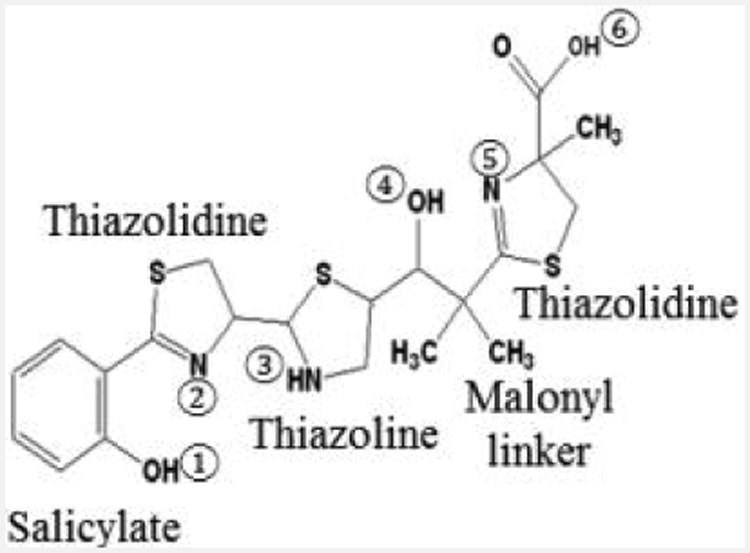
Structure of the Ybt siderophore. Salicylate, thiazolidine, and thiazoline rings as well as the malonyl linker are labelled. The six coordinate binding sites for Fe3+ are shown.
Fig. 5
Fig. 5
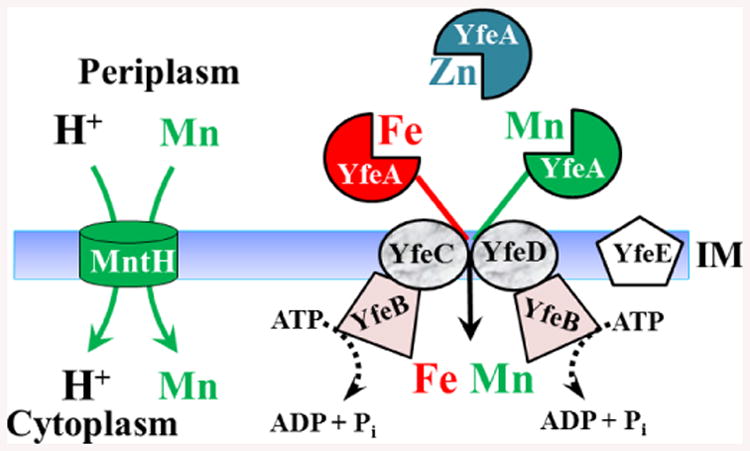
Models of proven Y. pestis Mn transporters YfeABCDE and MntH. The Yfe ABC transporter also accumulated Fe under aerobic and microaerobic conditions. In addition, the YfeA SBP binds Zn but does not transport it into the cytoplasm , , ,
Fig. 6
Fig. 6
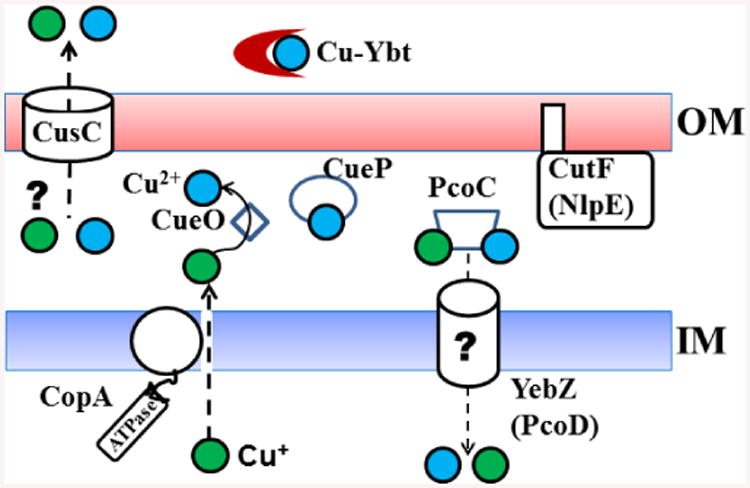
Proposed Y. pestis copper transport and resistance mechanisms. Proposed functions for Y. pestis proteins are based solely on similarities to those with established functions in other bacteria. Cu2+ binding by the Ybt siderophore has been experimentally demonstrated. Cu+, green spheres; Cu2+, blue spheres.
Fig. 7
Fig. 7
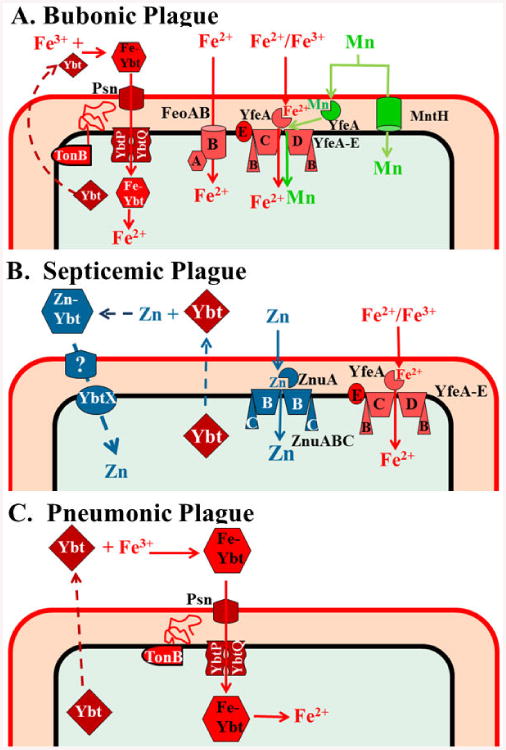
Fe, Zn, and Mn transporters with proven roles in mouse models of bubonic (A), septicemic (B), and pneumonic (C) plague. The Yfe system is shown as “transporting” both Fe3+ and Fe2+ since there is evidence it functions under aerobic conditions where Fe3+ would predominate and under microaerobic or reducing conditions where Fe2+ would be prevalent. However, the oxidation state transported is undetermined. Zn binding by Ybt (B) has not been shown; thus Ybt could play an indirect role in Zn uptake.

References

    1. Haley KP, Skaar EP. Microbes Infect. 2012;14:217–227. - PMC - PubMed
    1. Hood MI, Skaar EP. Nat Rev Microbiol. 2012;10:525–537. - PMC - PubMed
    1. Kehl-Fie TE, Skaar EP. Curr Opin Chem Biol. 2010;14:218–224. - PMC - PubMed
    1. Lisher JP, Giedroc DP. Front Cell Infect Microbiol. 2013;3:91. - PMC - PubMed
    1. Skaar EP. PLoS Pathog. 2010;6:e1000949. - PMC - PubMed

Publication types

LinkOut - more resources