


Uveitis Reactivation in Children Treated With Tumor Necrosis Factor Alpha Inhibitors
- PMID: 25892124
- PMCID: PMC4945247
- DOI: 10.1016/j.ajo.2015.04.016
Uveitis Reactivation in Children Treated With Tumor Necrosis Factor Alpha Inhibitors
Abstract
Purpose: To evaluate reactivation of pediatric uveitis during/following treatment with tumor necrosis factor alpha inhibition (anti-TNFα).
Design: Retrospective cohort study.
Methods: We assessed the incidence of uveitis reactivation in children ≤18 years who had achieved uveitis quiescence under anti-TNFα. Survival analysis was used to calculate reactivation rates while still on (primary outcome), and following discontinuation of (secondary outcome), anti-TNFα. Potential predictive factors were assessed.
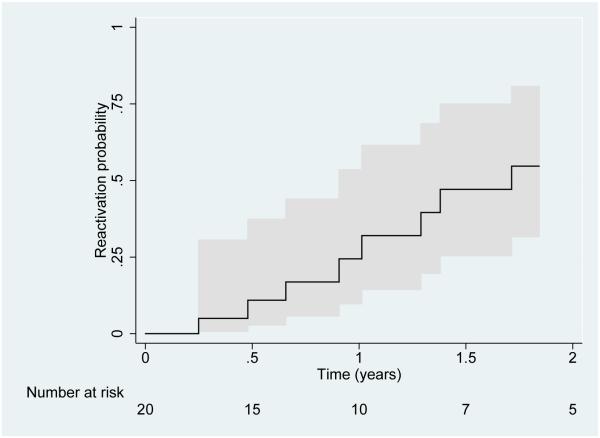
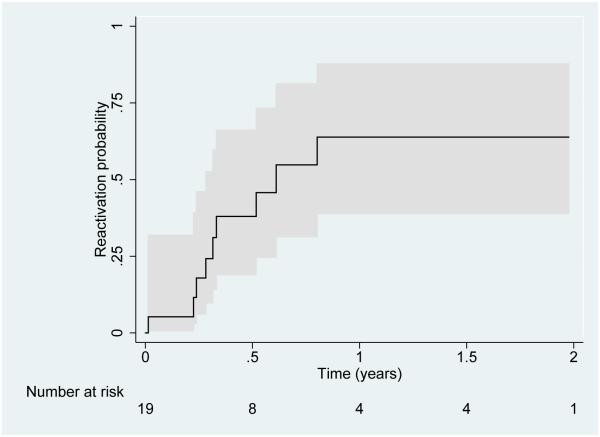
Results: Among 50 children observed to develop quiescence of uveitis under anti-TNFα, 39 met criteria to be "at risk" of the primary (19 for the secondary) outcome. 60% were female, ∼half had juvenile idiopathic arthritis, and most were treated with infliximab. Overall, the estimated proportion relapsing within 12 months was 27.8% (95% confidence interval [CI]: 15.9%-45.8%); the estimated probability of reactivation was higher following (63.8% [95% CI: 38.9%-87.7%]) vs before (21.6% [95% CI: 10.8%-40.2%]) anti-TNFα discontinuation. Among those who discontinued anti-TNFα, the likelihood of reactivation was higher for those treated with adalimumab vs infliximab (hazard ratio [HR] 13.4, P = .01, 95% CI: 2.2-82.5) and those with older age at uveitis onset (HR 1.3, P = .09, 95% CI: 1.0-1.7). The duration of suppression, on medication, did not significantly affect the likelihood of reactivation when quiescence was maintained for ≥1.5 years.
Conclusions: Approximately 75% of children remaining on anti-TNFα following achievement of uveitis quiescence remain quiescent at 1 year. However, most reactivate following anti-TNFα discontinuation. These results suggest that infliximab more often is followed by remission, off medication, than adalimumab. The data do not suggest that maintenance of suppression for more than 1.5 years decreases the reactivation risk.
Copyright © 2015 Elsevier Inc. All rights reserved.
Figures
References
-
- Gritz DC, Wong IG. Incidence and prevalence of uveitis in northern california; the northern california epidemiology of uveitis study. Ophthalmology. 2004;111(3):491–500. - PubMed
-
- Edelsten C, Reddy MA, Stanford MR, Graham EM. Visual loss associated with pediatric uveitis in english primary and referral centers. Am J Ophthalmol. 2003;135(5):676–80. - PubMed
-
- Holland GN, Denove CS, Yu F. Chronic anterior uveitis in children: Clinical characteristics and complications. Am J Ophthalmol. 2009;147(4):667–678. - PubMed
-
- Kump LI, Cervantes-Castañeda RA, Androudi SN, Foster CS. Analysis of pediatric uveitis cases at a tertiary referral center. Ophthalmology. 2005;112(7):1287–92. - PubMed
Publication types
MeSH terms
Substances
Grants and funding
LinkOut - more resources
Full Text Sources
Other Literature Sources
Miscellaneous
