


Socio-economic and lifestyle parameters associated with diet quality of children and adolescents using classification and regression tree analysis: the DIATROFI study
- PMID: 25892409
- PMCID: PMC10270971
- DOI: 10.1017/S136898001500110X
Socio-economic and lifestyle parameters associated with diet quality of children and adolescents using classification and regression tree analysis: the DIATROFI study
Abstract
Objective: To explore factors affecting children's and adolescents' diet quality, in the framework of a food aid and promotion of healthy nutrition programme implemented in areas of low socio-economic status of Greece, during the current financial crisis.
Design: From a total of 162 schools participating in the programme during 2012-2013, we gathered 15 897 questionnaires recording sociodemographic characteristics, lifestyle parameters and dietary habits of children and their families. As a measure of socio-economic status, the Family Affluence Scale (FAS) was used; whereas for the assessment of diet quality, the KIDMED score was computed. Associations between KIDMED and FAS, physical activity and socio-economic parameters were examined using regression and classification-regression tree analysis (CART).
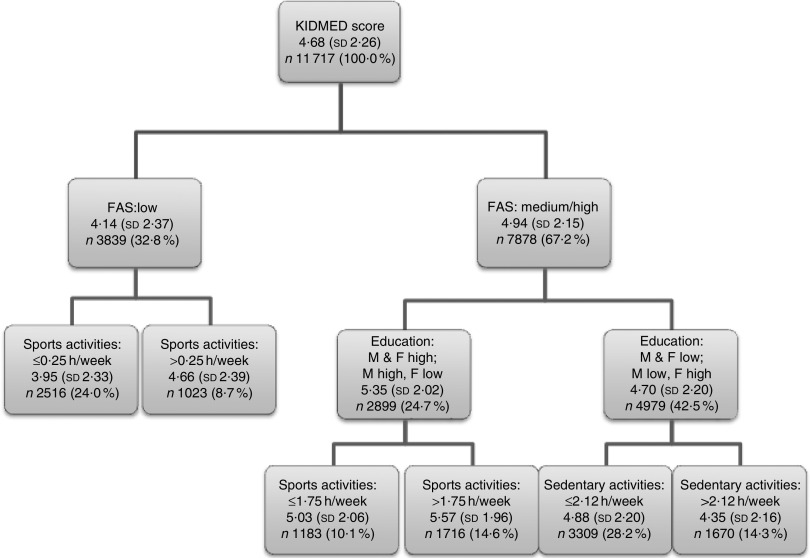
Results: The higher the FAS score, the greater the percentage of children and adolescents who reported to consume, on a daily basis, fruits and vegetables, dairy products and breakfast (P<0·001). Results from CART showed that children and adolescents in the medium or high FAS groups had higher KIDMED score, compared with those in the low FAS group. For those in the low FAS group, KIDMED score is expected to increase by 12·4 % when they spend more than 0·25 h/week in sports activities. The respective threshold for the medium and high FAS groups is 1·75 h/week, while education of the mother and father affected KIDMED score significantly as well.
Conclusions: Diet quality is strongly influenced by socio-economic parameters in children and adolescents living in economically disadvantaged areas of Greece, so that lower family affluence is associated with worse diet quality.
Keywords: Decision-tree analysis; Dietary habits; Nutrition; Socio-economic status.
Figures
References
-
- Mackenbach JP, Stirbu I, Roskam AJ et al. (2008) Socioeconomic inequalities in health in 22 European countries. N Engl J Med 358, 2468–2481. - PubMed
-
- Mackenbach JP, Karanikolos M & McKee M (2013) The unequal health of Europeans: successes and failures of policies. Lancet 381, 1125–1134. - PubMed
-
- Chandola T (2012) Spatial and social determinants of urban health in low-, middle- and high-income countries. Public Health 126, 259–261. - PubMed
-
- Spencer N, Thanh TM & Louise S (2013) Low income/socio-economic status in early childhood and physical health in later childhood/adolescence: a systematic review. Matern Child Health J 17, 424–431. - PubMed
Publication types
MeSH terms
LinkOut - more resources
Full Text Sources
Medical
Research Materials
Miscellaneous
