Review
. 2015 Dec;35 Suppl(Suppl):S25-S54.
doi: 10.1016/j.semcancer.2015.02.006. Epub 2015 Apr 17.

Sustained proliferation in cancer: Mechanisms and novel therapeutic targets

Affiliations
Review

Sustained proliferation in cancer: Mechanisms and novel therapeutic targets

Mark A Feitelson et al. Semin Cancer Biol. 2015 Dec.

Abstract

Proliferation is an important part of cancer development and progression. This is manifest by altered expression and/or activity of cell cycle related proteins. Constitutive activation of many signal transduction pathways also stimulates cell growth. Early steps in tumor development are associated with a fibrogenic response and the development of a hypoxic environment which favors the survival and proliferation of cancer stem cells. Part of the survival strategy of cancer stem cells may manifested by alterations in cell metabolism. Once tumors appear, growth and metastasis may be supported by overproduction of appropriate hormones (in hormonally dependent cancers), by promoting angiogenesis, by undergoing epithelial to mesenchymal transition, by triggering autophagy, and by taking cues from surrounding stromal cells. A number of natural compounds (e.g., curcumin, resveratrol, indole-3-carbinol, brassinin, sulforaphane, epigallocatechin-3-gallate, genistein, ellagitannins, lycopene and quercetin) have been found to inhibit one or more pathways that contribute to proliferation (e.g., hypoxia inducible factor 1, nuclear factor kappa B, phosphoinositide 3 kinase/Akt, insulin-like growth factor receptor 1, Wnt, cell cycle associated proteins, as well as androgen and estrogen receptor signaling). These data, in combination with bioinformatics analyses, will be very important for identifying signaling pathways and molecular targets that may provide early diagnostic markers and/or critical targets for the development of new drugs or drug combinations that block tumor formation and progression.

Keywords: Cancer hallmarks; Cancer stem cells; Natural products; Proliferation; Therapeutic targets.


Figures

Fig. 1
Fig. 1
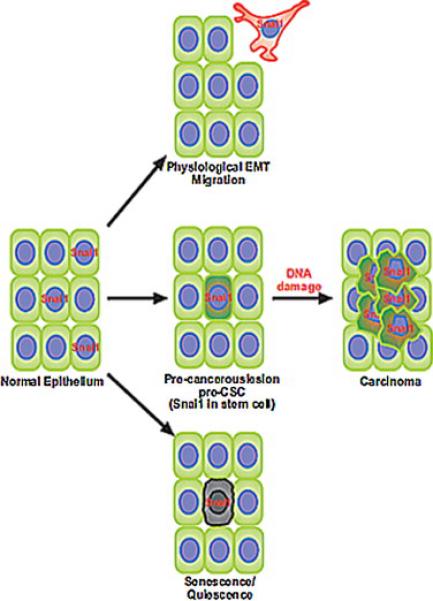
Senescence-resistant stem cells (SCs) are targets of Snail induced tumors. Tumor-associated Snail1/2 contribute to metastasis, but are also involved in early stages of cancer. In this model, cells expressing oncogenic Snail1/2 undergo EMT or senescence. However, SCs are resistant to this fate. Snail1/2 increases resistance to DNA damage, allowing those cells to accumulate mutations that fuel malignant transformation and uncontrolled cell growth.
Fig. 2
Fig. 2
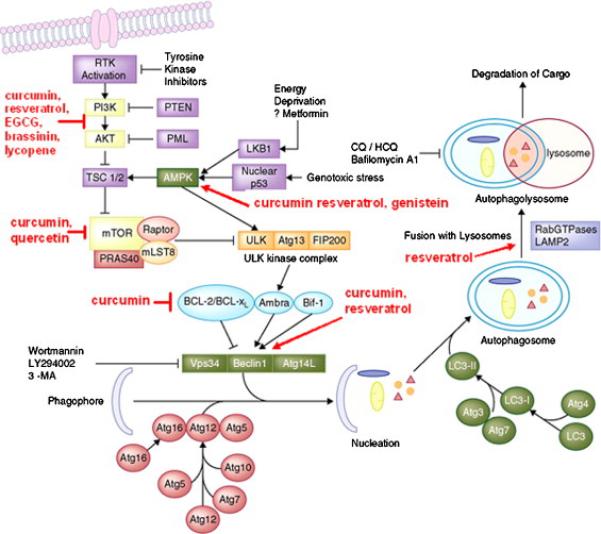
Major pathways of autophagy and natural compounds that inhibit these pathways. Autophagy inducers such as starvation (which may occur during hypoxic conditions) modulate the activity of the phagophore, consisting of the Atg1/unc-51-like kinase (ULK) complex, Beclin 1/PI3K complex, ubiquitin-like proteins (several Atg proteins), and proteins that mediate fusion between autophagosomes and lysosomes. Phagophore formation could be blocked with PI3K inhibitors. Autophagy induction involves budding of autophagosomes from the ER membranes, and inhibits interaction of TORC1 with the ULK1/2 complex. The latter regulates the activity of Beclin 1/class III PI3K complex. Beclin 1 interacts with factors that modulate its binding to Vps34, the catalytic unit of the PI3K, whose lipid kinase activity is essential for autophagy. This step could also be pharmacologically blocked. Fully mature autophagosomes can fuse with endosomes to form amphisomes. Autophagosomes or amphisomes fuse their external membranes with those from acidic lysosomes to acquire hydrolytic activity, degrade their cargo, and recycle essential biomolecules to the cytoplasm. Both fusion and degradation could also be inhibited by a variety of compounds, suggesting that autophagy would be a viable target in early stages of carcinogenesis [705].
Fig. 3
Fig. 3
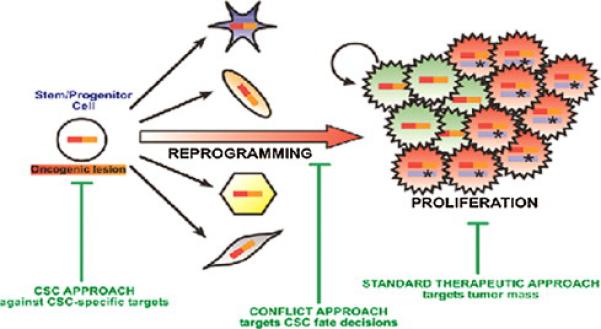
Cancer stem cells (CSCs) arise from tissue specific stem or progenitor cells that have undergone changes in gene expression (reprogramming) as a result of epigenetic mechanisms and/or oncogenic mutations. These CSCs undergo proliferation and differentiation into tumor cells. Standard therapeutic approaches target mostly the differentiated tumor cells, which reduce the bulk of the tumor, but CSCs are resistant to most therapies that are effective against the bulk of the tumor cells. In this model of carcinogenesis, it will be important to target key alterations in gene expression that drive reprogramming, be they natural compounds that epigenetically downregulate the expression of genes that contribute to reprogramming, and/or drugs that are effective against molecules that acquire driver mutations. Thus, blocking the reprogramming and proliferation of stem cells is likely to contribute importantly to cancer chemoprevention.
Fig. 4
Fig. 4
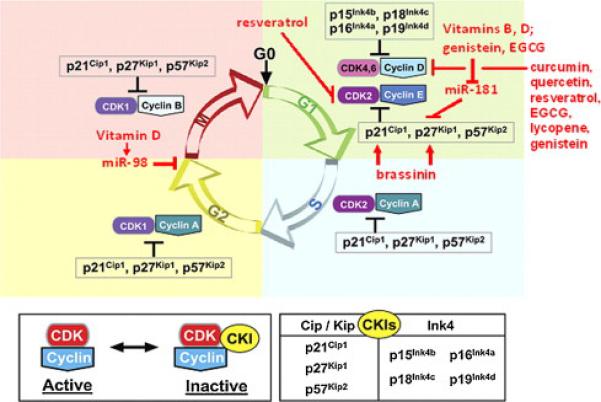
Selected natural products that block cell cycle progression. Receptor activation, via Raf, MEK, ERK, and AP1, increases cyclin D1 transcription. Cyclin D1 binds to cdk4 and the assembly factor, p27Kip1 to create an active ternary complex. This complex can be inactivated by association with Ink4A or loss of cyclin D1 via GSK-3β-mediated proteasomal degradation. Active cyclin D-cdk4-p27 complexes phosphorylate (inactivate) Rb, causing limited transcriptional activation of cyclin E. Increased cyclin E levels shifts the balance of inactive cyclin E-cdk2 complexes to active cyclin E-cdk2 complexes, which in turn phosphorylates its associated p27, targeting it for proteasomal degradation. p27-free cyclin E-cdk2 complexes now fully phosphorylate Rb, causing S phase gene transcription, and progression into S phase, where the cell cycle proceeds independently of extracellular signals. As shown in red, many natural compounds cause G1 arrest in several cancer cell culture models, due to effects on cyclin D1, p21, p27 or cyclin E. Some of these act via altered expresson of microRNAs. Modified from reference [650].
Fig. 5
Fig. 5
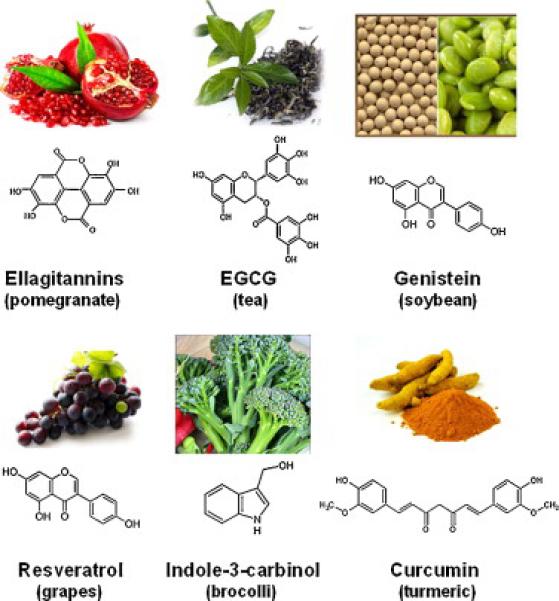
Examples of anti-proliferative compounds obtained from natural sources.
Fig. 6
Fig. 6
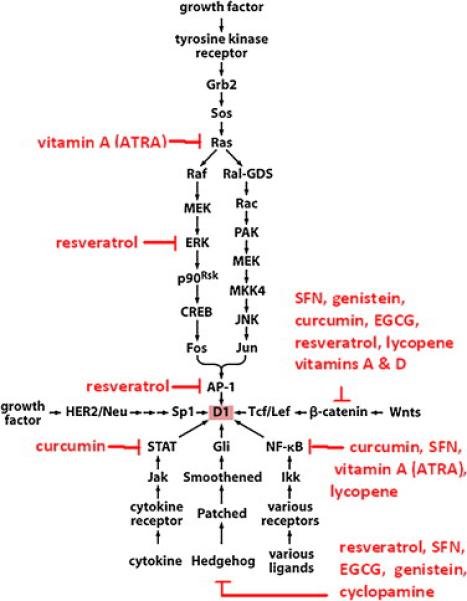
Impact of various natural compounds upon selected growth promoting signaling pathways. When proliferation is triggered by growth factor signaling, there are a number of natural compounds that could inhibit growth. For example, vitamin A, which promotes differentiation, downregulates ras signaling. Resveratrol could block downstream signaling components such as ERK, AP-1, and alternative pathways, such as Hedgehog. Other signaling pathways that promote growth, such as Wnt, cytokine triggered STAT signaling, and receptor mediated activation of NF-κB, could be blocked, in part, by a variety of natural compounds. This suggests that a combination of natural compounds could have a significant impact upon proliferation, even at early stages of carcinogenesis, by inhibiting normal signaling pathways.
Fig. 7
Fig. 7
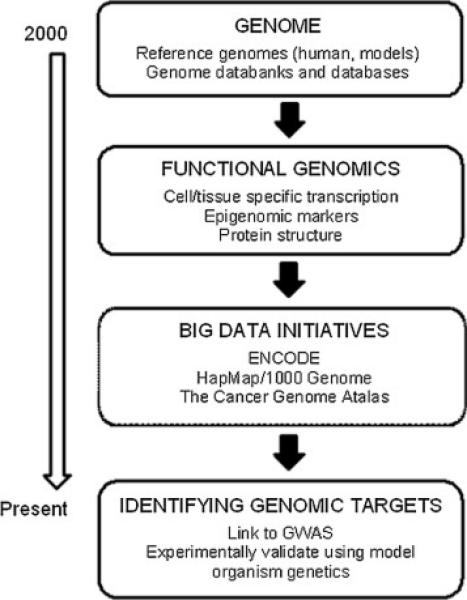
Evolution of genomic resources aimed at identification of cancer targets. There are a growing number of accessible genomic resources that provide an empirical foundation to identify genome-wide targets of tumor cell proliferation.

References

    1. Harris AL. Hypoxia a key regulatory factor in tumor growth. Nat Rev Cancer. 2002;2:38–47. - PubMed
    1. Qing G, Simon MC. Hypoxia inducible factor-2alpha: a critical mediator of aggressive tumor phenotypes. Curr Opin Genet Dev. 2009;19:60–66. - PMC - PubMed
    1. Qiang L, Wu T, Zhang HW, Lu N, Hu R, Wang YJ, et al. HIF-1alpha is critical for hypoxia-mediated maintenance of glioblastoma stem cells by activating Notch signaling pathway. Cell Death Differ. 2012;19:284–294. - PMC - PubMed
    1. Iida H, Suzuki M, Goitsuka R, Ueno H. Hypoxia induces CD133 expression in human lung cancer cells by up-regulation of OCT3/4 and SOX2. Int J Oncol. 2012;40:71–79. - PubMed
    1. Bos R, van Diest PJ, van der Groep P, Shvarts A, Greijer AE, van der Wall E. Expression of hypoxia-inducible factor-1alpha and cell cycle proteins in invasive breast cancer are estrogen receptor related. Breast Cancer Res. 2004;6:R450–459. - PMC - PubMed

Publication types

MeSH terms