


Genomic imbalances in pediatric patients with chronic kidney disease
- PMID: 25893603
- PMCID: PMC4463214
- DOI: 10.1172/JCI80877
Genomic imbalances in pediatric patients with chronic kidney disease
Abstract
Background: There is frequent uncertainty in the identification of specific etiologies of chronic kidney disease (CKD) in children. Recent studies indicate that chromosomal microarrays can identify rare genomic imbalances that can clarify the etiology of neurodevelopmental and cardiac disorders in children; however, the contribution of unsuspected genomic imbalance to the incidence of pediatric CKD is unknown.
Methods: We performed chromosomal microarrays to detect genomic imbalances in children enrolled in the Chronic Kidney Disease in Children (CKiD) prospective cohort study, a longitudinal prospective multiethnic observational study of North American children with mild to moderate CKD. Patients with clinically detectable syndromic disease were excluded from evaluation. We compared 419 unrelated children enrolled in CKiD to multiethnic cohorts of 21,575 children and adults that had undergone microarray genotyping for studies unrelated to CKD.
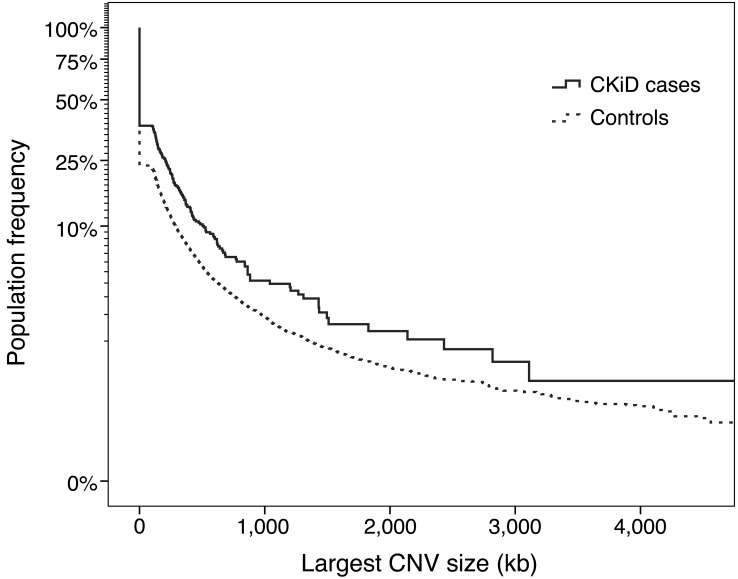
Results: We identified diagnostic copy number disorders in 31 children with CKD (7.4% of the cohort). We detected 10 known pathogenic genomic disorders, including the 17q12 deletion HNF1 homeobox B (HNF1B) and triple X syndromes in 19 of 419 unrelated CKiD cases as compared with 98 of 21,575 control individuals (OR 10.8, P = 6.1 × 10⁻²⁰). In an additional 12 CKiD cases, we identified 12 likely pathogenic genomic imbalances that would be considered reportable in a clinical setting. These genomic imbalances were evenly distributed among patients diagnosed with congenital and noncongenital forms of CKD. In the vast majority of these cases, the genomic lesion was unsuspected based on the clinical assessment and either reclassified the disease or provided information that might have triggered additional clinical care, such as evaluation for metabolic or neuropsychiatric disease.
Conclusion: A substantial proportion of children with CKD have an unsuspected genomic imbalance, suggesting genomic disorders as a risk factor for common forms of pediatric nephropathy. Detection of pathogenic imbalances has practical implications for personalized diagnosis and health monitoring in this population.
Trial registration: ClinicalTrials.gov NCT00327860.
Funding: This work was supported by the NIH, the National Institutes of Diabetes and Digestive and Kidney Diseases (NIDDK), the National Institute of Child Health and Human Development, and the National Heart, Lung, and Blood Institute.
Figures
Comment in
-
Idiopathic pediatric chronic kidney disease: can genomic technology crack the case?J Clin Invest. 2015 May;125(5):1799-800. doi: 10.1172/JCI81509. Epub 2015 Apr 20. J Clin Invest. 2015. PMID: 25893596 Free PMC article.
-
Genetics: Increased prevalence of large genomic imbalances among children with chronic kidney disease.Nat Rev Nephrol. 2015 Jun;11(6):315. doi: 10.1038/nrneph.2015.73. Epub 2015 May 5. Nat Rev Nephrol. 2015. PMID: 25941058 No abstract available.
References
-
- US Renal Data System. USRDS 2013 Annual Data Report: Atlas of End-Stage Renal Disease in the United States. Bethesda, Maryland, USA: National Institutes of Health, National Institute of Diabetes and Digestive and Kidney Diseases; 2013.
Publication types
MeSH terms
Associated data
Grants and funding
- U01 DK082194/DK/NIDDK NIH HHS/United States
- U01 DK066143/DK/NIDDK NIH HHS/United States
- U01 DK066116/DK/NIDDK NIH HHS/United States
- U01 DK066174/DK/NIDDK NIH HHS/United States
- R01DK103184/DK/NIDDK NIH HHS/United States
- R03DK099564/DK/NIDDK NIH HHS/United States
- R21DK098531/DK/NIDDK NIH HHS/United States
- R01 DK082394/DK/NIDDK NIH HHS/United States
- 1R01DK080099/DK/NIDDK NIH HHS/United States
- K23 DK090207/DK/NIDDK NIH HHS/United States
- R21 DK098531/DK/NIDDK NIH HHS/United States
- UL1 TR001449/TR/NCATS NIH HHS/United States
- R03 DK099564/DK/NIDDK NIH HHS/United States
- U54 DK104309/DK/NIDDK NIH HHS/United States
- R01 DK080099/DK/NIDDK NIH HHS/United States
- K23DK090207/DK/NIDDK NIH HHS/United States
- R01DK082394/DK/NIDDK NIH HHS/United States
- R01 DK103184/DK/NIDDK NIH HHS/United States
- 1U54DK104309/DK/NIDDK NIH HHS/United States
LinkOut - more resources
Full Text Sources
Medical
Research Materials
