Brain Stimulation for Torsion Dystonia
- PMID: 25894231
- PMCID: PMC4833438
- DOI: 10.1001/jamaneurol.2015.51
Brain Stimulation for Torsion Dystonia
Abstract
Importance: Dystonia is a heterogeneous neurologic disorder characterized by abnormal muscle contractions for which standard medical therapy is often inadequate. For such patients, therapeutic brain stimulation is becoming increasingly used.
Objectives: To review the evidence and effect sizes for treating different types of dystonia with different types of brain stimulation and to discuss recent advances relevant to patient selection, surgical approach, programming, and mechanism of action.
Evidence review: PubMed was searched for publications on the clinical effect of brain stimulation in dystonia up through December 31, 2014. Recent meta-analyses, consensus statements, and evidence-based guidelines were incorporated. Emphasis was placed on deep brain stimulation (DBS) and randomized clinical trials; however, other stimulation modalities and trial designs were included. For each intervention the mean change in dystonia severity, number of patients studied, and evidence of efficacy based on American Academy of Neurology criteria were determined.
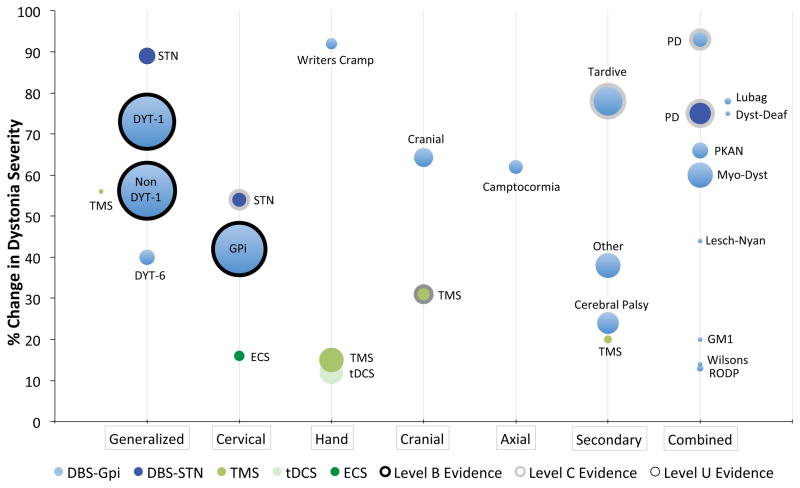
Findings: Strong (level B) evidence supports the use of DBS for the treatment of primary generalized or segmental dystonia, especially when due to mutation in the DYT1 gene, as well as for patients with cervical dystonia. Large effect sizes have also been reported for DBS treatment of tardive dystonia, writer's cramp, cranial dystonia, myoclonus dystonia, and off-state dystonia associated with Parkinson disease. Lesser benefit is generally seen in dystonia secondary to structural brain damage. Other brain stimulation techniques, including epidural cortical stimulation and noninvasive brain stimulation, have been investigated, but generally report smaller effect sizes in fewer patients.
Conclusions and relevance: Patients with dystonia that is not adequately controlled with standard medical therapy should be referred for consideration of DBS, especially patients with generalized, segmental, or cervical dystonia. Other less-invasive stimulation modalities require further research before being considered a therapeutic alternative.
Figures
References
-
- Balint B, Bhatia KP. Dystonia: an update on phenomenology, classification, pathogenesis and treatment. Current opinion in neurology. 2014;27(4):468–476. - PubMed
-
- Yianni J, Green AL, Aziz TZ. Surgical treatment of dystonia. International Review of Neurobiology. 2011;98:573–589. - PubMed
-
- Volkmann J, Mueller J, Deuschl G, et al. Pallidal neurostimulation in patients with medication-refractory cervical dystonia: a randomised, sham-controlled trial. Lancet neurology. 2014;13(9):875–884. - PubMed
-
- Kupsch A, Benecke R, Müller J, et al. Pallidal deep-brain stimulation in primary generalized or segmental dystonia. N Engl J Med. 2006;355(19):1978–1990. - PubMed
-
- Kupsch A, Tagliati M, Vidailhet M, et al. Early postoperative management of DBS in dystonia: programming, response to stimulation, adverse events, medication changes, evaluations, and troubleshooting. Movement disorders : official journal of the Movement Disorder Society. 2011;26(Suppl 1):S37–S53. - PubMed
Publication types
MeSH terms
Grants and funding
LinkOut - more resources
Full Text Sources
Other Literature Sources