Review
. 2015;6(12):9669-78.
doi: 10.18632/oncotarget.3430.

Ecology meets cancer biology: the cancer swamp promotes the lethal cancer phenotype

Affiliations
Review

Ecology meets cancer biology: the cancer swamp promotes the lethal cancer phenotype

Sarah R Amend et al. Oncotarget. 2015.

Abstract

As they grow, tumors fundamentally alter their microenvironment, disrupting the homeostasis of the host organ and eventually the patient as a whole. Lethality is the ultimate result of deregulated cell signaling and regulatory mechanisms as well as inappropriate host cell recruitment and activity that lead to the death of the patient. These processes have striking parallels to the framework of ecological biology: multiple interacting ecosystems (organ systems) within a larger biosphere (body), alterations in species stoichiometry (host cell types), resource cycling (cellular metabolism and cell-cell signaling), and ecosystem collapse (organ failure and death). In particular, as cancer cells generate their own niche within the tumor ecosystem, ecological engineering and autoeutrophication displace normal cell function and result in the creation of a hypoxic, acidic, and nutrient-poor environment. This "cancer swamp" has genetic and epigenetic effects at the local ecosystem level to promote metastasis and at the systemic host level to induce cytokine-mediated lethal syndromes, a major cause of death of cancer patients.

Keywords: autoeutrophication; cancer hallmarks; ecosystem; lethal phenotype; selection.


Figures
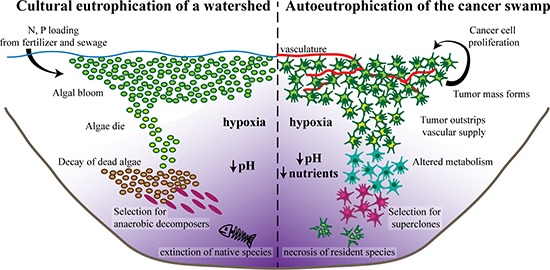
Figure 1
Figure 1. Autoeutrophication of the hypoxic, nutrient-poor, and acidic “cancer swamp”
(Left) Excess nitrogen and phosphorus deposits stimulate the growth of photosynthetic algae, resulting in a characteristic algal bloom. As the algae die off, organic material accumulates and decomposition levels increase, leading to severe hypoxia. These harsh conditions select for efficient anaerobic decomposers. The build-up of the waste product of anaerobic fermentation, carbon dioxide, results in an acidic environment. Ultimately, the severe conditions lead to the local extinction of native species and eventual irreversible ecosystem collapse. (Right) Even in the absence of external stimuli, cancer cells have a high proliferation rate, rapidly expanding to a tumor mass analogous to an algal bloom. As the tumor grows, it quickly outstrips its vascular supply, resulting in a hypoxic microenvironment. To survive, the cancer cells alter their metabolism to utilize relatively inefficient anaerobic glycolysis, exhausting available nutrient sources. The accumulation of lactic acid, the waste product of anaerobic glycolysis, results in an acidic microenvironment. Ultimately, the harsh “cancer swamp” selects for highly lethal cancer superclones. Simultaneously, the toxic conditions lead to increased rates of necrosis, extinction of native host cell types, and eventual organ failure.
Figure 2
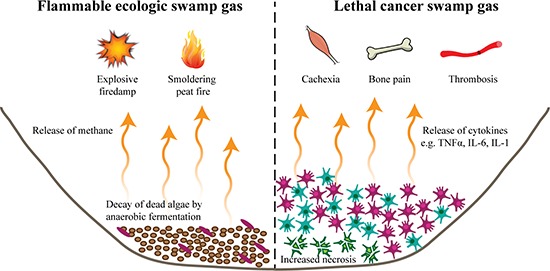
Figure 2. Release of toxic swamp gas
(Left) A byproduct of decomposition by anaerobic fermentation is methane gas that bubbles to the surface as swamp gas. When near a sufficient ignition source, accumulation of this gas can lead to smoldering underground fires in peat fields or explosions in coal mines (“firedamp”). (Right) The release of lysed cell products of necrotic cells combined with the pro-inflammatory cytokines secreted from the cancer cells produce the equivalent of swamp gas. At high and persistent levels, the release of this “swamp gas” from multiple metastatic sites leads to cytokine-mediated smoldering (e.g. cachexia or bone pain) or acute (e.g. thrombosis) lethal syndromes, the cause of death in the many of patients.
Figure 3
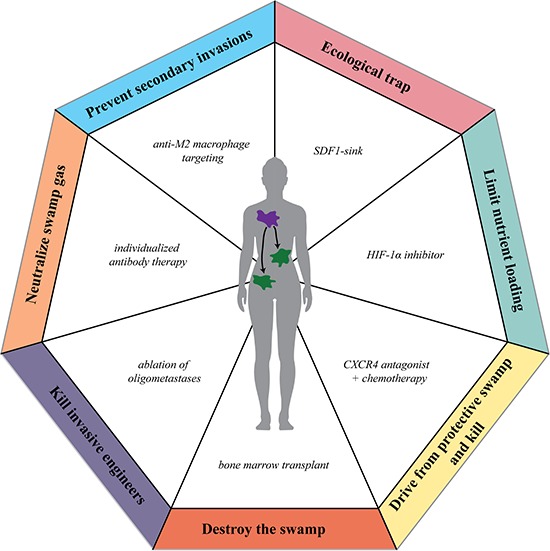
Figure 3. Using restoration ecology strategies as anti-cancer therapies
Strategies used to restore damaged ecologic ecosystems can be applied to develop therapeutics to restore the “cancer swamp.”

References

    1. Paget G. Remarks on a Case of Alternate Partial Anaesthesia. British medical journal. 1889;1:1–3. - PMC - PubMed
    1. Weilbaecher KN, Guise TA, McCauley LK. Cancer to bone: a fatal attraction. Nature reviews Cancer. 2011;11:411–425. - PMC - PubMed
    1. Hanahan D, Weinberg RA. The hallmarks of cancer. Cell. 2000;100:57–70. - PubMed
    1. Hanahan D, Weinberg RA. Hallmarks of cancer: the next generation. Cell. 2011;144:646–674. - PubMed
    1. Merlo LM, Pepper JW, Reid BJ, Maley CC. Cancer as an evolutionary and ecological process. Nature reviews Cancer. 2006;6:924–935. - PubMed

Publication types

LinkOut - more resources