


Association of gender to outcome after out-of-hospital cardiac arrest--a report from the International Cardiac Arrest Registry
- PMID: 25895673
- PMCID: PMC4426639
- DOI: 10.1186/s13054-015-0904-y
Association of gender to outcome after out-of-hospital cardiac arrest--a report from the International Cardiac Arrest Registry
Abstract
Introduction: Previous studies have suggested an effect of gender on outcome after out-of-hospital cardiac arrest (OHCA), but the results are conflicting. We aimed to investigate the association of gender to outcome, coronary angiography (CAG) and adverse events in OHCA survivors treated with mild induced hypothermia (MIH).
Methods: We performed a retrospective analysis of prospectively collected data from the International Cardiac Arrest Registry. Adult patients with a non-traumatic OHCA and treated with MIH were included. Good neurological outcome was defined as a cerebral performance category (CPC) of 1 or 2.
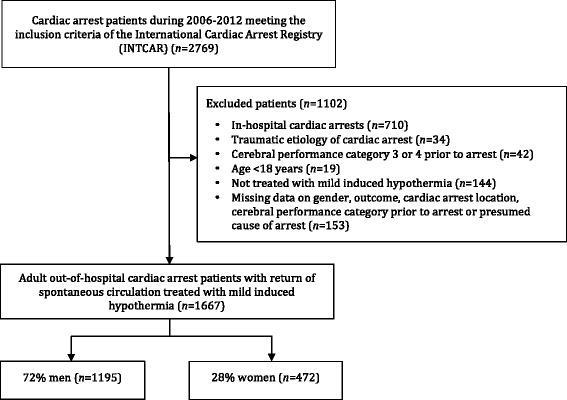
Results: A total of 1,667 patients, 472 women (28%) and 1,195 men (72%), met the inclusion criteria. Men were more likely to receive bystander cardiopulmonary resuscitation, have an initial shockable rhythm and to have a presumed cardiac cause of arrest. At hospital discharge, men had a higher survival rate (52% vs. 38%, P < 0.001) and more often a good neurological outcome (43% vs. 32%, P < 0.001) in the univariate analysis. When adjusting for baseline characteristics, male gender was associated with improved survival (OR 1.34, 95% CI 1.01 to 1.78) but no longer with neurological outcome (OR 1.24, 95% CI 0.92 to 1.67). Adverse events were common; women more often had hypokalemia, hypomagnesemia and bleeding requiring transfusion, while men had more pneumonia. In a subgroup analysis of patients with a presumed cardiac cause of arrest (n = 1,361), men more often had CAG performed on admission (58% vs. 50%, P = 0.02) but this discrepancy disappeared in an adjusted analysis.
Conclusions: Gender differences exist regarding cause of arrest, adverse events and outcome. Male gender was independently associated with survival but not with neurological outcome.
Figures
References
Publication types
MeSH terms
LinkOut - more resources
Full Text Sources
Other Literature Sources
Miscellaneous
