Review
. 2015 Apr 21:8:38.
doi: 10.1186/s13045-015-0133-5.

piRNA involvement in genome stability and human cancer

Affiliations
Review

piRNA involvement in genome stability and human cancer

Miguel Moyano et al. J Hematol Oncol. .

Abstract

PIWI-interacting RNAs (piRNAs) are a large family of small, single-stranded, non-coding RNAs present throughout the animal kingdom. They form complexes with several members of the PIWI clade of Argonaute proteins and carry out regulatory functions. Their best established biological role is the inhibition of transposon mobilization, which they enforce both at the transcriptional level, through regulation of heterochromatin formation, and by promoting transcript degradation. In this capacity, piRNAs and PIWI proteins are at the heart of the germline cells' efforts to preserve genome integrity. Additional regulatory roles of piRNAs and PIWI proteins in gene expression are becoming increasingly apparent.PIWI proteins and piRNAs are often detected in human cancers deriving from germline cells as well as somatic tissues. Their detection in cancer correlates with poorer clinical outcomes, suggesting that they play a functional role in the biology of cancer. Nonetheless, the currently available information, while highly suggestive, is still not sufficient to entirely discriminate between a 'passenger' role for the ectopic expression of piRNAs and PIWI proteins in cancer from a 'driver' role in the pathogenesis of these diseases. In this article, we review some of the key available evidence for the role of piRNAs and PIWI in human cancer and discuss ways in which our understanding of their functions may be improved.


Figures
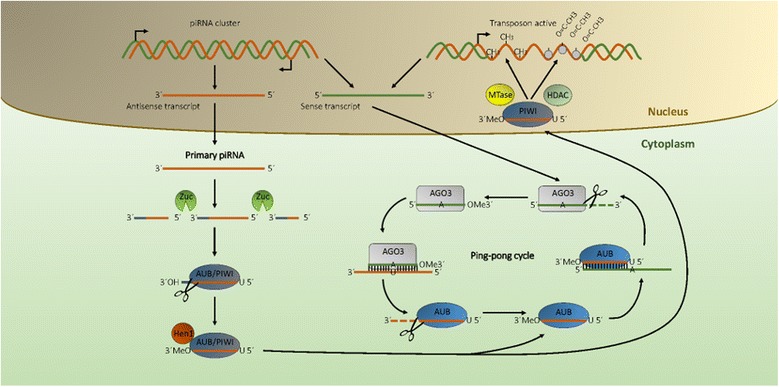
Figure 1
Figure 1
Biogenesis of piRNAs: piRNAs are generated from primary and secondary pathways. While most exhaustively explored in Drosophila, the general architecture of these pathways is largely conserved across animals. In the primary pathway, antisense primary piRNAs are cleaved by an endonuclease, most likely Zucchini. Cleaved precursors are incorporated in Aubergine (AUB) or Piwi, with a strong preference for uridine residues at the 5′ end. Subsequently, an exonuclease activity trims the 3′ end to a final length likely to be dictated by protection by the Piwi protein. The 3′ end is then methylated by the Hen enzyme. Aub-bound piRNAs can be amplified in the secondary pathway (ping-pong cycle), which involves the cleavage of a complementary sense transcript by Aub, its trimming, modification, and incorporation in a complex with AGO3. The final outcome is the inhibition of expression of piRNA targets by methylation at the DNA level and by a variety of post-transcriptional mechanisms (not shown in the figure, see text for details).

References

    1. Hanahan D, Weinberg RA. The hallmarks of cancer. Cell. 2000;100:57–70. doi: 10.1016/S0092-8674(00)81683-9. - DOI - PubMed
    1. Hanahan D, Weinberg RA. Hallmarks of cancer: the next generation. Cell. 2011;144:646–74. doi: 10.1016/j.cell.2011.02.013. - DOI - PubMed
    1. Lander ES, Linton LM, Birren B, Nusbaum C, Zody MC, Baldwin J, et al. Initial sequencing and analysis of the human genome. Nature. 2001;409:860–921. doi: 10.1038/35057062. - DOI - PubMed
    1. Hancks DC, Kazazian HH., Jr Active human retrotransposons: variation and disease. Curr Opin Genet Dev. 2012;22:191–203. doi: 10.1016/j.gde.2012.02.006. - DOI - PMC - PubMed
    1. Brouha B, Schustak J, Badge RM, Lutz-Prigge S, Farley AH, Moran JV, et al. Hot L1s account for the bulk of retrotransposition in the human population. Proc Natl Acad Sci U S A. 2003;100:5280–5. doi: 10.1073/pnas.0831042100. - DOI - PMC - PubMed

Substances
