Review
. 2015 Jun:83:112-21.
doi: 10.1016/j.yjmcc.2015.04.011. Epub 2015 Apr 17.

Vascular biology of ageing-Implications in hypertension

Affiliations
Review

Vascular biology of ageing-Implications in hypertension

Adam Harvey et al. J Mol Cell Cardiol. 2015 Jun.

Abstract

Ageing is associated with functional, structural and mechanical changes in arteries that closely resemble the vascular alterations in hypertension. Characteristic features of large and small arteries that occur with ageing and during the development of hypertension include endothelial dysfunction, vascular remodelling, inflammation, calcification and increased stiffness. Arterial changes in young hypertensive patients mimic those in old normotensive individuals. Hypertension accelerates and augments age-related vascular remodelling and dysfunction, and ageing may impact on the severity of vascular damage in hypertension, indicating close interactions between biological ageing and blood pressure elevation. Molecular and cellular mechanisms underlying vascular alterations in ageing and hypertension are common and include aberrant signal transduction, oxidative stress and activation of pro-inflammatory and pro-fibrotic transcription factors. Strategies to suppress age-associated vascular changes could ameliorate vascular damage associated with hypertension. An overview on the vascular biology of ageing and hypertension is presented and novel molecular mechanisms contributing to these processes are discussed. The complex interaction between biological ageing and blood pressure elevation on the vasculature is highlighted. This article is part of a Special Issue entitled: CV Ageing.

Keywords: Endothelial dysfunction; Mitochondria; Oxidative stress; Vascular remodeling.


Figures

None
Graphical abstract
Fig. 1
Fig. 1
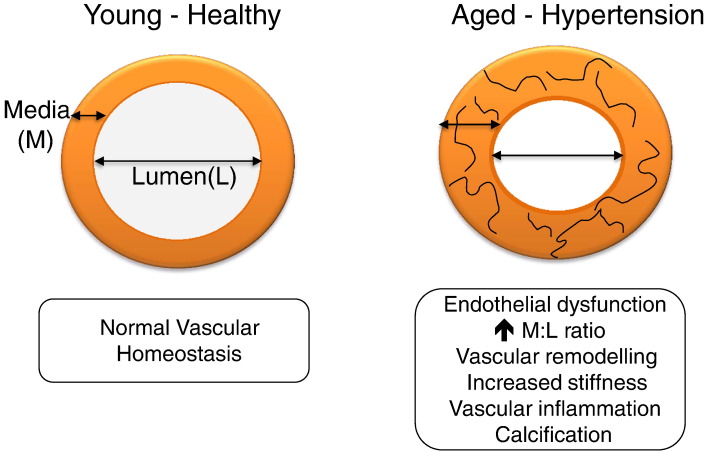
Schematic demonstrating vascular changes that occur during ageing and with the development of hypertension. Vascular changes in hypertension mimic those found in arteries observed with ageing.
Fig. 2
Fig. 2
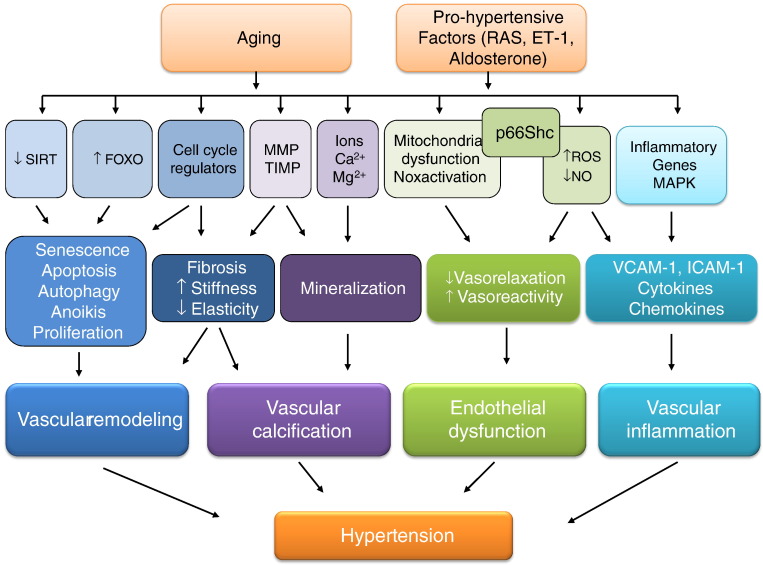
Molecular and cellular mechanisms associated with vascular changes in ageing and hypertension. Activation of pro-fibrotic, pro-inflammatory, redox-sensitive and growth/apoptotic signalling pathways lead to changes in vascular structure, mechanics and function with resultant arterial remodelling, calcification, inflammation, stiffness and impaired vasoreactivity. These vascular alterations are common features during ageing and in hypertension. VCAM-1, vascular cell adhesion molecule-1; ICAM-1, intercellular adhesion molecule-1; MMP, matrix metalloproteinases; TIMP, tissue inhibitor of metalloproteinase; RAS, renin angiotensin system; ET-1, endothelin-1; NO, nitric oxide.
Fig. 3
Fig. 3
Role of reactive oxygen species (ROS) in vascular processes associated with ageing and hypertension. Pro-hypertensive factors, such as angiotensin II and endothelin-1, and biological ageing, increase ROS production in vascular cells. An increase in the levels of ROS lead to oxidation of proteins and DNA, affecting cell signalling and inducing injurious responses, such as inflammation, senescence, fibrosis, calcification, and hypertrophy in the vasculature. Oxidation of transcription factors that regulate the anti-oxidant capacity in vascular cells, such as Nrf2, are also affected by oxidation leading to decreased activity. Sources responsible for the increase in ROS generation and oxidative modification of cellular molecules are the mitochondria, NADPH oxidases (Nox) and endoplasmic reticulum (ER) stress.

References

    1. Wang M., Monticone R.E., Lakatta E.G. Arterial aging: a journey into subclinical arterial disease. Curr Opin Nephrol Hypertens. 2010;19(2):201–207. - PMC - PubMed
    1. Barja G. Updating the mitochondrial free radical theory of aging: an integrated view, key aspects, and confounding concepts. Antioxid Redox Signal. 2013;19(12):1420–1445. - PMC - PubMed
    1. Bachschmid M.M., Schildknecht S., Matsui R., Zee R., Haeussler D., Cohen R.A. Vascular aging: chronic oxidative stress and impairment of redox signalling—consequences for vascular homeostasis and disease. Ann Med. 2013;45(1):17–36. - PMC - PubMed
    1. Kotsis V., Stabouli S., Karafillis I., Nilsson P. Early vascular aging and the role of central blood pressure. J Hypertens. 2011;29(10):1847–1853. - PubMed
    1. Gerhard-Herman M., Smoot L.B., Wake N., Kieran M.W., Kleinman M.E., Miller D.T. Mechanisms of premature vascular aging in children with Hutchinson–Gilford progeria syndrome. Hypertension. 2012;59(1):92–97. - PMC - PubMed

Publication types

MeSH terms

Substances