


Antifungal susceptibility profiles of bloodstream yeast isolates by Sensititre YeastOne over nine years at a large Italian teaching hospital
- PMID: 25896705
- PMCID: PMC4468684
- DOI: 10.1128/AAC.00285-15
Antifungal susceptibility profiles of bloodstream yeast isolates by Sensititre YeastOne over nine years at a large Italian teaching hospital
Abstract
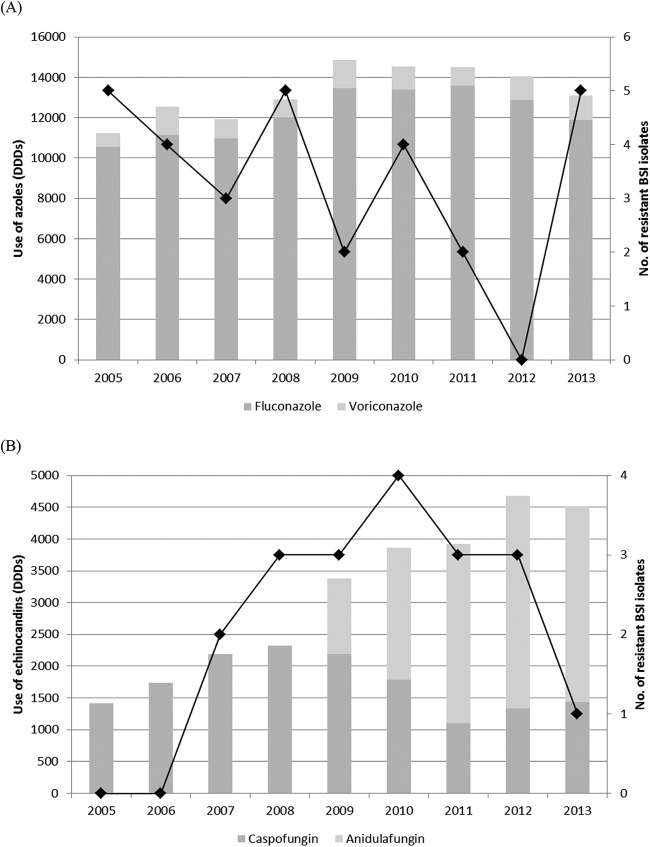
Sensititre YeastOne (SYO) is an affordable alternative to the Clinical and Laboratory Standards Institute (CLSI) reference method for antifungal susceptibility testing. In this study, the MICs of yeast isolates from 1,214 bloodstream infection episodes, generated by SYO during hospital laboratory activity (January 2005 to December 2013), were reanalyzed using current CLSI clinical breakpoints/epidemiological cutoff values to assign susceptibility (or the wild-type [WT] phenotype) to systemic antifungal agents. Excluding Candida albicans (57.4% of all isolates [n = 1,250]), the most predominant species were Candida parapsilosis complex (20.9%), Candida tropicalis (8.2%), Candida glabrata (6.4%), Candida guilliermondii (1.6%), and Candida krusei (1.3%). Among the non-Candida species (1.9%), 7 were Cryptococcus neoformans and 17 were other species, mainly Rhodotorula species. Over 97% of Candida isolates were susceptible (WT phenotype) to amphotericin B and flucytosine. Rates of susceptibility (WT phenotype) to fluconazole, itraconazole, and voriconazole were 98.7% in C. albicans, 92.3% in the C. parapsilosis complex, 96.1% in C. tropicalis, 92.5% in C. glabrata, 100% in C. guilliermondii, and 100% (excluding fluconazole) in C. krusei. The fluconazole-resistant isolates consisted of 6 C. parapsilosis complex isolates, 3 C. glabrata isolates, 2 C. albicans isolates, 2 C. tropicalis isolates, and 1 Candida lusitaniae isolate. Of the non-Candida isolates, 2 C. neoformans isolates had the non-WT phenotype for susceptibility to fluconazole, whereas Rhodotorula isolates had elevated azole MICs. Overall, 99.7% to 99.8% of Candida isolates were susceptible (WT phenotype) to echinocandins, but 3 isolates were nonsusceptible (either intermediate or resistant) to caspofungin (C. albicans, C. guilliermondii, and C. krusei), anidulafungin (C. albicans and C. guilliermondii), and micafungin (C. albicans). However, when the intrinsically resistant non-Candida isolates were included, the rate of echinocandin nonsusceptibility reached 1.8%. In summary, the SYO method proved to be able to detect yeast species showing antifungal resistance or reduced susceptibility.
Copyright © 2015, American Society for Microbiology. All Rights Reserved.
Figures
References
-
- Pappas PG, Kauffman CA, Andes D, Benjamin DK Jr, Calandra TF, Edwards JE Jr, Filler SG, Fisher JF, Kullberg BJ, Ostrosky-Zeichner L, Reboli AC, Rex JH, Walsh TJ, Sobel JD, Infectious Diseases Society of America. 2009. Clinical practice guidelines for the management of candidiasis: 2009 update by the Infectious Diseases Society of America. Clin Infect Dis 48:503–535. doi: 10.1086/596757. - DOI - PMC - PubMed
-
- Cornely OA, Bassetti M, Calandra T, Garbino J, Kullberg BJ, Lortholary O, Meersseman W, Akova M, Arendrup MC, Arikan-Akdagli S, Bille J, Castagnola E, Cuenca-Estrella M, Donnelly JP, Groll AH, Herbrecht R, Hope WW, Jensen HE, Lass-Flörl C, Petrikkos G, Richardson MD, Roilides E, Verweij PE, Viscoli C, Ullmann AJ, ESCMID Fungal Infection Study Group . 2012. ESCMID* guideline for the diagnosis and management of Candida diseases 2012: non-neutropenic adult patients. Clin Microbiol Infect 18(Suppl 7):S19–S37. doi: 10.1111/1469-0691.12039. - DOI - PubMed
-
- Ullmann AJ, Akova M, Herbrecht R, Viscoli C, Arendrup MC, Arikan-Akdagli S, Bassetti M, Bille J, Calandra T, Castagnola E, Cornely OA, Donnelly JP, Garbino J, Groll AH, Hope WW, Jensen HE, Kullberg BJ, Lass-Flörl C, Lortholary O, Meersseman W, Petrikkos G, Richardson MD, Roilides E, Verweij PE, Cuenca-Estrella M, ESCMID Fungal Infection Study Group . 2012. ESCMID* guideline for the diagnosis and management of Candida diseases 2012: adults with haematological malignancies and after haematopoietic stem cell transplantation (HCT). Clin Microbiol Infect 18(Suppl 7):S53–S67. doi: 10.1111/1469-0691.12041. - DOI - PubMed
-
- Arendrup MC, Boekhout T, Akova M, Meis JF, Cornely OA, Lortholary O, European Society of Clinical Microbiology and Infectious Diseases Fungal Infection Study Group, European Confederation of Medical Mycology. 2014. ESCMID and ECMM joint clinical guidelines for the diagnosis and management of rare invasive yeast infections. Clin Microbiol Infect 20(Suppl 3):S76–S98. doi: 10.1111/1469-0691.12360. - DOI - PubMed
MeSH terms
Substances
LinkOut - more resources
Full Text Sources
Medical
