


Interaural level difference cues determine sound source localization by single-sided deaf patients fit with a cochlear implant
- PMID: 25896774
- PMCID: PMC5869030
- DOI: 10.1159/000375394
Interaural level difference cues determine sound source localization by single-sided deaf patients fit with a cochlear implant
Abstract
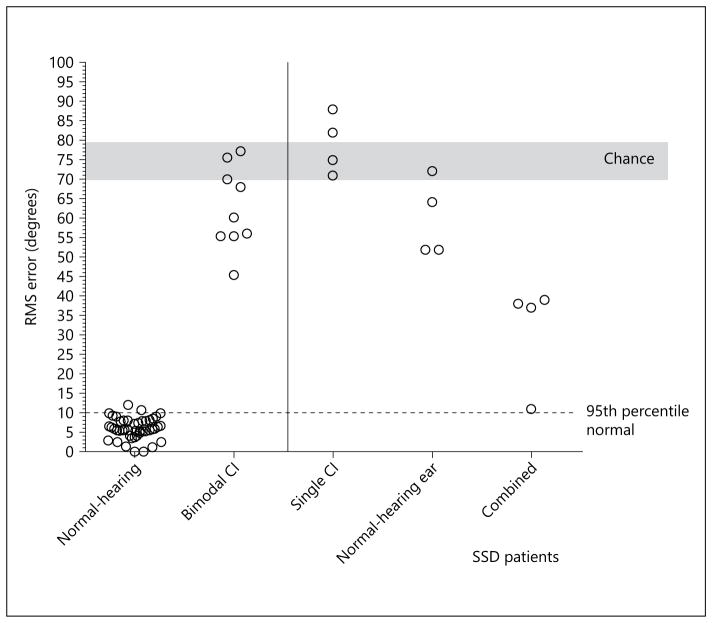
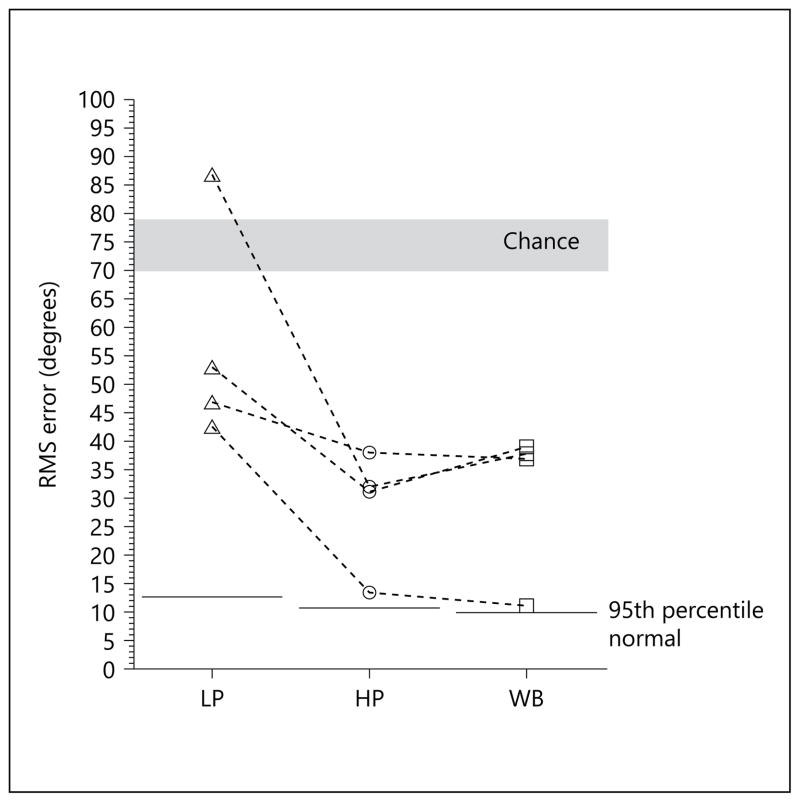
In this report, we used filtered noise bands to constrain listeners' access to interaural level differences (ILDs) and interaural time differences (ITDs) in a sound source localization task. The samples of interest were listeners with single-sided deafness (SSD) who had been fit with a cochlear implant in the deafened ear (SSD-CI). The comparison samples included listeners with normal hearing and bimodal hearing, i.e., with a cochlear implant in 1 ear and low-frequency acoustic hearing in the other ear. The results indicated that (i) sound source localization was better in the SSD-CI condition than in the SSD condition, (ii) SSD-CI patients rely on ILD cues for sound source localization, (iii) SSD-CI patients show functional localization abilities within 1-3 months after device activation and (iv) SSD-CI patients show better sound source localization than bimodal CI patients but, on average, poorer localization than normal-hearing listeners. One SSD-CI patient showed a level of localization within normal limits. We provide an account for the relative localization abilities of the groups by reference to the differences in access to ILD cues.
Figures
References
-
- Arndt S, Aschendorff A, Laszig R, Beck R, Schild C, Kroeger S, Ihorst G, Wesarg T. Comparison of pseudo-binaural hearing to real binaural hearing rehabilitation after cochlear implantation in patients with unilateral deafness and tinnitus. Otol Neurotol. 2011a;32:39–47. - PubMed
-
- Arndt S, Laszig R, Aschendorff A, Schild C, Beck R, Kroeger S, Ihorst G, Kirchem P, Wesarg T. The University of Freiburg Asymmetric Hearing Loss Study. Audiol Neurotol. 2011b;16(suppl 1):3–25.
-
- Blauert J. Spatial hearing: The Psychophysics of Human Sound Localization. Cambridge: MIT Press; 1997.
Publication types
MeSH terms
Grants and funding
LinkOut - more resources
Full Text Sources
Other Literature Sources
Medical
