


Right ventricular outflow tract septal pacing is superior to right ventricular apical pacing
- PMID: 25896891
- PMCID: PMC4579934
- DOI: 10.1161/JAHA.115.001777
Right ventricular outflow tract septal pacing is superior to right ventricular apical pacing
Abstract
Background: The effects of right ventricular apical pacing (RVAP) and right ventricular outflow tract (RVOT) septal pacing on atrial and ventricular electrophysiology have not been thoroughly compared.
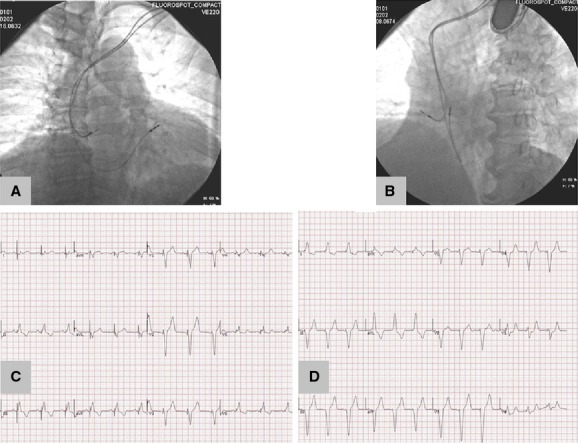
Methods and results: To identify a more favorable pacing strategy with fewer adverse effects, 80 patients who had complete atrioventricular block with normal cardiac function and who were treated with either RVAP (n=42) or RVOT septal pacing (n=38) were recruited after an average of 2 years of follow-up. The data from electrocardiography and echocardiography performed before pacemaker implantation and at the end of follow-up were collected. The patients in the RVOT septal pacing and RVAP groups showed similar demographic and clinical characteristics before pacing treatments. After a mean follow-up of 2 years, the final maximum P-wave duration; P-wave dispersion; Q-, R-, and S-wave complex duration; left atrial volume index; left ventricular end-systolic diameter; ratio of transmitral early diastolic filling velocity to mitral annular early diastolic velocity; and interventricular mechanical delay in the RVOT septal pacing group were significantly less than those in the RVAP group (P<0.05). The final left ventricular ejection fraction of the RVOT septal pacing group was significantly higher than that of the RVAP group (P<0.05).
Conclusions: Compared with RVAP, RVOT septal pacing has fewer adverse effects regarding atrial electrical activity and structure in patients with normal cardiac function.
Keywords: cardiovascular diseases; electrophysiology; pacemaker.
© 2015 The Authors. Published on behalf of the American Heart Association, Inc., by Wiley Blackwell.
Figures
References
-
- Hillock RJ, Mond HG. Pacing the right ventricular outflow tract septum: time to embrace the future. Europace. 2012; 14:28-35. - PubMed
-
- Furman S, Schwedel J. An intracardiac pacemaker for Stokes‐Adams seizures. N Engl J Med. 1959; 261:943-948. - PubMed
-
- Wang W, Wang Z, Zhang Y, Gao M, Wang J, Zhang Y, Xie X, Hou Y. Effects of right ventricular nonapical pacing on cardiac function: a meta‐analysis of randomized controlled trials. Pacing Clin Electrophysiol. 2013; 36:1032-1051. - PubMed
-
- Sweeney MO, Hellkamp AS, Ellenbogen KA, Greenspon AJ, Freedman RA, Lee KL, Lamas GAMOde Selection Trial Investigators. Adverse effect of ventricular pacing on heart failure and atrial fibrillation among patients with normal baseline QRS duration in clinical trial of pacemaker therapy for sinus node dysfunction. Circulation. 2003; 107:2932-2937. - PubMed
-
- Da Costa A, Gabriel L, Romeyer‐Bouchard C, Géraldine B, Gate‐Martinet A, Laurence B, Levallois M, Isaaz K. Focus on right ventricular outflow tract septal pacing. Arch Cardiovasc Dis. 2013; 106:394-403. - PubMed
Publication types
MeSH terms
LinkOut - more resources
Full Text Sources
