. 2015 May 12;112(19):5893-8.
doi: 10.1073/pnas.1500783112. Epub 2015 Apr 20.

Chemical messages in 170-year-old champagne bottles from the Baltic Sea: Revealing tastes from the past

Affiliations

Chemical messages in 170-year-old champagne bottles from the Baltic Sea: Revealing tastes from the past

Philippe Jeandet et al. Proc Natl Acad Sci U S A. .

Abstract

Archaeochemistry as the application of the most recent analytical techniques to ancient samples now provides an unprecedented understanding of human culture throughout history. In this paper, we report on a multiplatform analytical investigation of 170-y-old champagne bottles found in a shipwreck at the bottom of the Baltic Sea, which provides insight into winemaking practices used at the time. Organic spectroscopy-based nontargeted metabolomics and metallomics give access to the detailed composition of these wines, revealing, for instance, unexpected chemical characteristics in terms of small ion, sugar, and acid contents as well as markers of barrel aging and Maillard reaction products. The distinct aroma composition of these ancient champagne samples, first revealed during tasting sessions, was later confirmed using state-of-the-art aroma analysis techniques. After 170 y of deep sea aging in close-to-perfect conditions, these sleeping champagne bottles awoke to tell us a chapter of the story of winemaking and to reveal their extraordinary archaeometabolome and elemental diversity in the form of chemical signatures related to each individual step of champagne production.

Keywords: archaeochemistry; champagne; metabolomics; wine.


Conflict of interest statement

The authors declare no conflict of interest.

Figures
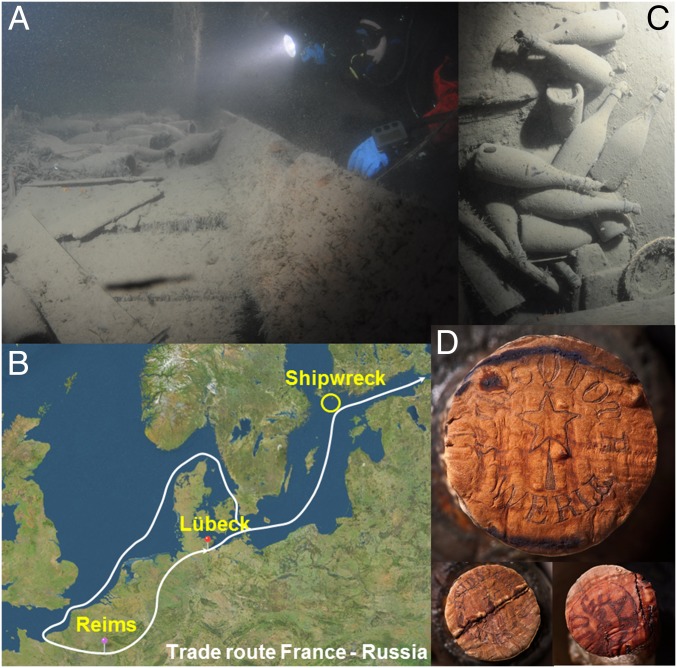
Fig. 1.
Fig. 1.
(A) Discovery of champagne bottles in a shipwreck off the Finnish Åland archipelago, in July 2010. The ship was a two-masted schooner (21.5 m long × 6.5 m broad) around 200 y old (location: south of the municipality of Föglö, Åland). Copyright, Anders Näsman/The Government of Åland. (B) One possible planned itinerary for the boat. (C) A few of the 168 bottles found in the Baltic Sea at a depth of about 50 m, in nearly ideal slow-aging conditions in terms of temperature (2–4 °C), darkness, low salinity, and high pressure. (D) Branded engravings on the cork surface that is in contact with the wine (mirroir in French). The representation of the 1811 great meteorite attests to the bottles having been corked after 1811. (C and D) Courtesy of Visit Åland.
Fig. 2.
Fig. 2.
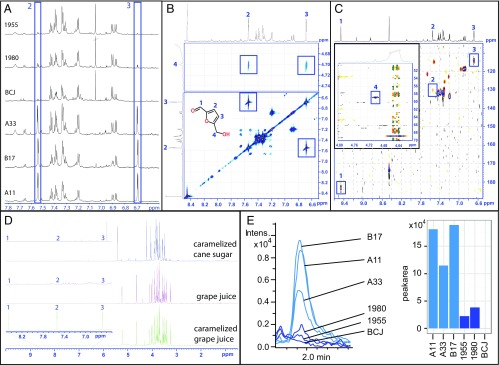
Characterization of 5-hydroxymethylfurfural (HMF) in the Baltic Sea champagne samples. (A) 1H NMR spectra (spectral region 7.8–6.6 ppm) illustrating the presence or absence of HMF in the six different champagne samples (blue boxes). (B) Molecular structure of HMF and carbon annotation. (B and C) Identification of HMF via (B) 2D-1H-1H DIPSI and (C) 2D-1H-13C-NMR (blue boxes) (D) Determination of the possible origin of HMF in the Baltic champagne samples. Absence of HMF (with focus on carbons 1, 2, and 3) in caramelized cane sugar and unheated grape juice vs. presence of HMF in heat-treated grape juice. (E) Quantification of HMF by UPLC-MS. High-resolution–extracted ion chromatogram of mass 125.024418 ± 0. 005 Da corresponding to [M-H]− ion of hydroxymethylfurfural in different champagne samples analyzed under reversed-phase conditions and peak area of the chromatographic peak of hydroxymethylfurfural.
Fig. 3.
Fig. 3.
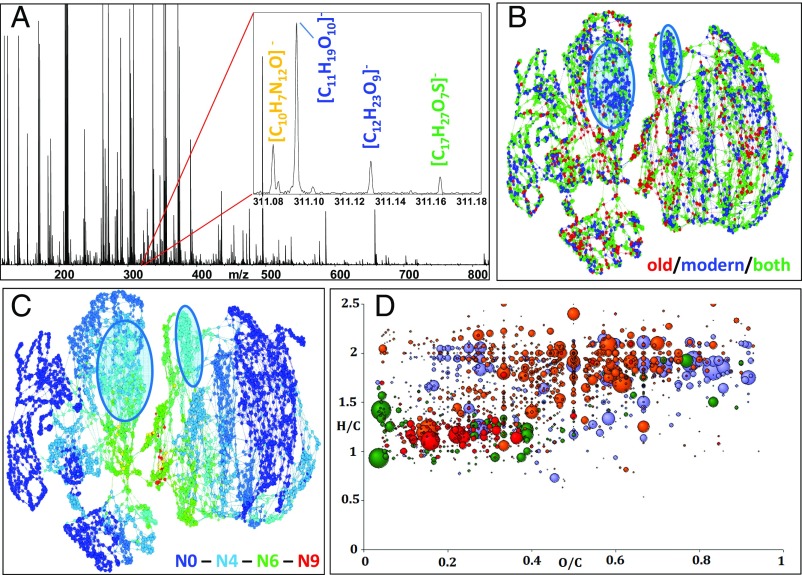
Compositional space of champagne samples as analyzed with FTICR/MS. (A) Mass spectrum of sample A33 in the m/z range from 150 to 800; 10-millimass-range spectrum details (331.08–311.18) with elemental composition assignment are shown. (B) Compositional similarity network (CSN) of all 4,196 features highlighting the m/z specific of old (Baltic Sea) (red) and modern (blue) champagne samples; two zones specific to the modern champagne specimens are highlighted in blue. (C) Nitrogen compositional space showing the distribution of compounds according to the number of nitrogen atoms they contain, ranging from none (N0, dark blue) to 9 (color gradient). (D) Typical electrospray ionization (+)-FTICR/MS van Krevelen diagram of sample A33 with CHO (blue), CHNO (orange), CHOS (green), and CHNOS (red) compounds; circle size is proportional to signal intensity.
Fig. 4.
Fig. 4.
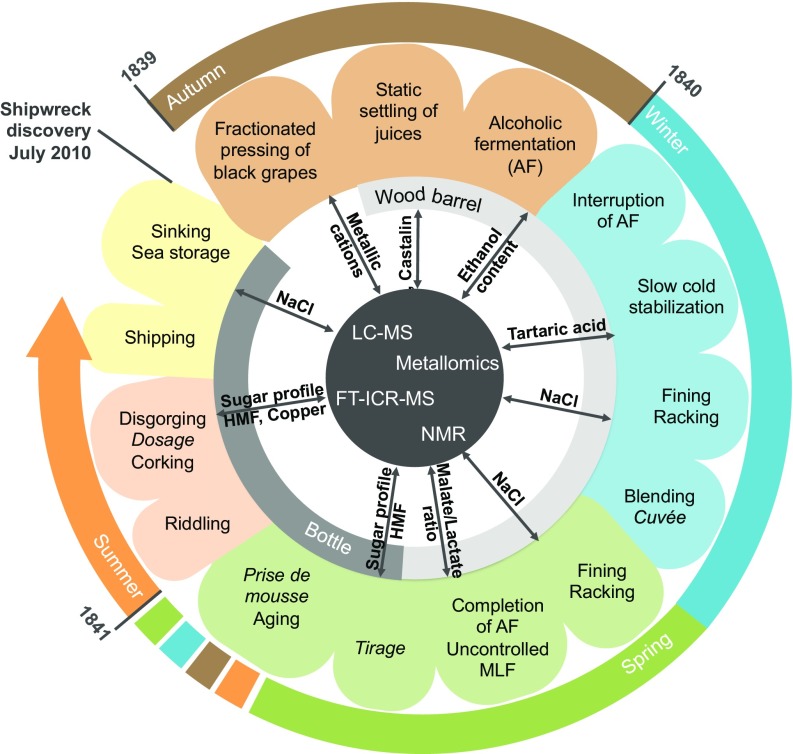
Representation of the putative champagne elaboration process in place at the beginning of the 19th century.
Fig. 5.
Fig. 5.
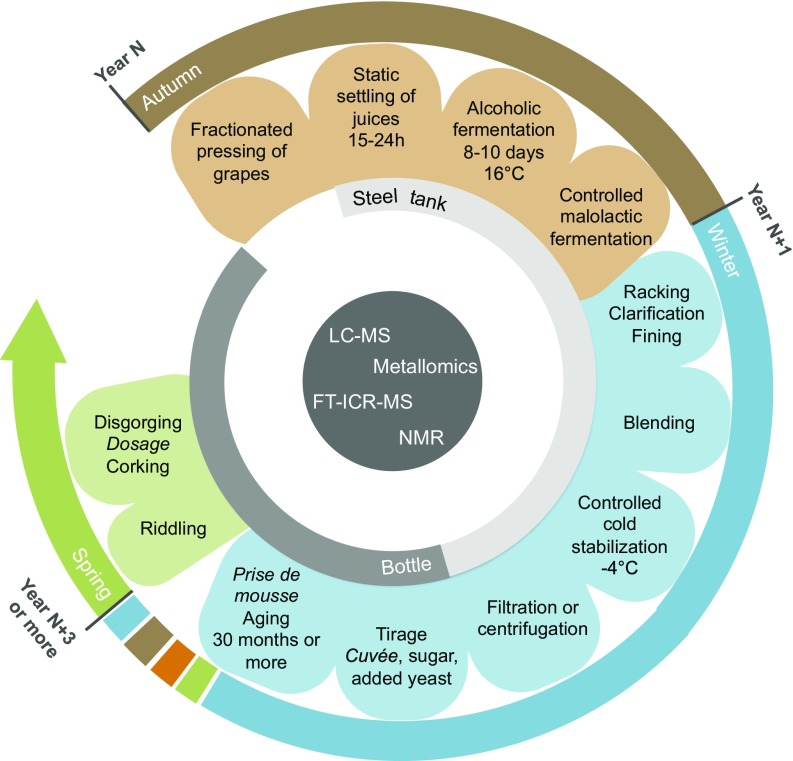
Representation of the modern champagne-making process.

References

    1. McGovern PE, Glusker DL, Exner LJ, Voigt MM. Neolithic resinated wine. Nature. 1996;381(6582):480–481.
    1. McGovern PE, Mirzoian A, Hall GR. Ancient Egyptian herbal wines. Proc Natl Acad Sci USA. 2009;106(18):7361–7366. - PMC - PubMed
    1. Cavalieri D, McGovern PE, Hartl DL, Mortimer R, Polsinelli M. Evidence for S. cerevisiae fermentation in ancient wine. J Mol Evol. 2003;57(Suppl 1):S226–S232. - PubMed
    1. Leppäranta M, Myrberg K. Physical Oceanography of the Baltic Sea. Springer; New York: 2009.
    1. Veuve Clicquot Archives (1810−1840) Correspondence exchanged by Madame Clicquot with Louis Bohne and Louis Boissonnet, 1810s through 1840s (Veuve Clicquot Archives, Reims, France)

LinkOut - more resources