. 2015 Jul;197(13):2190-200.
doi: 10.1128/JB.00193-15. Epub 2015 Apr 20.

The Cyclic AMP-Vfr Signaling Pathway in Pseudomonas aeruginosa Is Inhibited by Cyclic Di-GMP

Affiliations

The Cyclic AMP-Vfr Signaling Pathway in Pseudomonas aeruginosa Is Inhibited by Cyclic Di-GMP

Henrik Almblad et al. J Bacteriol. 2015 Jul.

Erratum in

Abstract

The opportunistic human pathogen Pseudomonas aeruginosa expresses numerous acute virulence factors in the initial phase of infection, and during long-term colonization it undergoes adaptations that optimize survival in the human host. Adaptive changes that often occur during chronic infection give rise to rugose small colony variants (RSCVs), which are hyper-biofilm-forming mutants that commonly possess mutations that increase production of the biofilm-promoting secondary messenger cyclic di-GMP (c-di-GMP). We show that RSCVs display a decreased production of acute virulence factors as a direct result of elevated c-di-GMP content. Overproduction of c-di-GMP causes a decrease in the transcription of virulence factor genes that are regulated by the global virulence regulator Vfr. The low level of Vfr-dependent transcription is caused by a low level of its coactivator, cyclic AMP (cAMP), which is decreased in response to a high level of c-di-GMP. Mutations that cause reversion of the RSCV phenotype concomitantly reactivate Vfr-cAMP signaling. Attempts to uncover the mechanism underlying the observed c-di-GMP-mediated lowering of cAMP content provided evidence that it is not caused by inhibition of adenylate cyclase production or activity and that it is not caused by activation of cAMP phosphodiesterase activity. In addition to the studies of the RSCVs, we present evidence that the deeper layers of wild-type P. aeruginosa biofilms have high c-di-GMP levels and low cAMP levels.

Importance: Our work suggests that cross talk between c-di-GMP and cAMP signaling pathways results in downregulation of acute virulence factors in P. aeruginosa biofilm infections. Knowledge about this cross-regulation adds to our understanding of virulence traits and immune evasion by P. aeruginosa in chronic infections and may provide new approaches to eradicate biofilm infections.


Figures

FIG 1
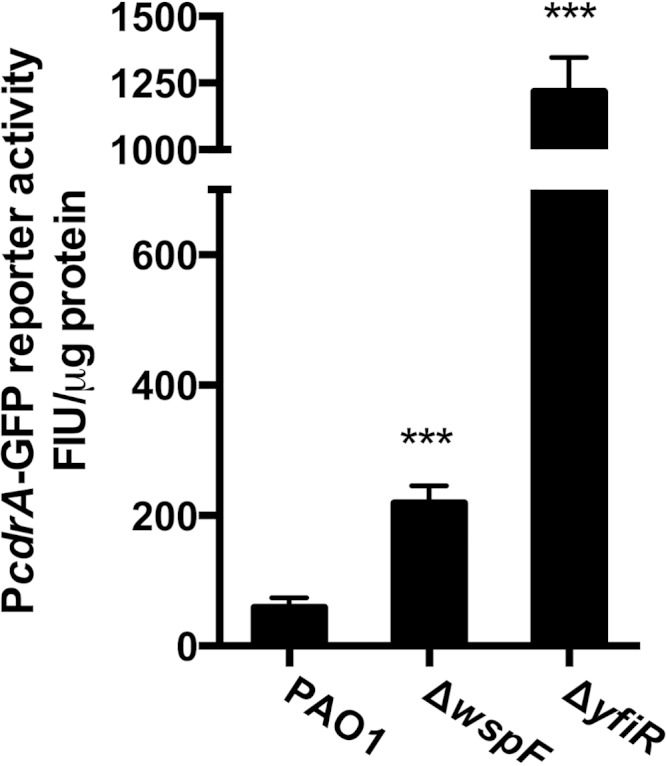
FIG 1
Increased c-di-GMP levels in RSCVs. c-di-GMP levels were estimated by using a transcriptional reporter [pUCp22Not::PcdrA-GFP(asv)] in wild-type PAO1 and the two RSCVs, ΔwspF and ΔyfiR. All measurements represent results from at least 2 biological experiments with at least 8 technical replicates. Fluorescence intensity units (FIU) from the reporter were normalized to the total protein content. Bars indicate standard deviations of the means. Statistical significance (P ≤ 0.001) is indicated with three asterisks.
FIG 2
FIG 2
RSCVs show a decrease in transcription of acute virulence factors. Transcription levels of the exoT (black bars) and ptxR (white bars) promoters were measured using the fluorescence intensity from an unstable GFP reporter gene. exoT and ptxR transcription levels were measured in wild-type PAO1 and the two RSCVs, ΔwspF and ΔyfiR. Experiments were done in VBMM medium with a low calcium content. The data represent results of at least two biological experiments with 8 technical replicates each. Fluorescence intensity units (FIU) were normalized to the total protein content. Bars indicate standard deviations of the means. Statistical significance (P ≤ 0.001) is indicated with three asterisks.
FIG 3
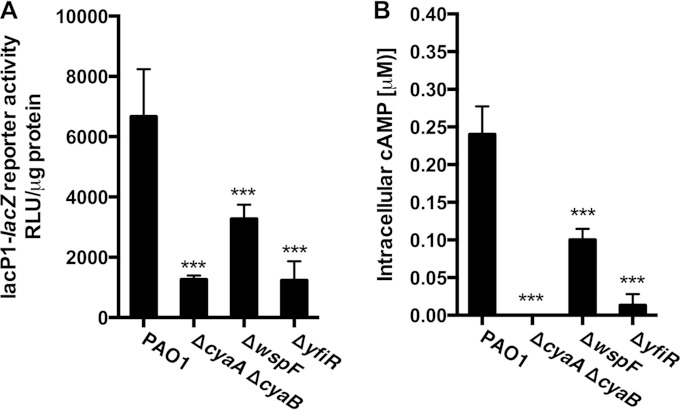
FIG 3
The RSCV phenotype is associated with severe repression in the cAMP-Vfr signaling cascade. (A) The transcriptional activity of the cAMP-Vfr complex was measured using the E. coli lacP1 promoter fused to lacZ. β-Galactosidase activity was assayed using a Tropix Galacto-Star kit. (B) Intracellular cAMP levels were measured in an EIA. The lacP1 transcriptional activity and cAMP levels were measured in the PAO1 wild type and the ΔwspF and ΔyfiR mutant strains. The cAMP-defective strain, ΔcyaA ΔcyaB, was included as a negative control. LacZ activity is reported in RLU (see Materials and Methods). Data sets represent results from at least two biological experiments with three technical replicates each. All measurements were standardized to the total protein content. Bars indicate standard deviations of the means. Statistical significance (P ≤ 0.001) is indicated with three asterisks.
FIG 4
FIG 4
cAMP-Vfr signaling is repressed in response to c-di-GMP production. The direct effect of c-di-GMP production was assayed using an exopolysaccharide-negative strain (ΔpslD ΔpelF). The pBAD promoter was induced using 0.2% arabinose. The strains harbor a chromosomal insertion of a mini-CTX::lacP-lacZ construct. The data set represents results for at least two biological experiments with three technical replicates each. RLU were standardized to the total protein content. Bars indicate standard deviations of the means.
FIG 5
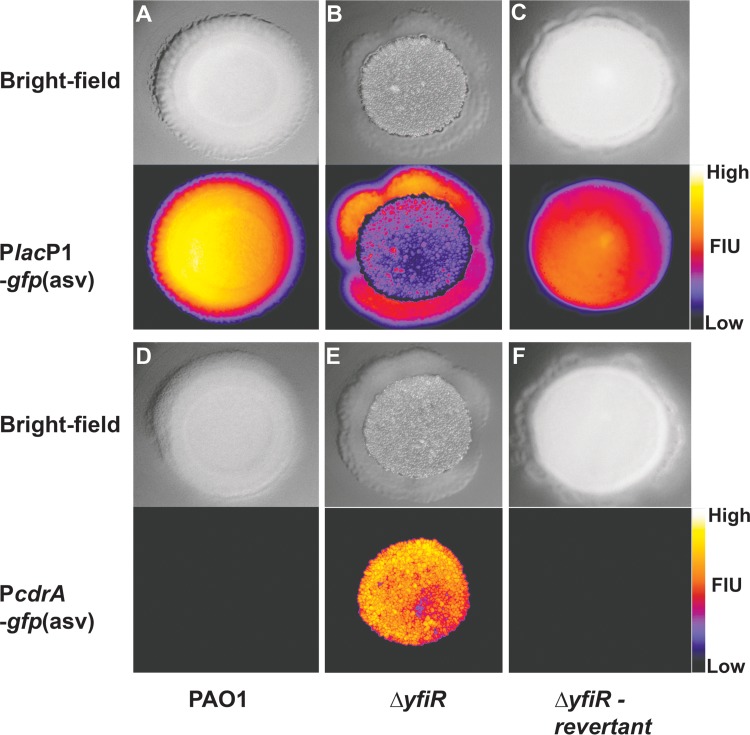
FIG 5
Phenotypic reversion of RSCVs causes regain of cAMP-Vfr signaling. c-di-GMP signaling and Vfr-cAMP signaling were monitored for several days on CR agar plates by using fluorescent transcriptional reporters. Images were obtained after 4 days of growth at room temperature. Vfr-cAMP signaling was monitored for wild-type PAO1 (A), ΔyfiR (B), and a reverted ΔyfiR strain (C). c-di-GMP signaling was also monitored for wild-type PAO1 (D), ΔyfiR (E), and a reverted ΔyfiR strain (F). The calibration bar indicates fluorescence intensity units (FIU) for the biosensors.
FIG 6
FIG 6
P. aeruginosa biofilms shows heterogeneity in cAMP and c-di-GMP signaling. cAMP and c-di-GMP signaling levels were monitored by the use of GFP fluorescent reporters during planktonic growth and in biofilms grown in a continuous flow system. The activity of each signaling system was monitored using fluorescent transcriptional reporters. Images of c-di-GMP-producing cells were obtained from a mid-log-phase (A) and a late-log/early-stationary-phase (B) planktonic culture and from a 72-h-old biofilm (C). Images of cAMP-producing cells were also obtained from a mid-log-phase (D) and a late-log-/early-stationary-phase (E) planktonic culture and from a 72-h-old biofilm (F). Bar, 5 μM (planktonic cultures) or 10 μm (flow chambers). The calibration bar indicates fluorescence intensity units (FIU) for the biosensors.
FIG 7
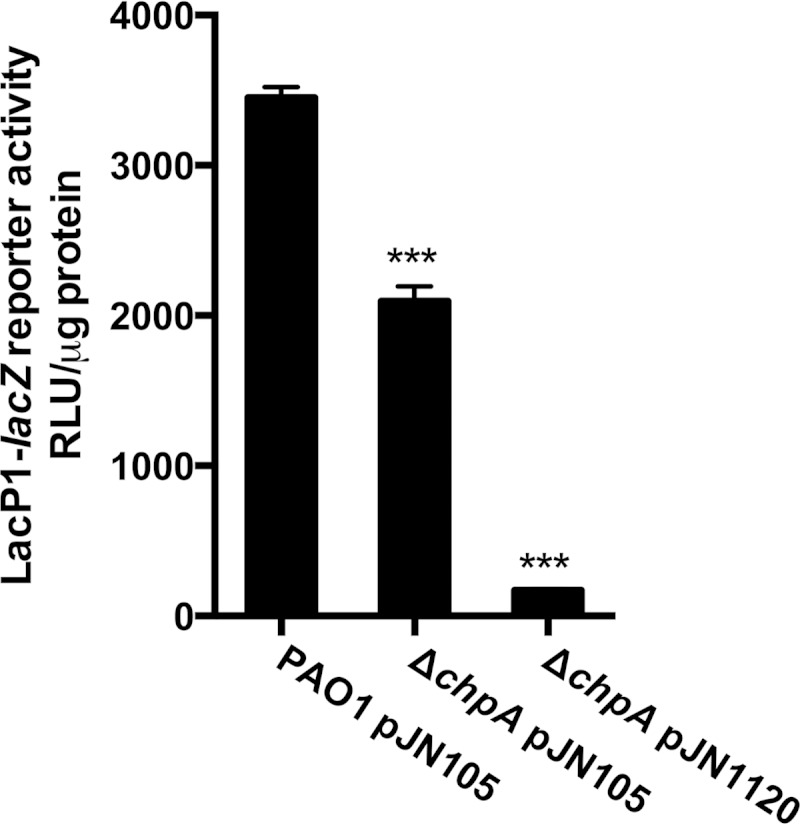
FIG 7
The Chp chemosensory system is not involved in c-di-GMP inhibition of cAMP-Vfr signaling. The transcriptional activity of the cAMP-Vfr reporter was measured in a ΔchpA mutant strain during PA1120 DGC expression (pJN1120). Wild-type PAO1 and ΔchpA strain containing the empty vector (pJN105) were included for comparison. All strains contained the mini-CTX::lacP1-lacZ construct inserted on the chromosome. Data sets represent results from at least two biological experiments with three technical replicates each. All measurements were standardized to the total protein content. Bars indicate standard deviations of the means. Statistical significance (P ≤ 0.001) is indicated with three asterisks.
FIG 8
FIG 8
cAMP levels produced by both the ACs are affected by DGC expression. Intracellular levels of cAMP in ΔcyaA and ΔcyaB mutant strains were measured using an EIA (A). The cAMP levels were measured during expression of PA1120 DGC (pJN1120) or with the vector control (pJN105). Vfr-cAMP transcriptional activity was measured in the same strain by using the mini-CTX::lacP-lacZ transcriptional reporter (B). Data sets represent results of at least two biological experiments with three technical replicates each. All measurements were standardized to the total protein content. Bars indicate standard deviations of the means. Statistical significance (P ≤ 0.001) is indicated with three asterisks.
FIG 9
FIG 9
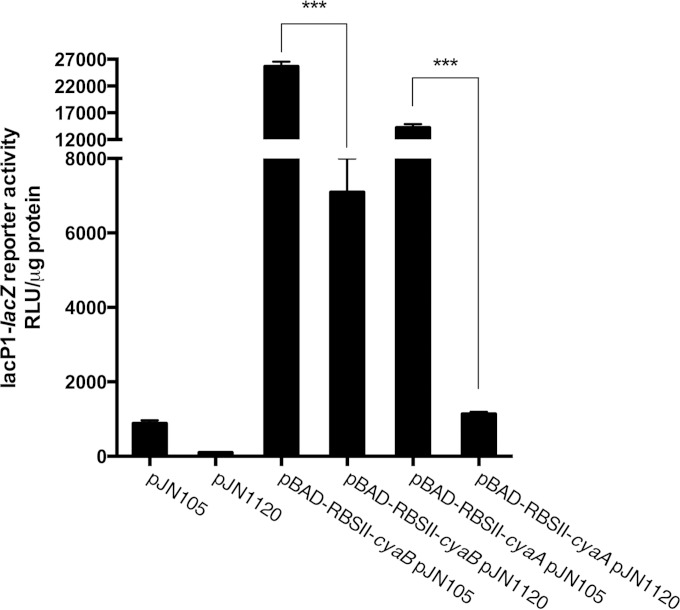
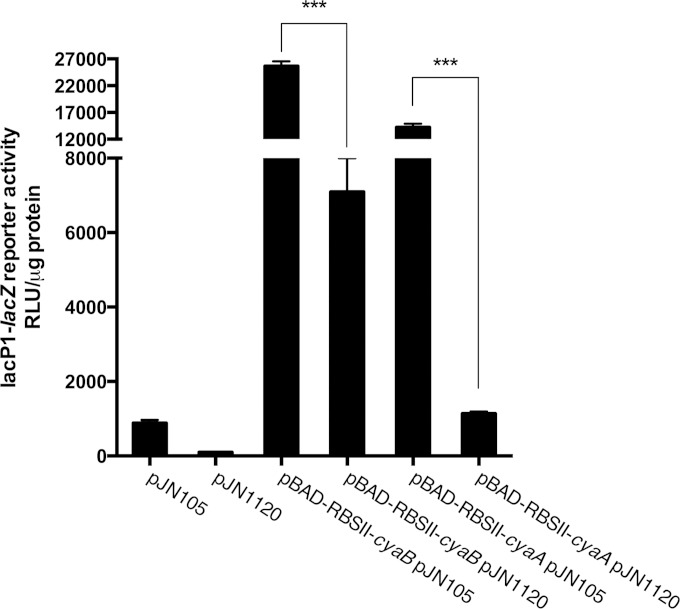
Transcription and translation of adenylate cyclases are not affected by c-di-GMP. The effects of c-di-GMP on Vfr-cAMP signaling through inhibition of AC transcription and translation were tested. The native AC genes (cyaA and cyaB) were deleted and were subsequently reintroduced individually under the control of the pBAD promoter with RBSII. Vfr-cAMP transcriptional activity was measured via LacZ measurement using the attCTX::lacP1-lacZ fusion. Data sets represent at results of least two biological experiments with three technical replicates each. All measurements were standardized to the total protein content. Bars indicate standard deviations of the means. Statistical significance (P ≤ 0.001) is indicated with three asterisks.
FIG 10
FIG 10
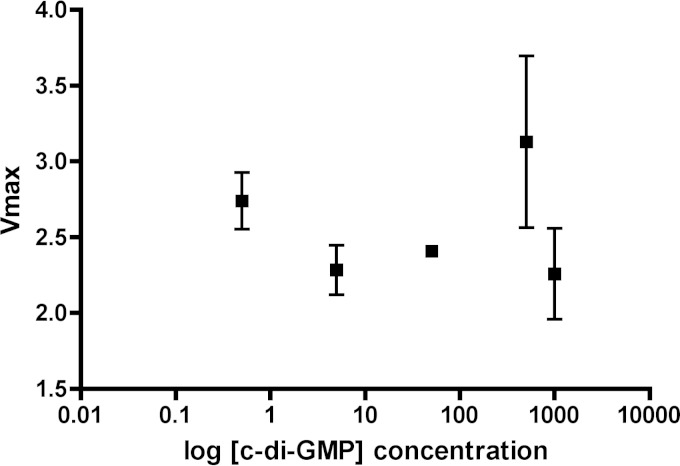
Adenylate cyclase activity is not inhibited by c-di-GMP. Vmax activity of CyaB-His was measured in an EnzCheck pyrophosphatase assay. The cyclase activity of CyaB was assayed with different concentrations of c-di-GMP, ranging from 0.5 μM to 1 mM. ATP (1 mM) substrate was used. The assay was performed with at least two replicates.
FIG 11
FIG 11
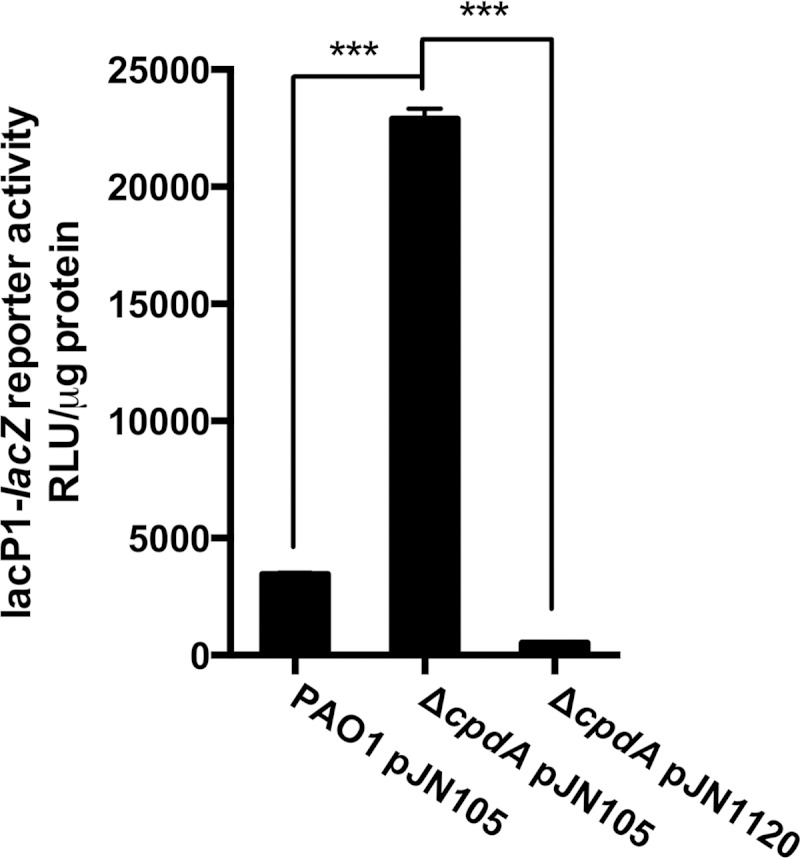
Deletion of the cpdA gene does not affect c-di-GMP inhibition of cAMP-Vfr signaling. The transcriptional activity of the cAMP-Vfr complex was measured in the ΔcpdA mutant strain during PA1120 DGC expression (pJN1120). Wild-type PAO1 and the ΔcpdA strain containing the empty vector (pJN105) were included for comparison. All strains contained the lacP1-lacZ construct allowing quantification of cAMP-Vfr transcriptional activity via LacZ measurements. Data sets represent results of at least two biological experiments with three technical replicates each. All measurements were standardized to the total protein content. Bars indicate standard deviations of the means. Statistical significance (P ≤ 0.001) is indicated with three asterisks.

References

    1. Burns JL, Gibson RL, McNamara S, Yim D, Emerson J, Rosenfeld M, Hiatt P, McCoy K, Castile R, Smith AL, Ramsey BW. 2001. Longitudinal assessment of Pseudomonas aeruginosa in young children with cystic fibrosis. J Infect Dis 183:444–452. doi:10.1086/318075. - DOI - PubMed
    1. Haussler S. 2003. Highly adherent small-colony variants of Pseudomonas aeruginosa in cystic fibrosis lung infection. J Med Microbiol 52:295–301. doi:10.1099/jmm.0.05069-0. - DOI - PubMed
    1. Smith EE, Buckley DG, Wu Z, Saenphimmachak C, Hoffman LR, D'Argenio DA, Miller SI, Ramsey BW, Speert DP, Moskowitz SM, Burns JL, Kaul R, Olson MV. 2006. Genetic adaptation by Pseudomonas aeruginosa to the airways of cystic fibrosis patients. Proc Natl Acad Sci U S A 103:8487–8492. doi:10.1073/pnas.0602138103. - DOI - PMC - PubMed
    1. Drenkard E, Ausubel FM. 2002. Pseudomonas biofilm formation and antibiotic resistance are linked to phenotypic variation. Nature 416:740–743. doi:10.1038/416740a. - DOI - PubMed
    1. Mishra M, Byrd MS, Sergeant S, Azad AK, Parsek MR, McPhail L, Schlesinger LS, Wozniak DJ. 2012. Pseudomonas aeruginosa Psl polysaccharide reduces neutrophil phagocytosis and the oxidative response by limiting complement-mediated opsonization. Cell Microbiol 14:95–106. doi:10.1111/j.1462-5822.2011.01704.x. - DOI - PMC - PubMed

Publication types

MeSH terms

LinkOut - more resources