. 2015 May;21(5):824-32.
doi: 10.3201/eid2105.141920.

Canine distemper in endangered Ethiopian wolves

Canine distemper in endangered Ethiopian wolves

Christopher H Gordon et al. Emerg Infect Dis. 2015 May.

Abstract

The Ethiopian wolf (Canis simensis) is the world's rarest canid; ≈500 wolves remain. The largest population is found within the Bale Mountains National Park (BMNP) in southeastern Ethiopia, where conservation efforts have demonstrated the negative effect of rabies virus on wolf populations. We describe previously unreported infections with canine distemper virus (CDV) among these wolves during 2005-2006 and 2010. Death rates ranged from 43% to 68% in affected subpopulations and were higher for subadult than adult wolves (83%-87% vs. 34%-39%). The 2010 CDV outbreak started 20 months after a rabies outbreak, before the population had fully recovered, and led to the eradication of several focal packs in BMNP's Web Valley. The combined effect of rabies and CDV increases the chance of pack extinction, exacerbating the typically slow recovery of wolf populations, and represents a key extinction threat to populations of this highly endangered carnivore.

Keywords: Bale Mountains National Park; Canis simensis; Ethiopia; Ethiopian wolves; canid species; canine distemper; conservation; endangered; epizootics; morbillivirus; rabies; vaccination; viruses; wolves.


Figures
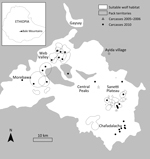
Figure 1
Figure 1
Bale Mountains National Park in Ethiopia, showing location of wolves that died during the 2005–2006 and 2010 canine distemper virus outbreaks in Worgona Valley and Sanetti Plateau and the location of Ayida village, the source of the outbreaks.
Figure 2
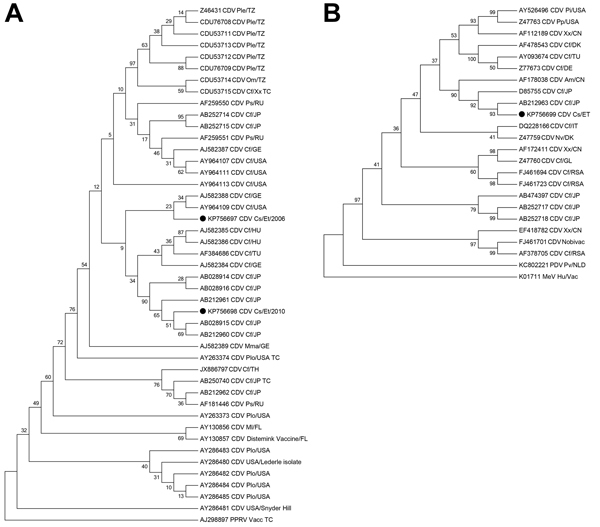
Figure 2
Phylogenetic neighbor-joining trees of canine distemper virus (CDV) isolates from samples collected during outbreaks in 2006 and 2011 (A) and 2010 (B). Evolutionary analyses were conducted in MEGA6 (30). A) Tree constructed using the phosphoprotein gene (331 nt). Evolutionary distances were computed using the Kimura 2-parameter method and are in the units of the number of base substitutions per site. The analysis involved 45 nt sequences and a total of 331 positions in the final dataset. B) Tree constructed by using the hemagglutinin gene (1,334 nt). Bootstrap values (10,000 replicates) are indicated at relevant nodes. Black dot indicates Ethiopian wolf samples. Species from which the viruses were isolated are indicated by the following abbreviations: Am, Ailuropoda melanoleuca (giant panda); Cf, Canis familiaris (dog); Cs, Canis simensis (Ethiopian wolf); Hu, human; Mma, Martes martes (European marten); Ml, Mustela lutreola (European mink); Mm, Meles meles (badger); Nv, Neovison vison (American mink); Om, Otocyon megalotis (bat-eared fox); Ple, Panthera leo (lion); Plo, Procyon lotor (raccoon); Pp, Panthera pardus (black leopard); Ps, Phoca sibirica (Baikal seal); Pv, Phoca vitulina (harbor seal); Xx, species unidentified. Country of sample origin are indicated as follows: CN, China; DK, Denmark; ET, Ethiopia; FL, Finland; GE, Germany; GL, Greenland; HU, Hungary; IT, Italy; JP, Japan; NLD, the Netherlands; RU, Russia; RSA, South Africa; TU, Turkey; TZ, Tanzania. TC denotes where isolates have undergone extensive tissue culture passage. Phylogenetic outgroups are indicated as follows: PPRV, peste des petits ruminants virus; PDV, phocine distemper virus; and MeV, measles virus.
Figure 3
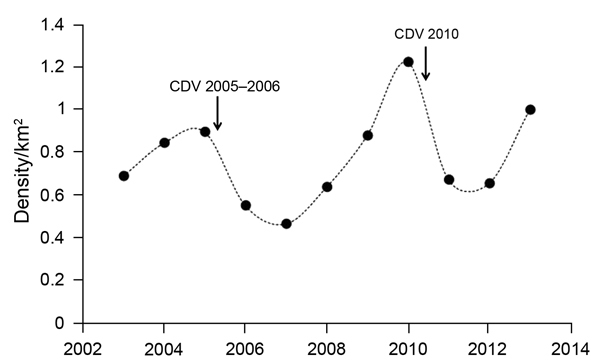
Figure 3
Adult and subadult Ethiopian wolf population in Sanetti Plateau, Ethiopia, 2002–2013. Dots indicate wolf population estimates at different time points; arrows indicate canine distemper virus outbreaks in this study.
Figure 4
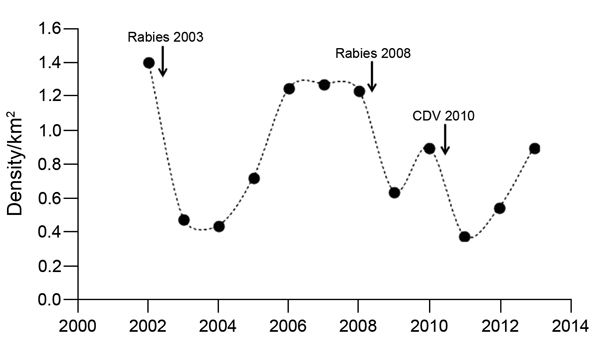
Figure 4
Density of adult and subadult Ethiopian wolf population in Web Valley, Ethiopia, 2002–2013. Dots indicate wolf population estimates at different time points; arrows indicate known rabies epizootics and canine distemper virus outbreaks in this study. Of 7 wolf packs in Web Valley, 4 went extinct after the 2010 canine distemper virus outbreak; in 2011, two new packs formed in the area.

References

    1. Dobson A, Foufopoulos J. Emerging infectious pathogens of wildlife. Philos Trans R Soc Lond B Biol Sci. 2001;356:1001–12. 10.1098/rstb.2001.0900 - DOI - PMC - PubMed
    1. Alexander KA, Appel MJ. African wild dogs (Lycaon pictus) endangered by a canine distemper epizootic among domestic dogs near the Masai Mara National Reserve, Kenya. J Wildl Dis. 1994;30:481–5. 10.7589/0090-3558-30.4.481 - DOI - PubMed
    1. Roelke-Parker ME, Munson L, Packer C, Kock R, Cleaveland S, Carpenter M, et al. A canine distemper virus epidemic in Serengeti lions (Panthera leo). Nature. 1996;379:441–5. 10.1038/379441a0 - DOI - PMC - PubMed
    1. Haas L, Hofer H, East M, Wohlsein P, Liess B, Barrett T. Canine distemper virus infection in Serengeti spotted hyenas. Vet Microbiol. 1996;49:147–52. 10.1016/0378-1135(95)00180-8 - DOI - PubMed
    1. Sakai K, Yoshikawa T, Seki F, Fukushi S, Tahara M, Nagata N, et al. Canine distemper virus associated with a lethal outbreak in monkeys can readily adapt to use human receptors. J Virol. 2013;87:7170–5. 10.1128/JVI.03479-12 - DOI - PMC - PubMed

Publication types

LinkOut - more resources