


Obesity is independently associated with spinal anesthesia outcomes: a prospective observational study
- PMID: 25898360
- PMCID: PMC4405588
- DOI: 10.1371/journal.pone.0124264
Obesity is independently associated with spinal anesthesia outcomes: a prospective observational study
Abstract
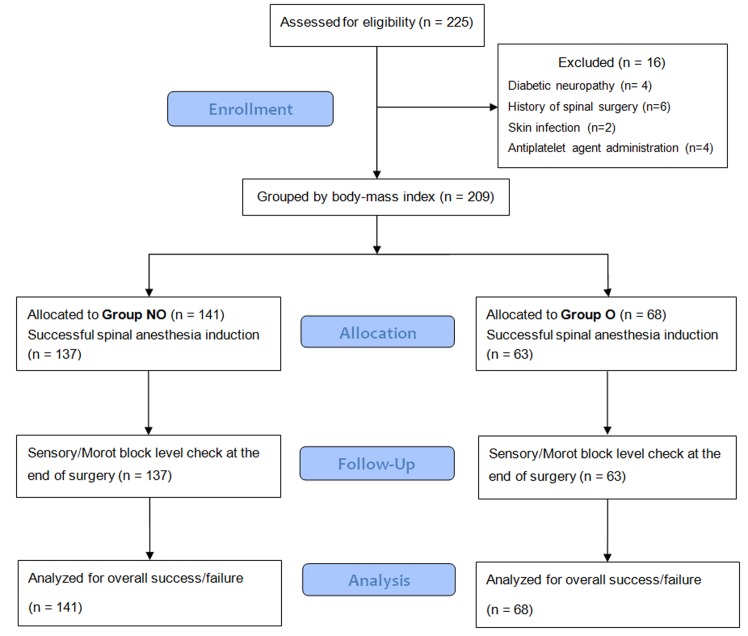
The influence of body-mass index (BMI) on spinal anesthesia is still controversial, with discrepant results reported in previous studies. To compare spinal anesthesia in obese and non-obese subjects, the anesthesia profiles in patients who underwent spinal anesthesia using intrathecal hyperbaric bupivacaine were compared. A total of 209 patients undergoing elective total knee replacement arthroplasty (TKRA) surgery under spinal anesthesia were divided into an NO (non-obese) group (BMI < 30 kg/m2, n = 141) and an O (obese) group (BMI ≥ 30 kg/m2, n = 68). Anesthesia was deemed successful if a bilateral T12 sensory block occurred within 15 minutes of intrathecal drug administration, and if the level of sensory block was higher than T12 when the surgery ended. Logistic regression analysis with multiple variables known to influence spinal anesthesia was performed to identify which parameters independently determined the spinal anesthesia outcome. Similar doses of bupivacaine were administered to the NO and O groups. The incidence of anesthesia failure was significantly lower in the O group [n = 43 (30.5%) in the NO group vs. n = 10 (18.9%) in the O group, p = 0.014]. The independent predictors for successful anesthesia in all patients were dose of hyperbaric bupivacaine [odds ratio (OR) 2.12, 95% CI: 1.64-2.73] and obese status (BMI ≥ 30 kg/m2, OR 2.86, 95% CI: 1.25-6.52). Time to first report of postoperative pain and time to first self-void were significantly longer in the O group. These results suggest that the duration of block with hyperbaric bupivacaine is prolonged in obese patients and obesity is independently associated with spinal anesthesia outcomes, as is bupivacaine dosage. A further study enrolling patients with morbid obesity and using a fixed bupivacaine dosage is required to confirm the effect of obesity on spinal anesthesia.
Conflict of interest statement
Figures

References
-
- Logan MR, McClure JH, Wildsmith JA. Plain bupivacaine: an unpredictable spinal anaesthetic agent. Br J Anaesth. 1986;58: 292–296. - PubMed
-
- Pitkanen M, Haapaniemi L, Tuominen M, Rosenberg PH. Influence of age on spinal anaesthesia with isobaric 0.5% bupivacaine. Br J Anaesth. 1984;56: 279–284. - PubMed
-
- Pitkanen MT. Body mass and spread of spinal anesthesia with bupivacaine. Anesth Analg. 1987;66: 127–131. - PubMed
-
- Schnider TW, Minto CF, Bruckert H, Mandema JW. Population pharmacodynamic modeling and covariate detection for central neural blockade. Anesthesiology. 1996;85: 502–512. - PubMed
-
- McCulloch WJ, Littlewood DG. Influence of obesity on spinal analgesia with isobaric 0.5% bupivacaine. Br J Anaesth. 1986;58: 610–614. - PubMed
Publication types
MeSH terms
LinkOut - more resources
Full Text Sources
Other Literature Sources
Medical
