


Clostridium difficile infection among hospitalized HIV-infected individuals: epidemiology and risk factors: results from a case-control study (2002-2013)
- PMID: 25899507
- PMCID: PMC4408587
- DOI: 10.1186/s12879-015-0932-x
Clostridium difficile infection among hospitalized HIV-infected individuals: epidemiology and risk factors: results from a case-control study (2002-2013)
Abstract
Background: HIV infection is a risk factor for Clostridium difficile infection (CDI) yet the immune deficiency predisposing to CDI is not well understood, despite an increasing incidence of CDI among such individuals. We aimed to estimate the incidence and to evaluate the risk factors of CDI among an HIV cohort in Italy.
Methods: We conducted a retrospective case-control (1:2) study. Clinical records of HIV inpatients admitted to the National Institute for Infectious Disease "L. Spallanzani", Rome, were reviewed (2002-2013).
Cases: HIV inpatients with HO-HCFA CDI, and controls: HIV inpatients without CDI, were matched by gender and age. Logistic regression was used to identify risk factors associated with CDI.
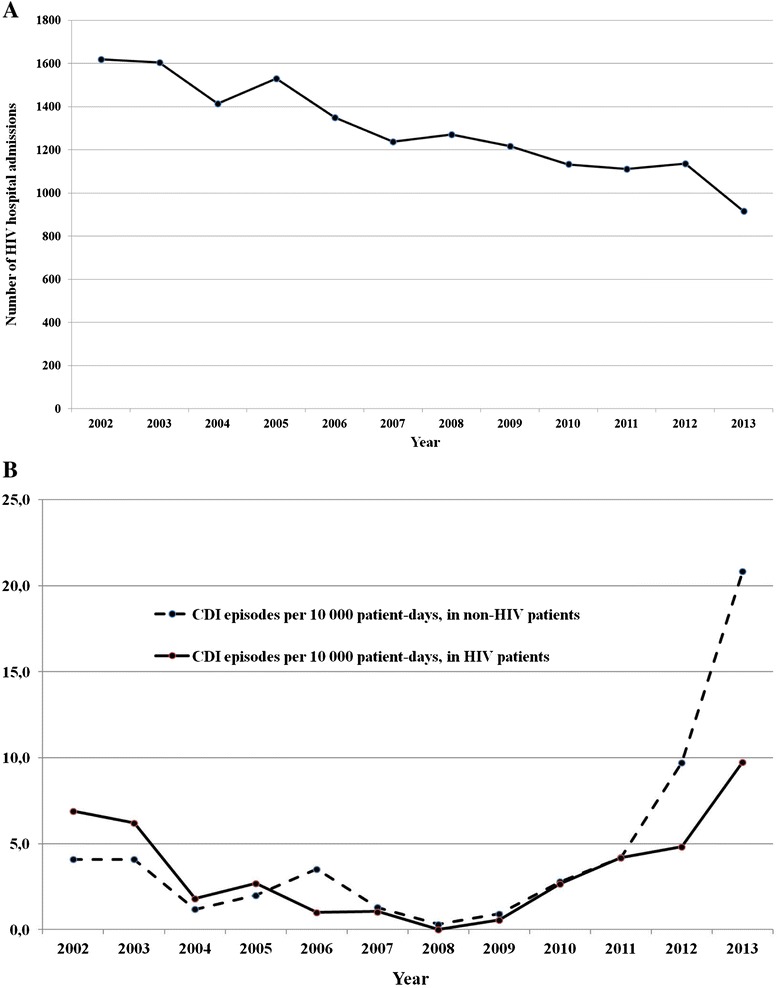
Results: We found 79 CDI episodes (5.1 per 1000 HIV hospital admissions, 3.4 per 10000 HIV patient-days). The mean age of cases was 46 years. At univariate analysis factors associated with CDI included: antimycobacterial drug exposure, treatment for Pneumocystis pneumonia, acid suppressant exposure, previous hospitalization, antibiotic exposure, low CD4 cell count, high Charlson score, low creatinine, low albumin and low gammaglobulin level. Using multivariate analysis, lower gammaglobulin level and low serum albumin at admission were independently associated with CDI among HIV-infected patients.
Conclusions: Low gammaglobulin and low albumin levels at admission are associated with an increased risk of developing CDI. A deficiency in humoral immunity appears to play a major role in the development of CDI. The potential protective role of albumin warrants further investigation.
Figures
Similar articles
-
Burden of Clostridium difficile infection between 2010 and 2013: Trends and outcomes from an academic center in Eastern Europe.World J Gastroenterol. 2015 Jun 7;21(21):6728-35. doi: 10.3748/wjg.v21.i21.6728. World J Gastroenterol. 2015. PMID: 26074711 Free PMC article.
-
Clostridium difficile in an Urban, University-Affiliated Long-Term Acute-Care Hospital.Infect Control Hosp Epidemiol. 2017 Mar;38(3):294-299. doi: 10.1017/ice.0000-0.291. Epub 2016 Dec 7. Infect Control Hosp Epidemiol. 2017. PMID: 27923419
-
Incidence and risk factors for hospital-acquired Clostridium difficile infection among inpatients in an orthopaedic tertiary care hospital.J Hosp Infect. 2013 Feb;83(2):146-9. doi: 10.1016/j.jhin.2012.11.009. Epub 2013 Jan 10. J Hosp Infect. 2013. PMID: 23313026
-
Risk factors for Clostridium difficile infection in pediatric inpatients: A meta-analysis and systematic review.Infect Control Hosp Epidemiol. 2019 Apr;40(4):420-426. doi: 10.1017/ice.2019.23. Epub 2019 Mar 7. Infect Control Hosp Epidemiol. 2019. PMID: 30841948
-
Updates in the epidemiology and management of candidemia and Clostridioides difficile coinfection.Expert Rev Anti Infect Ther. 2019 May;17(5):375-382. doi: 10.1080/14787210.2019.1608183. Epub 2019 May 3. Expert Rev Anti Infect Ther. 2019. PMID: 30982376 Review.
Cited by
-
Risk factors for Clostridium difficile infection in HIV-infected patients.SAGE Open Med. 2016 Dec 14;4:2050312116684295. doi: 10.1177/2050312116684295. eCollection 2016. SAGE Open Med. 2016. PMID: 28348742 Free PMC article.
-
Characteristics of Clostridium difficile infection in patients hospitalized with myelodysplastic syndrome or acute myelogenous leukemia.World J Clin Oncol. 2017 Oct 10;8(5):398-404. doi: 10.5306/wjco.v8.i5.398. World J Clin Oncol. 2017. PMID: 29067276 Free PMC article.
-
Clostridium difficile Toxins A and B: Insights into Pathogenic Properties and Extraintestinal Effects.Toxins (Basel). 2016 May 3;8(5):134. doi: 10.3390/toxins8050134. Toxins (Basel). 2016. PMID: 27153087 Free PMC article. Review.
-
Clostridioides difficile infection: history, epidemiology, risk factors, prevention, clinical manifestations, treatment, and future options.Clin Microbiol Rev. 2024 Jun 13;37(2):e0013523. doi: 10.1128/cmr.00135-23. Epub 2024 Feb 29. Clin Microbiol Rev. 2024. PMID: 38421181 Free PMC article. Review.
References
Publication types
MeSH terms
Substances
LinkOut - more resources
Full Text Sources
Other Literature Sources
Medical
Research Materials
