Cryptosporidium infections in suckler herd beef calves
- PMID: 25899555
- PMCID: PMC4453919
- DOI: 10.1017/S0031182015000426
Cryptosporidium infections in suckler herd beef calves
Abstract
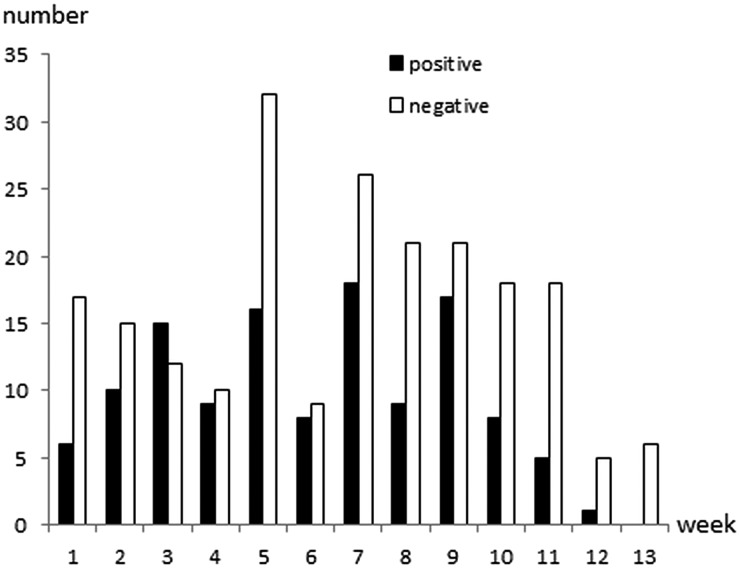
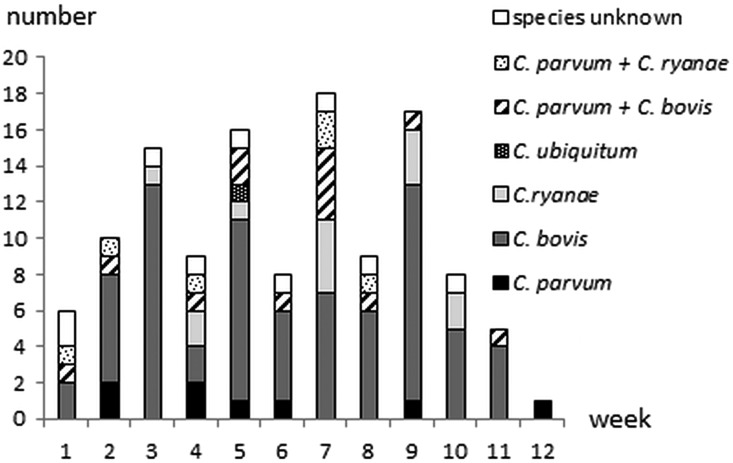
A study was carried out to investigate how common Cryptosporidium infections are in beef calves in Swedish suckler herds and to explore which species and subtypes that occur. We further aimed at identifying factors associated with shedding of Cryptosporidium oocysts in this type of calf management. The study was conducted in two regions in Sweden and included 30 herds. Faecal samples were collected from calves younger than 3 months. A brief clinical examination was done and a questionnaire was used to collect data on management routines. Faeces were cleaned and concentrated and oocysts identified by epifuorescence microscopy. Cryptosporidium positive samples were analyzed at the 18S rRNA and GP60 genes to determine species and Cryptosporidium parvum subtype, respectively. Logistic regression was used to identify factors associated with infection. Oocysts were detected in 122 (36.7%) calves from 29 (97%) herds, at 400 to 2.4 × 10⁷ OPG. The youngest positive calves were only 1 and 2 days old. There was no association between age and Cryptosporidium infection. Cryptosporidium bovis, Cryptosporidium ryanae, C. parvum and Cryptosporidium ubiquitum were identified, with C. bovis being the major species. Two C. parvum subtypes, IIaA16G1R1 and IIdA27G1 were identified. Routines for cleaning calf pens and number of cows in calving pens were associated with infection.
Keywords: Cryptosporidium; Cryptosporidium bovis; Cryptosporidium parvum; Cryptosporidium ryanae; Cryptosporidium ubiquitum; beef calves; diarrhea; suckler herd.
Figures
References
-
- Broglia A., Reckinger S., Cacció S. M. and Nöckler K. (2008). Distribution of Cryptosporidium parvum subtypes in calves in Germany. Veterinary Parasitology 154, 8–13. - PubMed
-
- Brook E. J., Anthony Hart C., French N. P. and Christley R. M. (2009). Molecular epidemiology of Cryptosporidium subtypes in cattle in England. Veterinary Journal 179, 378–382. - PubMed
-
- Cacciò S. M. and Widmer G. (ed.) (2014). Cryptosporidium: Parasite and Disease, Springer-Verlag, Wien.
-
- Chalmers R. M., Ferguson C., Caccio S., Gasser R. B., Abs El-Osta Y. G., Heijnen L., Xiao L., Elwin K., Hadfield S., Sinclair M. and Stevens M. (2005). Direct comparison of selected methods for genetic categorisation of Cryptosporidium parvum and Cryptosporidium hominis species. International Journal for Parasitology 35, 397–410. - PubMed