


Differential Lipid Response to Statins Is Associated With Variants in the BUD13-APOA5 Gene Region
- PMID: 25900265
- PMCID: PMC4993018
- DOI: 10.1097/FJC.0000000000000261
Differential Lipid Response to Statins Is Associated With Variants in the BUD13-APOA5 Gene Region
Abstract
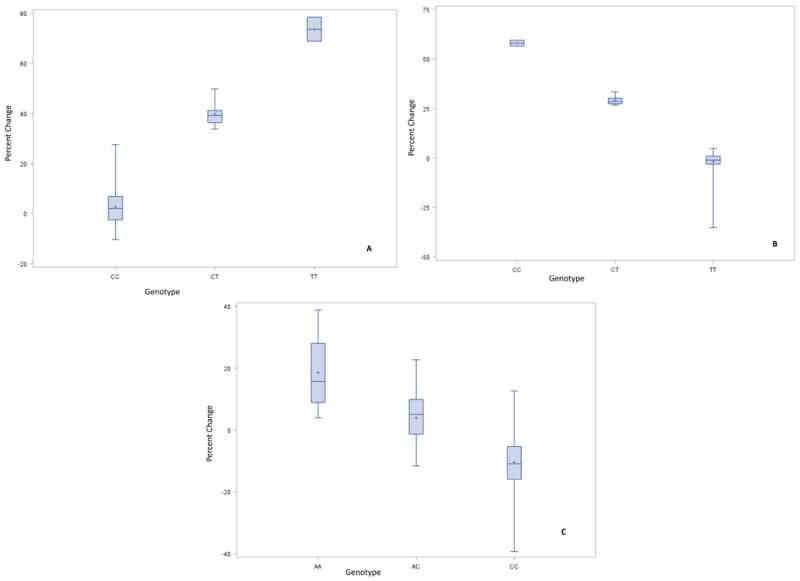
Genetic variants within the BUD13-APOA5 gene region are known to be associated with high-density lipoprotein cholesterol (HDL-C) and triglyceride (TG) levels. Recent studies suggest that single nucleotide polymorphisms (SNPs) within this region affect HDL-C response to statin-fibrate combination therapy and low-density lipoprotein cholesterol (LDL-C) response to statin therapy. We hypothesized that SNPs within the BUD13-APOA5 region are associated with TG, HDL-C, and LDL-C response to statin therapy. We examined 1520 observations for 1086 patients from the Personalized Medicine Research Project, a large biorepository at the Marshfield Clinic Research Foundation, who had received statin therapy and been previously genotyped for polymorphisms in the 11q23 chromosomal region. A significant differential response to statin therapy was observed for 3 SNPs. The minor allele at rs11605293 significantly attenuated TG-lowering response to pravastatin (P = 0.000159), whereas the minor allele at rs12806755 was associated with a similar response to lovastatin (P = 0.000192). Genotypes at rs947990 significantly attenuated LDL-C reduction to atorvastatin therapy (P = 0.000668) with some patients with the minor allele having LDL-C increase after therapy. No SNPs within the BUD13-APOA5 region were associated with a significant effect on HDL-C reduction in response to statin therapy. In conclusion, this study suggests that common SNPs within the BUD13-APOA5 can affect TG and LDL-C response to statin therapy in a North American population.
Conflict of interest statement
The authors report no conflict of interest.
Figures

References
-
- Eckel RH, Jakicic JM, Ard JD, et al. 2013 AHA/ACC guideline on lifestyle managementto reduce cardiovascular risk: a report of the American College of Cardiology/ American/Heart Association Task Force on Practice Guidelines. Circulation. 2014;129:S76–S99. - PubMed
-
- Meqa JL, Morrow DA, Brown A, et al. Identification of genetic variants associated with response to statin therapy. Arterioscler Thromb Vasc Biol. 2009;29:1310–15. - PubMed
-
- Thompson JF, Hyde CL, Wood LS, et al. Comprehensive whole-genome and candidate gene analysis for response to statin therapy in the Treating to New Targets (TNT) cohort. Circ Cardiovasc Genet. 2009;2:173–181. - PubMed
Publication types
MeSH terms
Substances
Grants and funding
LinkOut - more resources
Full Text Sources
Medical
Miscellaneous
