


Predicting 5- and 10-year survival in older women with early-stage breast cancer: self-rated health and walking ability
- PMID: 25900489
- PMCID: PMC4407370
- DOI: 10.1111/jgs.13340
Predicting 5- and 10-year survival in older women with early-stage breast cancer: self-rated health and walking ability
Abstract
Objectives: To determine life expectancy for older women with breast cancer.
Design: Prospective longitudinal study with 10 years of follow-up data.
Setting: Hospitals or collaborating tumor registries in four geographic regions (Los Angeles, California; Minnesota; North Carolina; Rhode Island).
Participants: Women aged 65 and older at time of breast cancer diagnosis with Stage I to IIIA disease with measures of self-rated health (SRH) and walking ability at baseline (N = 615; 17% aged ≥80, 52% Stage I, 58% with ≥2 comorbidities).
Measurements: Baseline SRH, baseline self-reported walking ability, all-cause and breast cancer-specific estimated probability of 5- and 10-year survival.
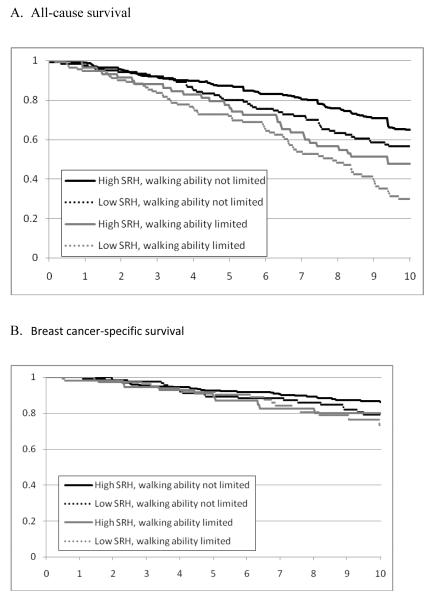
Results: At the time of breast cancer diagnosis, 39% of women reported poor SRH, and 28% reported limited ability to walk several blocks. The all-cause survival curves appear to separate after approximately 3 years, and the difference in survival probability between those with low SRH and limited walking ability and those with high SRH and no walking ability limitation was significant (0.708 vs 0.855 at 5 years, P ≤ .001; 0.300 vs 0.648 at 10 years, P < .001). There were no differences between the groups in breast cancer-specific survival at 5 and 10 years (P = .66 at 5 years, P = .16 at 10 years).
Conclusion: The combination of low SRH and limited ability to walk several blocks at diagnosis is an important predictor of worse all-cause survival at 5 and 10 years. These self-report measures easily assessed in clinical practice may be an effective strategy to improve treatment decision-making in older adults with cancer.
Keywords: breast cancer; physical function; self-rated health.
© 2015, Copyright the Authors Journal compilation © 2015, The American Geriatrics Society.
Figures
References
-
- Hurria A. Communicating treatment options to older patients: Challenges and opportunities. J Natl Compr Canc Netw. 2012;10:1174–1176. - PubMed
-
- Lee SJ, Lindquist K, Segal MR, et al. Development and validation of a prognostic index for 4-year mortality in older adults. JAMA. 2006;295:801–808. - PubMed
Publication types
MeSH terms
Grants and funding
LinkOut - more resources
Full Text Sources
Other Literature Sources
Medical
