


Reunion behavior after social separation is associated with enhanced HPA recovery in young marmoset monkeys
- PMID: 25900596
- PMCID: PMC4437813
- DOI: 10.1016/j.psyneuen.2015.03.019
Reunion behavior after social separation is associated with enhanced HPA recovery in young marmoset monkeys
Abstract
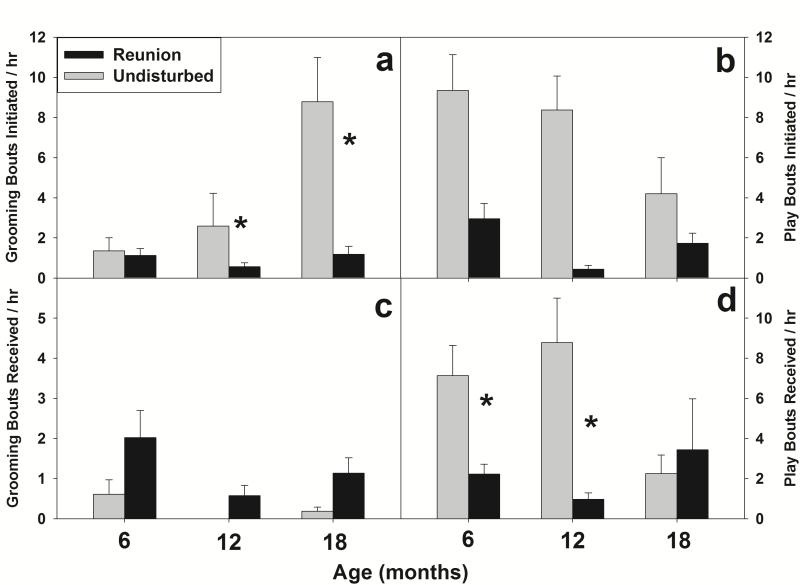
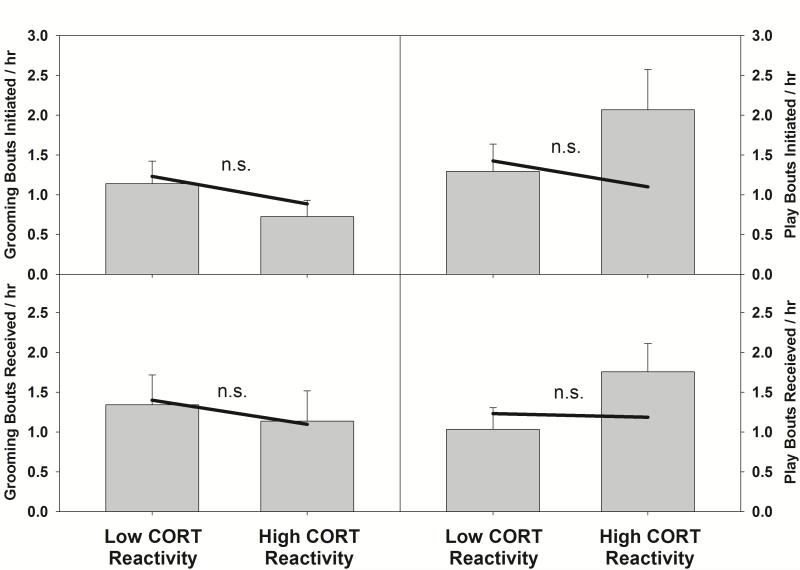
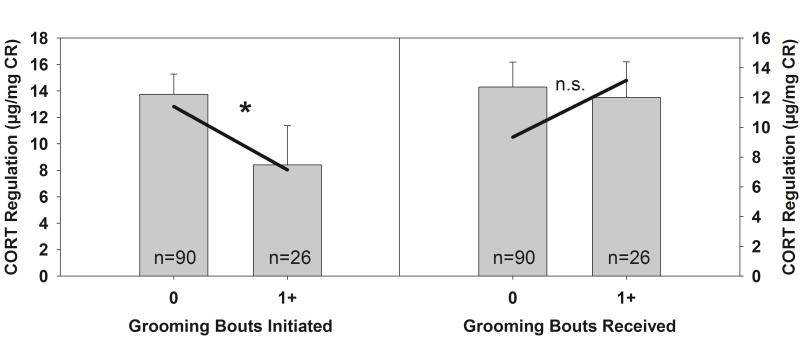
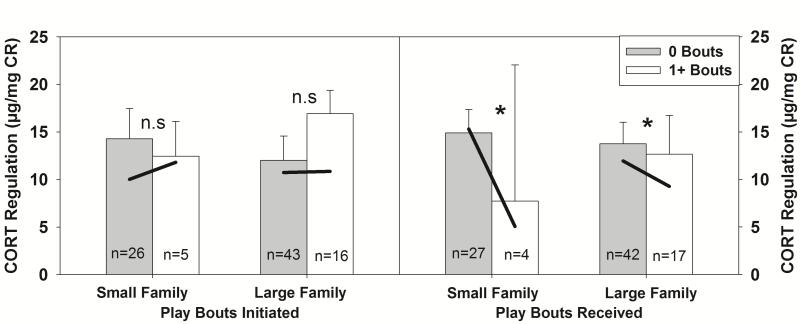
The relationships that offspring develop with caregivers can exert a powerful influence on behavior and physiology, including the hypothalamic-pituitary-adrenal (HPA) axis. In many mammalian species, offspring-caregiver relationships are largely limited to interactions with mother. Marmoset monkeys receive care in early life from multiple classes of caregivers in addition to the mother, including fathers and siblings. We evaluated whether affiliative social interactions with family members in marmosets were associated with differences in cortisol reactivity to a short-term social separation stressor, and whether these variations in affiliative interactions upon reunion predicted how well marmosets subsequently regulated HPA axis function after cessation of the stressor. Marmosets were separated from the family for 8h at three developmental time points (6-, 12-, and 18-months of age), and interactions of the separated marmoset with the family group were recorded during reunion. Urinary cortisol was measured prior to social separation, every 2h during the separation, and on the morning after separation. Heightened cortisol reactivity during social separation did not predict affiliative social behavior upon reunion but higher rates of grooming and play behavior predicted enhanced HPA regulation. Marmosets with higher rates of grooming and play with family members upon reunion had post-stress cortisol levels closer to preseparation baseline than marmosets with lower rates of affiliative reunion behavior. Combined with previous research showing the early programming effects of social interactions with caregivers, as well as the buffering effect of a close social partner during stress, the current study highlights the high degree of behavioral and HPA adaptability to social stressors across development in marmoset monkeys.
Keywords: Family; Hypothalamic-pituitary-adrenal; Primate; Regulation; Social behavior.
Copyright © 2015 Elsevier Ltd. All rights reserved.
Figures
References
-
- Arabadzisz D, Diaz-Heijtz R, Knuesel I, Weber E, Pilloud S, Dettling AC, Feldon J, Law AJ, Harrison PJ, Pryce CR. Primate Early Life Stress Leads to Long-Term Mild Hippocampal Decreases in Corticosteroid Receptor Expression. Biol. Psychiatry, Synaptic Development in Mood Disorders. 2010;67:1106–1109. doi:10.1016/j.biopsych.2009.12.016. - PubMed
-
- Bayart F, Hayashi KT, Faull KF, Barchas JD, Levine S. Influence of maternal proximity on behavioral and physiological responses to separation in infant rhesus monkeys (Macaca mulatta) Behav. Neurosci. 1990;104:98. - PubMed
-
- Capitanio JP, Mendoza SP, Lerche NW. Individual differences in peripheral blood immunological and hormonal measures in adult male rhesus macaques (Macaca mulatta): Evidence for temporal and situational consistency. Am. J. Primatol. 1998;44:29–41. doi:10.1002/(SICI)1098-2345(1998)44:1<29::AID-AJP3>3.0.CO;2-Z. - PubMed
-
- Capitanio JP, Mendoza SP, Mason WA, Maninger N. Rearing environment and hypothalamic-pituitary-adrenal regulation in young rhesus monkeys (Macaca mulatta) Dev. Psychobiol. 2005;46:318–330. doi:10.1002/dev.20067. - PubMed
Publication types
MeSH terms
Substances
Grants and funding
LinkOut - more resources
Full Text Sources
Other Literature Sources
