


Biology in the Anthropocene: Challenges and insights from young fossil records
- PMID: 25901315
- PMCID: PMC4413286
- DOI: 10.1073/pnas.1403660112
Biology in the Anthropocene: Challenges and insights from young fossil records
Abstract
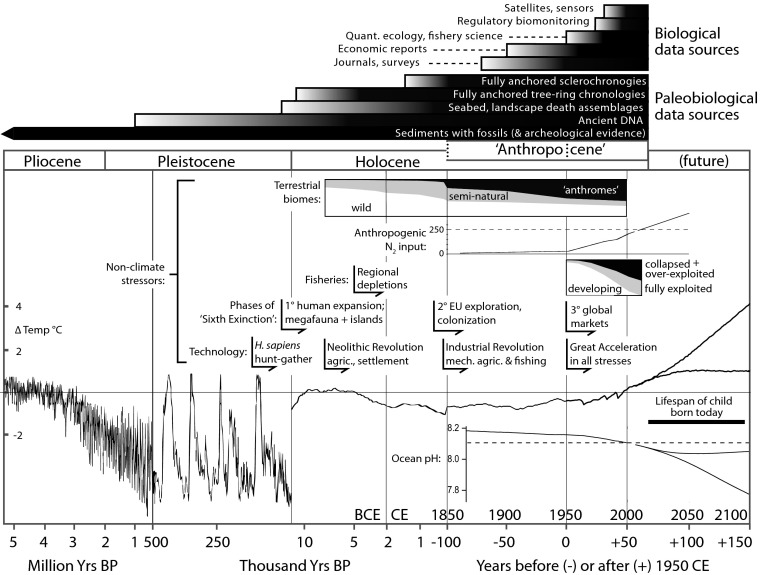
With overwhelming evidence of change in habitats, biologists today must assume that few, if any, study areas are natural and that biological variability is superimposed on trends rather than stationary means. Paleobiological data from the youngest sedimentary record, including death assemblages actively accumulating on modern land surfaces and seabeds, provide unique information on the status of present-day species, communities, and biomes over the last few decades to millennia and on their responses to natural and anthropogenic environmental change. Key advances have established the accuracy and resolving power of paleobiological information derived from naturally preserved remains and of proxy evidence for environmental conditions and sample age so that fossil data can both implicate and exonerate human stressors as the drivers of biotic change and permit the effects of multiple stressors to be disentangled. Legacy effects from Industrial and even pre-Industrial anthropogenic extirpations, introductions, (de)nutrification, and habitat conversion commonly emerge as the primary factors underlying the present-day status of populations and communities; within the last 2 million years, climate change has rarely been sufficient to drive major extinction pulses absent other human pressures, which are now manifold. Young fossil records also provide rigorous access to the baseline composition and dynamics of modern-day biota under pre-Industrial conditions, where insights include the millennial-scale persistence of community structures, the dominant role of physical environmental conditions rather than biotic interactions in determining community composition and disassembly, and the existence of naturally alternating states.
Keywords: biodiversity; conservation; ecology; paleobiology; paleoecology.
Conflict of interest statement
The author declares no conflict of interest.
Figures
References
-
- Crutzen PJ. Geology of mankind. Nature. 2002;415(6867):23. - PubMed
-
- Steffen W, Grinevald J, Crutzen P, McNeill J. The Anthropocene: Conceptual and historical perspectives. Philos Trans A Math Phys Eng Sci. 2011;369(1938):842–867. - PubMed
-
- Doney SC, et al. Climate change impacts on marine ecosystems. Annu Rev Mar Sci. 2012;4:11–37. - PubMed
-
- Poloczanska ES, et al. Global imprint of climate change on marine life. Nat Clim Chang. 2013;3(10):919–925.
Publication types
MeSH terms
LinkOut - more resources
Full Text Sources
Other Literature Sources
