. 2015 Apr 22:6:6884.
doi: 10.1038/ncomms7884.

Tunable solid-state fluorescent materials for supramolecular encryption

Affiliations

Tunable solid-state fluorescent materials for supramolecular encryption

Xisen Hou et al. Nat Commun. .

Abstract

Tunable solid-state fluorescent materials are ideal for applications in security printing technologies. A document possesses a high level of security if its encrypted information can be authenticated without being decoded, while also being resistant to counterfeiting. Herein, we describe a heterorotaxane with tunable solid-state fluorescent emissions enabled through reversible manipulation of its aggregation by supramolecular encapsulation. The dynamic nature of this fluorescent material is based on a complex set of equilibria, whose fluorescence output depends non-linearly on the chemical inputs and the composition of the paper. By applying this system in fluorescent security inks, the information encoded in polychromic images can be protected in such a way that it is close to impossible to reverse engineer, as well as being easy to verify. This system constitutes a unique application of responsive complex equilibria in the form of a cryptographic algorithm that protects valuable information printed using tunable solid-state fluorescent materials.


Figures
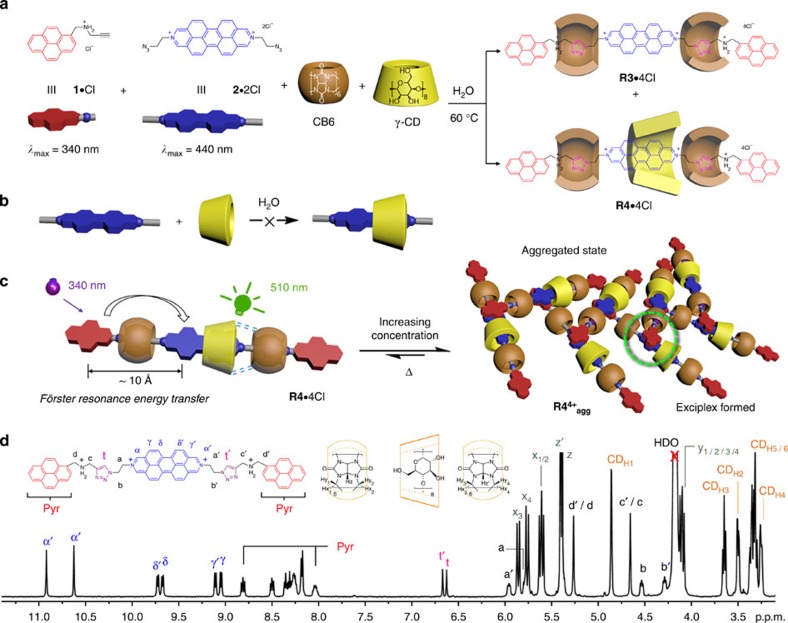
Figure 1
Figure 1. Synthesis and characterization of heterorotaxanes.
(a) Synthesis of the heterorotaxanes R3·4Cl and R4·4Cl from the stopper 1·Cl, the dumbbell precursor 2·2Cl, CB6 and γ-CD. (b) No complexation was observed between 2·2Cl and γ-CD. (c) Graphical representation of the aggregation of R44+ monomers in response to changes in concentration or temperature. (d) 1H NMR spectrum (600 MHz) of R4·4Cl (1 mM) recorded in D2O at 80 °C.
Figure 2
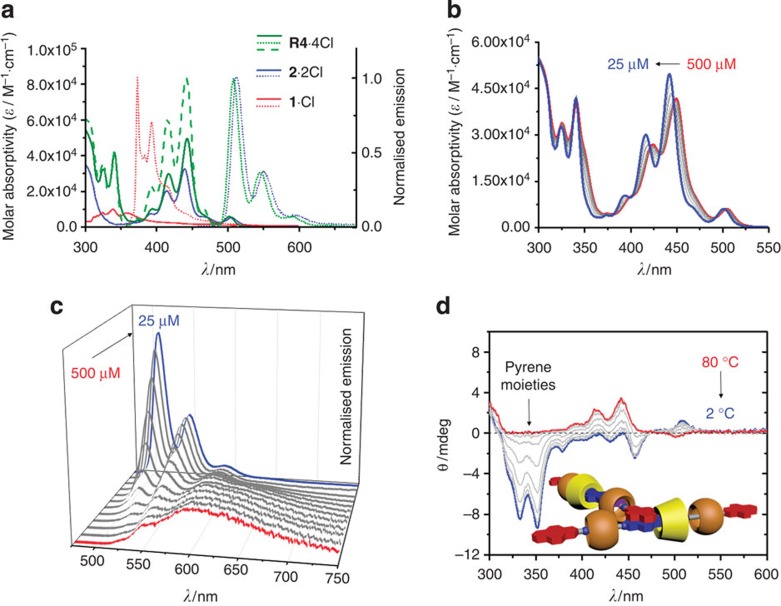
Figure 2. Photophysical studies of R4·4Cl.
(a) UV/Vis absorption (solid lines) and normalised fluorescence spectra (excitation: dashed lines, emission: dotted lines) of aqueous solutions of R4·4Cl (green), stopper 1·Cl (red) and dumbbell precursor 2·2Cl (blue). (b) Concentration-dependent (25–500 μM) UV/Vis absorption spectra of R4·4Cl at 25 °C in water. (c) Normalised concentration-dependent (25–500 μM) fluorescence emission spectra (λexcitation=341 nm) of R4·4Cl at 25 °C in water. (d) Temperature-dependent (2–80 °C) ICD spectra (200 μM) of R4·4Cl in water.
Figure 3
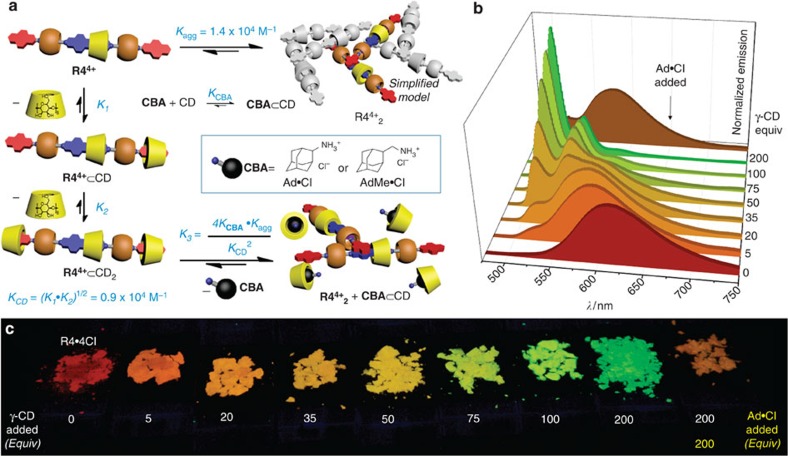
Figure 3. Equilibrium network and solid-state fluorescence studies.
(a) Graphical representation of the equilibria involving R44+ as its Cl salt in the presence of γ-CD and CBAs. (b) Solid-state fluorescence spectra (λexcitation=347 nm) of R4·4Cl on adding 0–200 equiv. of γ-CD, followed by 200 equiv. of Ad·Cl. (c) Powders obtained from homogeneous mixtures of R4·4Cl and varying amounts (0–200 equiv) of γ-CD and Ad·Cl (200 equiv) under UV light.
Figure 4
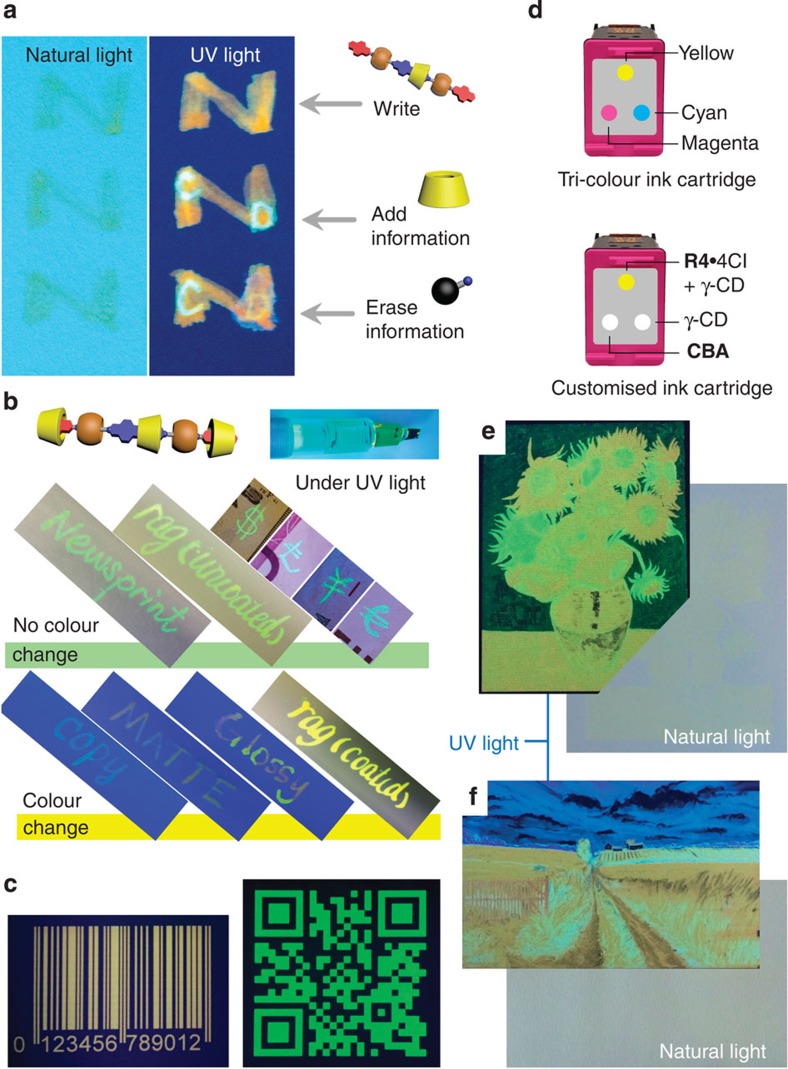
Figure 4. Security features of the heterorotaxane R44+- and its complex R44+⊂CD2-based fluorescent inks.
(a) Reversibly adding and erasing information on the fluorescent ink with γ-CD and Ad·Cl aqueous solution. (b) Surface-dependent fluorescence of R44+CD2 ink on different paper media (newsprint, coated and uncoated rag paper, banknotes, copy, matte and glossy white paper) under UV light. (c) A UV barcode and a QR code under UV light printed using a customized black inkjet cartridge filled with R44+ and R44+⊂CD2 ink, respectively. (d) Graphical representations of a customized tri-colour inkjet cartridge, in which aqueous solutions of R4·4Cl/γ-CD (R4·4Cl: 1 mM, γ-CD: 200 mM), a CBA and γ-CD occupy the yellow, magenta and cyan colour channels, respectively. (e) Fluorescent replica of van Gogh's ‘Sunflowers' on rag paper printed using the customized tri-colour inkjet cartridge under UV and natural light. (f) Fluorescent image printed using an inkjet cartridge under UV and natural light, in which the cyan channel was loaded with γ-CD and PyMe·Cl.
Figure 5
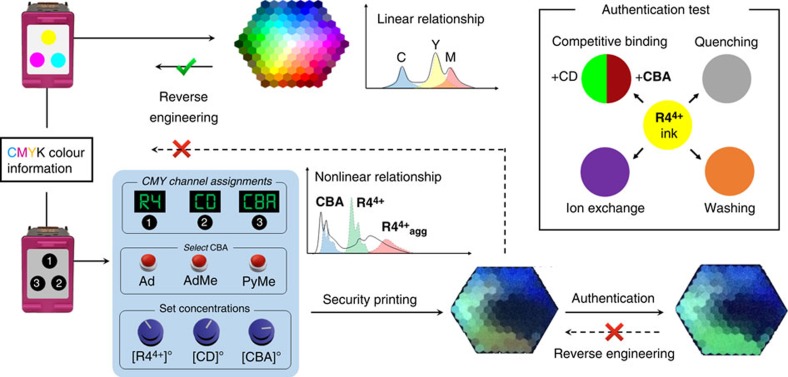
Figure 5. Supramolecular encryption and fraud detection using the heterorotaxane-based fluorescent security inks.
A comparison between conventional cyan-magenta-yellow-black (CMYK) printing and supramolecular encrypted printing technology. Inset: possible mechanisms to verify the authenticity of the protected colour document.
Figure 6
Figure 6. Demonstration of the supramolecular encryption and authentication using the heterorotaxane-based fluorescent security inks.
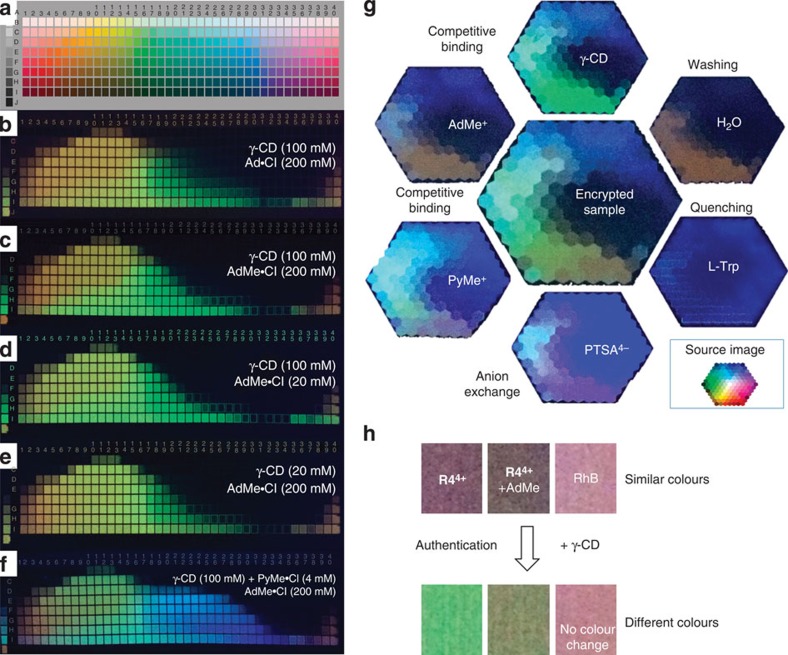
(a) A standard colour palette. (bf) Colour palette images produced using the customized tri-colour inkjet cartridge with (b) Ad·Cl (200 mM), (c) AdMe·Cl (200 mM) and (d) AdMe·Cl (20 mM) in channel , (e) γ-CD (20 mM) and (f) γ-CD (100 mM) with PyMe·Cl (4 mM) in channel , respectively. R4·4Cl+γ-CD (R4·4Cl: 1 mM, γ-CD: 40 mM) solution was loaded in channel in the tri-colour inkjet cartridge. (g) Encrypted polychromic colour palette samples produced by the customized inkjet cartridge (centre) and its derivatives (around the periphery, after printing a layer of authentication reagents) under UV light. (h) Similar colours produced by R44+-based security inks have composition-dependent response after chemical authentication. No distinguishable colour change is observed after chemical authentication when rhodamine B (RhB) is applied as the fluorescent ink.

References

    1. Hide F. et al. Semiconducting polymers: a new class of solid-state laser materials. Science 273, 1833–1836 (1996).
    1. Zhu X. H., Peng J. B., Caoa Y. & Roncali J. Solution-processable single-material molecular emitters for organic light-emitting devices. Chem. Soc. Rev. 40, 3509–3524 (2011). - PubMed
    1. Santra M. et al. Dramatic substituent effects on the photoluminescence of boron complexes of 2-(benzothiazol-2-yl)phenols. Chem. Eur. J. 18, 9886–9893 (2012). - PubMed
    1. Sasabe H. et al. 3,3′-Bicarbazole-based host materials for high-efficiency blue phosphorescent OLEDs with extremely low driving voltage. Adv. Mater. 24, 3212–3217 (2012). - PubMed
    1. Kumar K. et al. Printing colour at the optical diffraction limit. Nat. Nanotechnol. 7, 557–561 (2012). - PubMed

Publication types