


Association between monovalent influenza A (H1N1) pdm09 vaccine and pneumonia among the elderly in the 2009-2010 season in Japan: A case-control study
- PMID: 25901995
- PMCID: PMC4514410
- DOI: 10.1080/21645515.2015.1016668
Association between monovalent influenza A (H1N1) pdm09 vaccine and pneumonia among the elderly in the 2009-2010 season in Japan: A case-control study
Erratum in
-
Corrigendum.Hum Vaccin Immunother. 2015;11(10):2510. doi: 10.1080/21645515.2015.1082393. Hum Vaccin Immunother. 2015. PMID: 26376017 Free PMC article. No abstract available.
Abstract
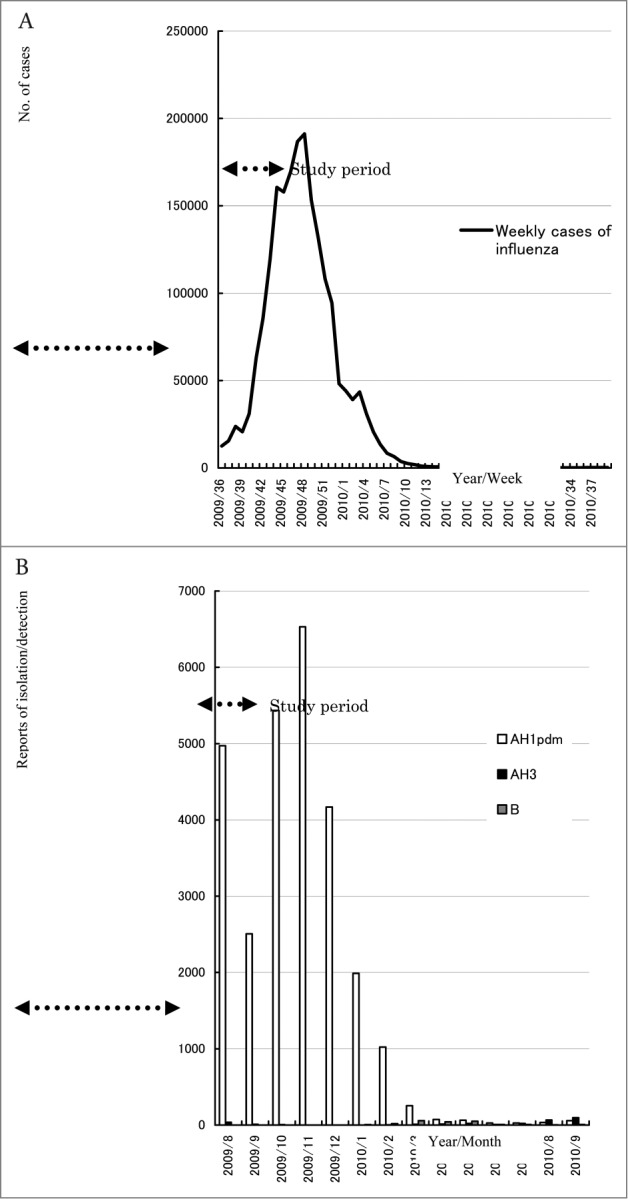
We investigated the association between monovalent influenza A (H1N1) pdm09 (H1N1pdm) vaccine and pneumonia in elderly people. Study design was a hospital-based, matched case-control study. Cases comprised patients ≥ 65 years old who had been newly diagnosed with pneumonia. For each case, 2 controls were defined as individuals with other diseases (not pneumonia) who were matched by sex, age, entry date, and the visited hospital. Study period was the interval from 1 September 2009 until 30 September 2010. Because a pandemic of influenza A (H1N1) occurred during study period, we analyzed selected subjects who had enrolled during the influenza A (H1N1) pandemic. We calculated the odds ratios (ORs) and 95% confidence intervals (CIs) for pneumonia in H1N1pdm-vaccinated subjects compared with unvaccinated subjects using a conditional logistic regression model to assess the association between H1N1pdm vaccine and pneumonia. The subjects during the period of the influenza A (H1N1) pandemic were 20 cases and 40 controls. Subjects who had received H1N1pdm vaccine showed a significantly decreased OR for pneumonia (OR = 0.10, 95% CI = 0.01-0.98) compared with unvaccinated subjects. In conclusion, H1N1pdm vaccination may have prevented pneumonia among the elderly during the 2009-2010 influenza A (H1N1) pandemic in Japan.
Keywords: ADL, activities of daily living; CI, confidence interval; COPD, chronic obstructive pulmonary disease; H1N1pdm, monovalent influenza A (H1N1) pdm09; OR, odds ratio; TIV, trivalent seasonal influenza vaccine; effectiveness; elderly people; matched case-control study; monovalent influenza A (H1N1) pdm09 vaccine; pneumonia.
Figures
References
-
- Ministry of Health, Labour and Welfare. Annual Statistical Report of National Health Conditions and Health Promotion 2009 2009 Tokyo: Health, Labour and Welfare Statistical Association, [in Japanese].
-
- Chan TC, Hung IF, Luk JK, Shea YF, Chan FH, Woo PC, Chu LW. Efficacy of dual vaccination of pandemic H1N1 2009 influenza and seasonal influenza on institutionalized elderly: a one-year prospective cohort study. Vaccine 2011; 29:7773–8; PMID:21821084; http://dx.doi.org/ 10.1016/j.vaccine.2011.07.112 - DOI - PubMed
-
- Mullooly JP, Bennett MD, Hornbrook MC, Barker WH, Williams WW, Patriarca PA, Rhodes PH. Influenza vaccination programs for elderly persons: cost-effectiveness in a health maintenance organization. Ann Intern Med 1994; 121:947–52; PMID:7978721; http://dx.doi.org/ 10.7326/0003-4819-121-12-199412150-00008 - DOI - PubMed
-
- Nichol KL, Nordin JD, Nelson DB, Mullooly JP, Hak E. Effectiveness of influenza vaccine in the community-dwelling elderly. N Engl J Med 2007; 357:1373–81; PMID:17914038; http://dx.doi.org/ 10.1056/NEJMoa070844 - DOI - PubMed
-
- Nichol KL, Wuorenma J, Sternberg T. Benefits of influenza vaccination for low-, intermediate-, and high-risk senior citizens. Arch Intern Med 1998; 158:1769–76; PMID:9738606; http://dx.doi.org/ 10.1001/archinte.158.16.1769 - DOI - PubMed
Publication types
MeSH terms
Substances
LinkOut - more resources
Full Text Sources
Other Literature Sources
Medical
