


Plasma Free Hemoglobin Is an Independent Predictor of Mortality among Patients on Extracorporeal Membrane Oxygenation Support
- PMID: 25902047
- PMCID: PMC4406730
- DOI: 10.1371/journal.pone.0124034
Plasma Free Hemoglobin Is an Independent Predictor of Mortality among Patients on Extracorporeal Membrane Oxygenation Support
Abstract
Background: Hemolysis is common in all extracorporeal circuits as evident by the elevated plasma free hemoglobin (PFHb) level. We investigated whether increased hemolysis during extracorporeal membrane oxygenation (ECMO) is an independent mortality predictor.
Methods: We performed a retrospective observational study of consecutive subjects who received ECMO at a tertiary care facility from 2007-2013 to investigate independent predictors of in-hospital mortality. We examined variables related to patient demographics, comorbidities, markers of hemolysis, ECMO characteristics, transfusion requirements, and complications. 24-hour PFHb > 50 mg/dL was used as a marker of severe hemolysis.
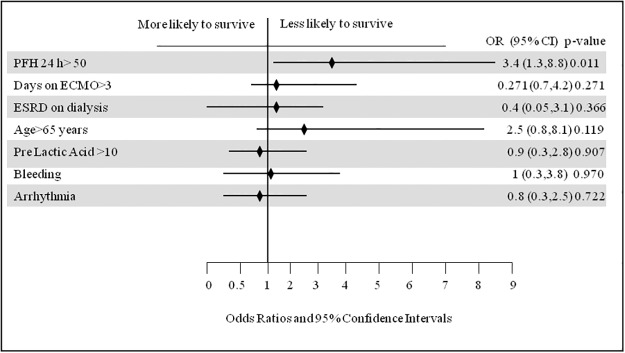
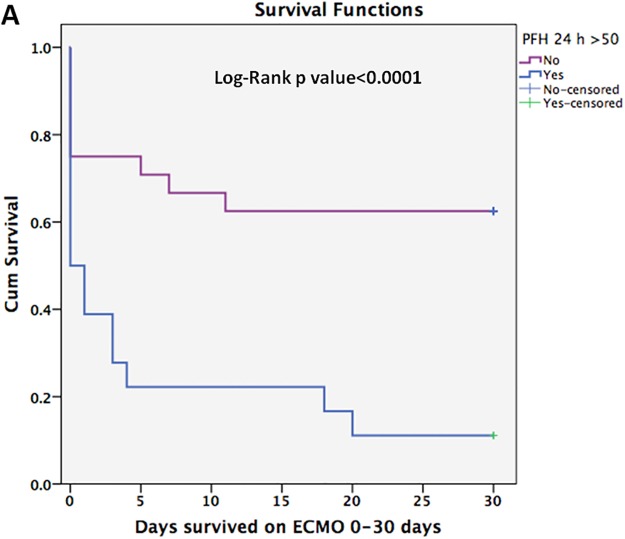
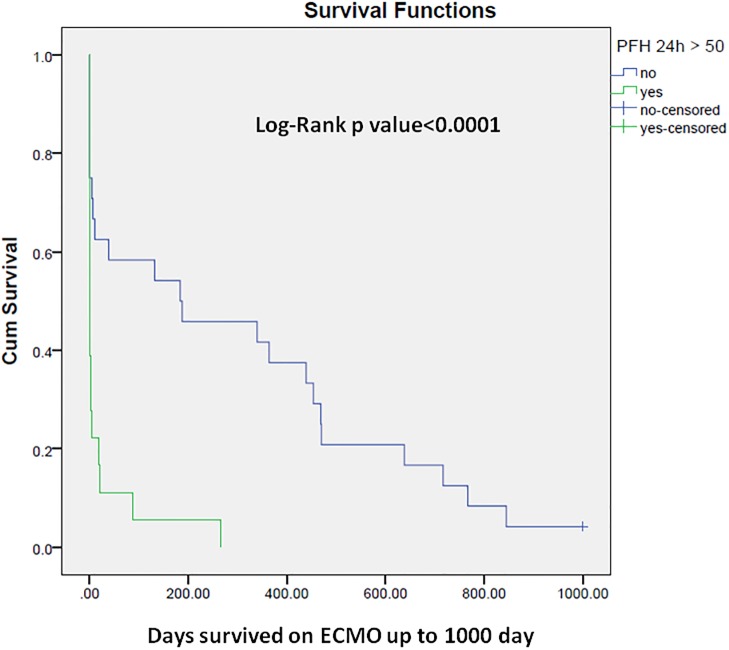
Results: 154 patients received ECMO for cardiac (n = 115) or pulmonary (n = 39) indications. Patients' mean age was 51 years and 75.3% were males. Compared to nonsurvivors, survivors had lower pre-ECMO lactic acid (p = 0.026), lower 24-hour lactic acid (p = 0.023), shorter ECMO duration (P = 0.01), fewer RBC transfusions on ECMO (p = 0.008) and lower level of PFHb 24-hours post ECMO implantation (p = 0.029). 24-hour PFHb > 50 mg/dL occurred in 3.9 % versus 15.5% of survivors and nonsurvivors, respectively, p = 0.002. A Cox proportional hazard analysis identified PFHb > 50 mg/dL 24-hours post ECMO as an independent predictor of mortality (OR= 3.4, 95% confidence interval: 1.3 - 8.8, p = 0.011).
Conclusion: PFHb > 50 mg/dL checked 24-hour post ECMO implantation is a useful tool to predict mortality. We propose the routine checking of PFHb 24-hours after ECMO initiation for early identification and treatment of the cause of hemolysis.
Conflict of interest statement
Figures
References
-
- Peek GJ, Mugford M, Tiruvoipati R, Wilson A, Allen E, Thalanany MM, et al. Efficacy and economic assessment of conventional ventilatory support versus extracorporeal membrane oxygenation for severe adult respiratory failure (CESAR): a multicentre randomised controlled trial. Lancet. 2009. October 17;374(9698):1351–63. 10.1016/S0140-6736(09)61069-2 - DOI - PubMed
-
- Conrad SA, Rycus PT, Dalton H. Extracorporeal Life Support registry report 2004. ASAIO J.2005;51:4–10. - PubMed
-
- Lin CY, Tsai FC, Tian YC, Jenq CC, Chen YC, Fang JT, et al. Evaluation of outcome scoring systems for patients on extracorporeal membrane oxygenation. Ann Thorac Surg. 2007. October;84(4):1256–62. - PubMed
-
- Lin CY, Chen YC, Tsai FC, Tian YC, Jenq CC, et al. RIFLE classification is predictive of short-term prognosis in critically ill patients with acute renal failure supported by extracorporeal membrane oxygenation. Nephrol Dial Transplant.2006;21:2867–2873. - PubMed
Publication types
MeSH terms
Substances
Grants and funding
LinkOut - more resources
Full Text Sources
Other Literature Sources
Medical
