. 2015 May 5;112(18):5797-802.
doi: 10.1073/pnas.1502390112. Epub 2015 Apr 20.

Cellular inhibitor of apoptosis proteins prevent clearance of hepatitis B virus

Affiliations

Cellular inhibitor of apoptosis proteins prevent clearance of hepatitis B virus

Gregor Ebert et al. Proc Natl Acad Sci U S A. .

Abstract

Hepatitis B virus (HBV) infection can result in a spectrum of outcomes from immune-mediated control to disease progression, cirrhosis, and liver cancer. The host molecular pathways that influence and contribute to these outcomes need to be defined. Using an immunocompetent mouse model of chronic HBV infection, we identified some of the host cellular and molecular factors that impact on infection outcomes. Here, we show that cellular inhibitor of apoptosis proteins (cIAPs) attenuate TNF signaling during hepatitis B infection, and they restrict the death of infected hepatocytes, thus allowing viral persistence. Animals with a liver-specific cIAP1 and total cIAP2 deficiency efficiently control HBV infection compared with WT mice. This phenotype was partly recapitulated in mice that were deficient in cIAP2 alone. These results indicate that antagonizing the function of cIAPs may promote the clearance of HBV infection.

Keywords: TNF; cIAP1; cIAP2; cellular inhibitor of apoptosis proteins; hepatitis B virus.


Conflict of interest statement

Conflict of interest statement: The Walter and Eliza Hall Institute of Medical Research has a research license agreement with TetraLogic Pharmaceuticals Corporation, Inc., the manufacturer of the cellular inhibitor of apoptosis protein antagonist birinapant. TetraLogic Pharmaceuticals Corporation, Inc. has filed a patent cooperation treaty application on behalf of The Walter and Eliza Hall Institute of Medical Research. J.S. is on the scientific advisory board of and M.P. provides consultative advice to TetraLogic Pharmaceuticals Corporation, Inc. J.S. has options on a small number of shares in TetraLogic Pharmaceuticals Corporation, Inc. C.G.B is employed by TetraLogic Pharmaceuticals Corporation, Inc.

Figures
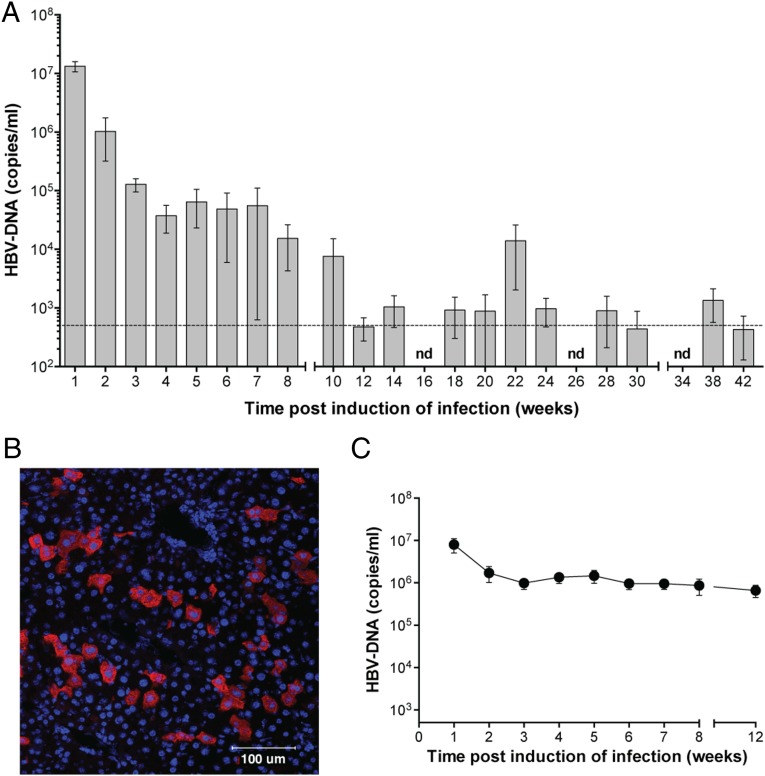
Fig. 1.
Fig. 1.
Two preclinical models of chronic HBV infection. (A) Serum HBV DNA levels in C57BL/6 mice after induction of infection over 42 wk. The horizontal line denotes the limit of detection for any single sample, and bars depicted below this limit represent the average of all samples at that time point, some of which were below and some of which were above the limit of detection (if all samples were below the detection limit, no bar is depicted; n = 10). (B) Immunofluorescence staining (blue DAPI and red HBcAg) of a liver section taken from an HBV-infected C57BL/6 mouse 1 wk after induction of infection (representative of n = 10). (C) Serial measurement of serum HBV DNA levels in C3H mice after induction of HBV infection (n = 6). Graphs show means and SEMs, and data are representative of (A and B) 10 or (C) 3 independent experiments that served as controls in the remainder of the study. Experiments were blinded. nd, not detected.
Fig. 2.
Fig. 2.
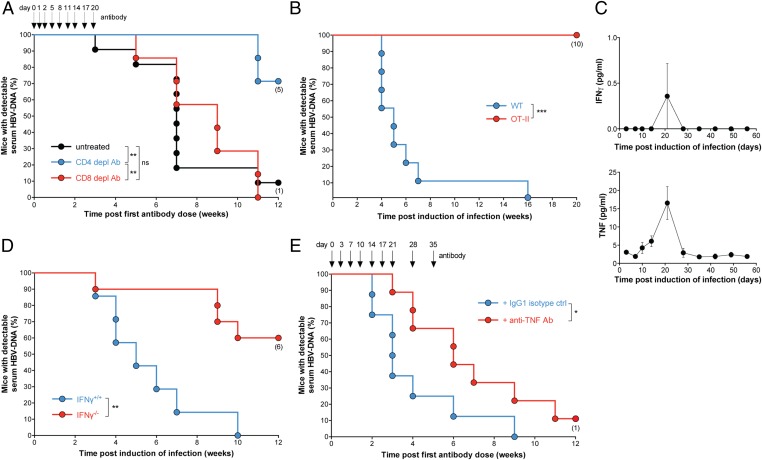
Control of HBV viremia in mice is dependent on CD4+ T cells, IFN-γ, and TNF. (A) Proportion of animals and time when C57BL/6 mice treated with the indicated antibodies or left untreated first achieved an undetectable serum HBV DNA level; CD8 and CD4 antibodies are of the same isotype and serve as controls for each other (arrows indicate timing of repeated antibody doses; n = 7–11 per group). (B) Proportion of animals and time when mice of the specified genotype first achieved an undetectable serum HBV DNA level (n = 9–10 per group). (C) Serial quantification of serum cytokine levels at the indicated time points after induction of HBV infection in C57BL/6 mice (n = 10). (D) Proportion of animals and time when mice of the indicated genotypes first achieved an undetectable serum HBV DNA level (n = 7–10). (E) Proportion of animals and time when mice treated with the indicated antibodies first achieved an undetectable serum HBV DNA level (arrows indicate timing of repeated antibody doses; n = 8–9 per group). Numbers below dots in time to event analyses represent remaining mice that have been censored. Graphs show means and SEMs, and data are representative of (A) three or (BE) two independent experiments. Experiments were blinded. ns, not significant. *P < 0.05; **P < 0.01; ***P < 0.001 (log-rank Mantel–Cox test).
Fig. 3.
Fig. 3.
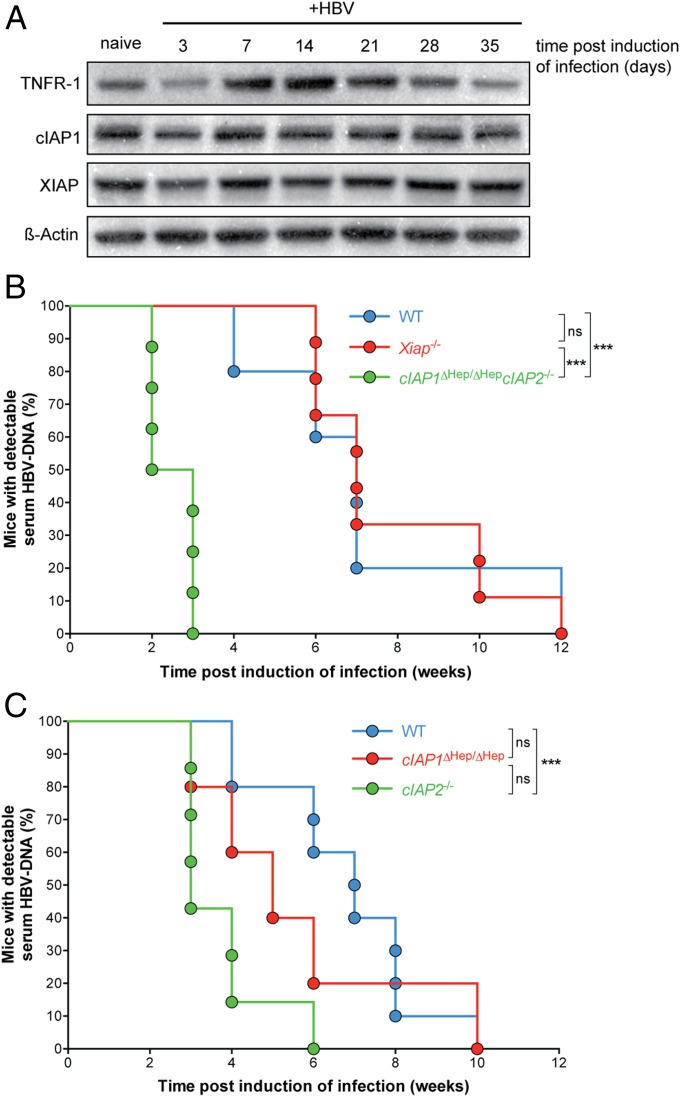
cIAPs restrict clearance of HBV. (A) Western blot analysis of liver protein levels after HBV infection in C57BL/6 mice at the indicated time points posthydrodynamic injection. (B and C) Proportion of animals and time when mice of the indicated genotypes first achieved an undetectable serum HBV DNA level (n = 5–9 for each group). Data are representative of three independent experiments. Experiments were blinded. ns, not significant. ***P < 0.001 (log-rank Mantel–Cox test).
Fig. 4.
Fig. 4.
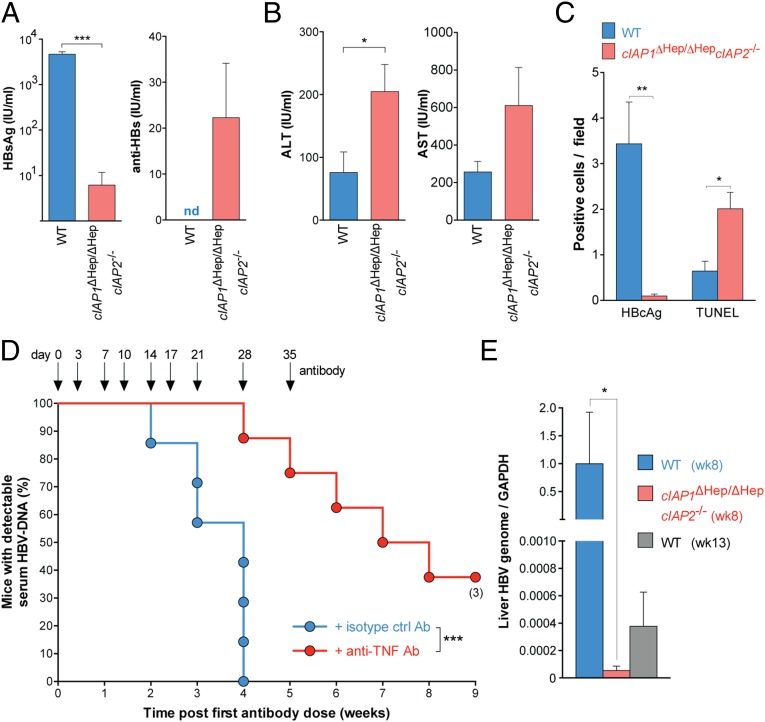
Deficiency of cIAPs promotes TNF-mediated clearance of HBV infection. (A and B) Serological HBV assays and serum transaminase levels performed 2 wk after induction of infection in mice of the indicated genotypes (n = 5 in each group). (C) Quantification of TUNEL staining and HBcAg expression in liver sections taken from HBV-infected mice 2 wk after induction of infection (n = 3–5 in each group). (D) Proportion of animals and time when cIAP1ΔHep/ΔHepcIAP2−/− mice treated with the indicated antibodies first achieved an undetectable serum HBV DNA level (n = 7–8 for each group). (E) RT-PCR of HBV DNA relative to GAPDH in the liver of infected mice with the indicated genotypes and at the indicated times (n = 4 in each group). Numbers below dots in time to event analyses represent remaining mice that have been censored. Graphs show means and SEMs, and data are representative of two independent experiments. (A, B, D, and E) Experiments were blinded. ALT, alanine aminotransferase; AST, aspartate aminotransferase; nd, not detected. *P < 0.05; **P < 0.01; ***P < 0.001 (A and B, unpaired two-tailed t test; C, unpaired two-tailed t test with Holm–Sidak correction; D, log-rank Mantel–Cox test; and E, Mann–Whitney test).

References

    1. WHO Hepatitis B vaccines. Wkly Epidemiol Rec. 2009;84(40):405–419. - PubMed
    1. Lozano R, et al. Global and regional mortality from 235 causes of death for 20 age groups in 1990 and 2010: A systematic analysis for the Global Burden of Disease Study 2010. Lancet. 2012;380(9859):2095–2128. - PMC - PubMed
    1. Ganem D, Prince AM. Hepatitis B virus infection—natural history and clinical consequences. N Engl J Med. 2004;350(11):1118–1129. - PubMed
    1. Shale MJ, et al. Review article: Chronic viral infection in the anti-tumour necrosis factor therapy era in inflammatory bowel disease. Aliment Pharmacol Ther. 2010;31(1):20–34. - PubMed
    1. Vassilopoulos D, Calabrese LH. Risks of immunosuppressive therapies including biologic agents in patients with rheumatic diseases and co-existing chronic viral infections. Curr Opin Rheumatol. 2007;19(6):619–625. - PubMed

Publication types

MeSH terms