. 2015 May 5;112(18):5803-8.
doi: 10.1073/pnas.1502400112. Epub 2015 Apr 20.

Eliminating hepatitis B by antagonizing cellular inhibitors of apoptosis

Affiliations

Eliminating hepatitis B by antagonizing cellular inhibitors of apoptosis

Gregor Ebert et al. Proc Natl Acad Sci U S A. .

Abstract

We have shown that cellular inhibitor of apoptosis proteins (cIAPs) impair clearance of hepatitis B virus (HBV) infection by preventing TNF-mediated killing/death of infected cells. A key question, with profound therapeutic implications, is whether this finding can be translated to the development of drugs that promote elimination of infected cells. Drug inhibitors of cIAPs were developed as cancer therapeutics to promote TNF-mediated tumor killing. These drugs are also known as Smac mimetics, because they mimic the action of the endogenous protein Smac/Diablo that antagonizes cIAP function. Here, we show using an immunocompetent mouse model of chronic HBV infection that birinapant and other Smac mimetics are able to rapidly reduce serum HBV DNA and serum HBV surface antigen, and they promote the elimination of hepatocytes containing HBV core antigen. The efficacy of Smac mimetics in treating HBV infection is dependent on their chemistry, host CD4(+) T cells, and TNF. Birinapant enhances the ability of entecavir, an antiviral nucleoside analog, to reduce viral DNA production in HBV-infected animals. These results indicate that birinapant and other Smac mimetics may have efficacy in treating HBV infection and perhaps, other intracellular infections.

Keywords: Smac mimetic; TNF; birinapant; cellular inhibitor of apoptosis proteins; hepatitis B virus.


Conflict of interest statement

Conflict of interest statement: The Walter and Eliza Hall Institute of Medical Research has a research license agreement with TetraLogic Pharmaceuticals Corporation, Inc., the manufacturer of the cellular inhibitor of apoptosis protein antagonist birinapant. TetraLogic Pharmaceuticals Corporation, Inc. has filed a patent cooperation treaty application on behalf of The Walter and Eliza Hall Institute of Medical Research. J.S. is on the scientific advisory board of and M.P. provides consultative advice to TetraLogic Pharmaceuticals Corporation, Inc. J.S. has options on a small number of shares in TetraLogic Pharmaceuticals Corporation, Inc. C.G.B. is employed by TetraLogic Pharmaceuticals Corporation, Inc.

Figures
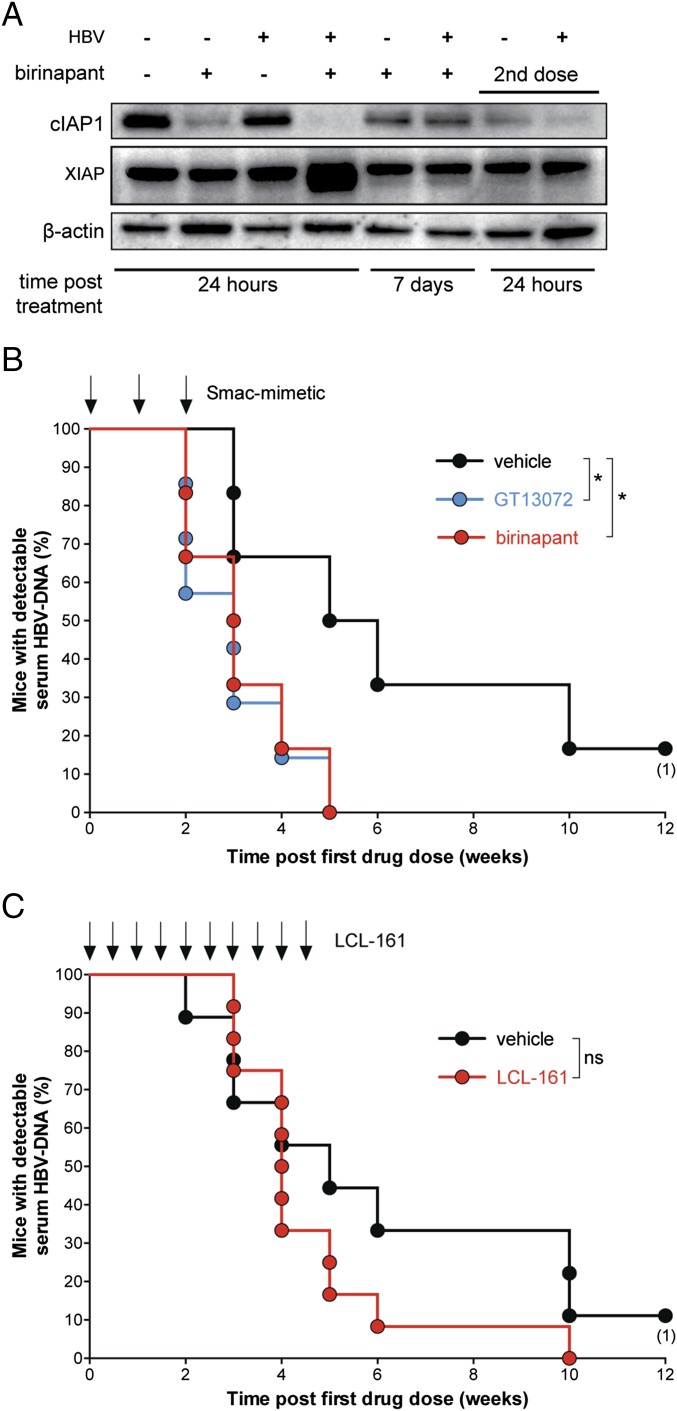
Fig. 1.
Fig. 1.
Birinapant promotes clearance of HBV. (A) Western blot analysis of protein levels in the liver of HBV-infected mice 1 wk postinduction of infection or uninfected mice at the indicated time points after a single dose of birinapant treatment and a second dose of birinapant administered 7 d after the first dose. (B) Proportion of animals and time when mice treated with the indicated compound starting 1 wk after induction of infection and administered once weekly for 3 wk first achieved an undetectable serum HBV DNA level (n = 6–7 for each group). (C) Proportion of animals and time when mice treated with the indicated compound starting 1 wk after induction of infection and administered as indicated (arrows) first achieved an undetectable serum HBV DNA level (n = 9–12 for each group). Vehicle treatment differed across experiments [(B) weekly DMSO injections or (C) daily gavage with vehicle], and therefore, results should not be compared across experiments. Numbers below dots in time to event analyses represent remaining mice that have been censored. Data are representative of (A) three or (B and C) two independent experiments. (B and C) Experiments were performed blinded. ns, not significant. *P < 0.05 (log-rank Mantel–Cox test).
Fig. 2.
Fig. 2.
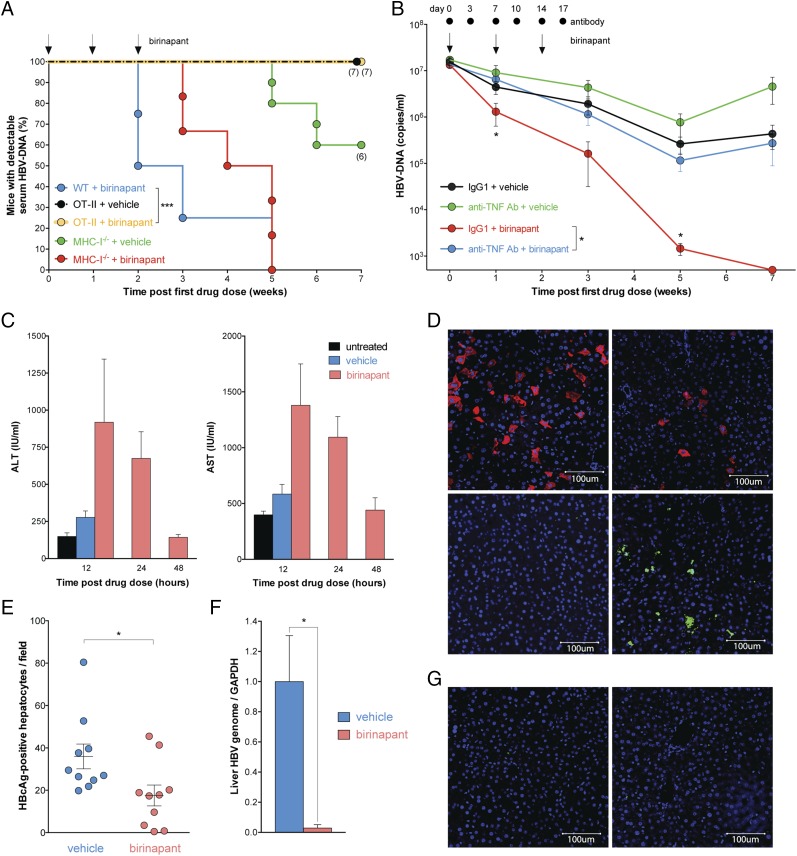
Birinapant sensitizes HBV-infected hepatocytes to TNF-mediated killing. (A) Proportion of animals and time when mice with the specified genotypes treated with birinapant or vehicle commencing 1 wk after induction of infection at the times indicated by arrows first achieved an undetectable serum HBV DNA level (n = 4–10 in each group). (B) Serial serum HBV DNA levels in C57BL/6 mice treated with birinapant (arrows) and TNF-neutralizing antibody or isotype control (dots) commencing 1 wk after induction of infection (n = 7–16 per group). (C) Serum transaminase levels quantified at the indicated times in HBV-infected untreated mice or mice treated with a single dose of birinapant (10 mg/kg) or vehicle 1 wk postinduction of infection (n = 4–5 in each group). (D) Immunofluorescence staining (blue DAPI and red HBcAg in Upper and blue DAPI and green TUNEL in Lower) of liver sections from HBV-infected C57BL/6 mice 12 h after treatment with (Right) a single dose of 10 mg/kg birinapant or (Left) vehicle administered 2 wk postinduction of infection (representative of n = 6 each group). (E) Number of HBV-infected hepatocytes (described and treated as in D) expressing HBcAg (n = 10 for each group). (F) RT-PCR of HBV DNA relative to GAPDH in the liver of infected C57BL/6 mice treated with birinapant or vehicle (as described in A above) 7 wk after induction of infection (n = 5 in each group). (G) Immunofluorescence staining (blue DAPI and green TUNEL) of liver sections from uninfected C57BL/6 mice 12 h after treatment with a single dose of (Right) 10 mg/kg birinapant or (Left) vehicle (representative of n = 3 in each group). Numbers below dots in time to event analyses represent remaining mice that have been censored. (AE and G) Graphs show means and SEMs, and data are representative of two independent experiments. (AC) Experiments were performed blinded. ALT, alanine aminotransferase; AST, aspartate aminotransferase. *P < 0.05; ***P < 0.001 (A, log-rank Mantel–Cox test; B, unpaired two-tailed t test with Holm–Sidak correction; E, unpaired two-tailed t test; and F, Mann–Whitney test).
Fig. 3.
Fig. 3.
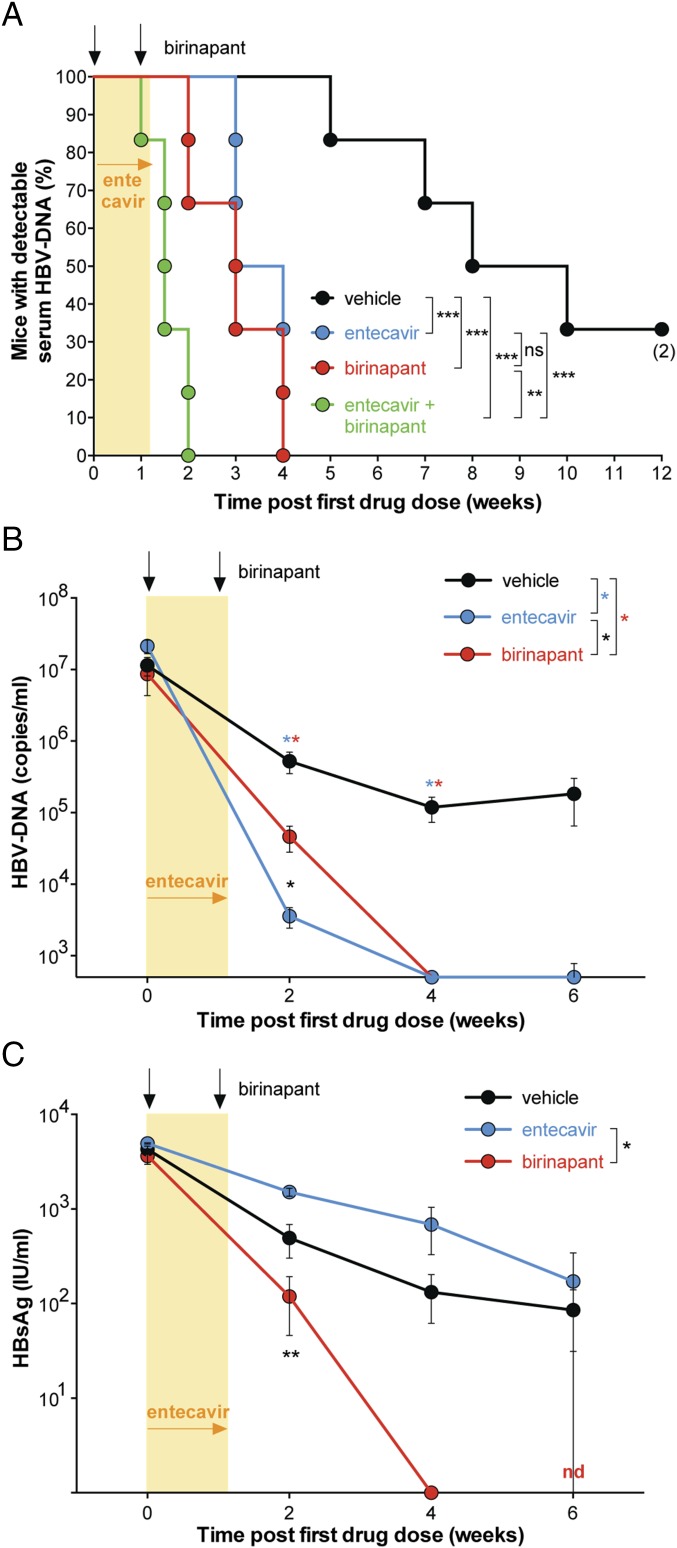
Birinapant enhances the efficacy of entecavir. (A) Proportion of animals and time when C57BL/6 mice treated with the specified compounds (shaded area, entecavir; arrows, birinapant doses starting 1 wk after induction of infection) first achieved an undetectable serum HBV DNA level (n = 6 for each group). (B and C) A direct comparison of (B) serum HBV DNA and (C) serum HBsAg levels in the same animals during the course of infection/treatment described in A above (n = 6 for each group). Numbers below dots in time to event analyses represent remaining mice that have been censored. Vehicle-treated mice in A received both injectable and oral vehicles, and birinapant- and entecavir-treated mice received the corresponding vehicle; therefore, these mice should not be compared across other experiments. Graphs show means and SEMs. Experiments were performed blinded. nd, Not detected; ns, not significant. *P < 0.05; **P < 0.01; ***P < 0.001 (A, log-rank Mantel–Cox test; and B and C, unpaired two-tailed t test with Holm–Sidak correction).
Fig. 4.
Fig. 4.
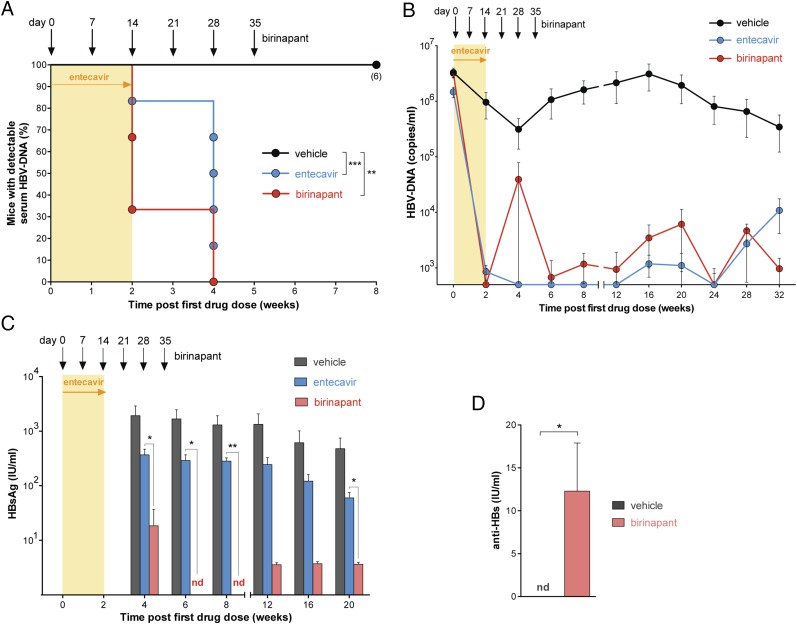
Birinapant promotes seroconversion. (A) Proportion of animals and time when C3H mice treated with the specified compounds (shaded area, entecavir; arrows, birinapant doses starting 1 wk after infection) first achieved an undetectable serum HBV DNA level (n = 3–6 for each group). (B) Serial measurement of serum HBV DNA levels in C3H mice treated as described in A above (n = 3–6 for each group). (C) Serum HBsAg levels in C3H mice treated as described in A (n = 3–6). (D) HBsAb in C3H mice treated with birinapant or vehicle as described in A quantified 7 wk after commencement of drug (n = 4–5). Numbers below dots in time to event analyses represent remaining mice that have been censored. Graphs show means and SEMs. Experiments were performed blinded. *P < 0.05; **P < 0.01; ***P < 0.001 (A, log-rank Mantel–Cox test; C, unpaired two-tailed t-test with Holm–Sidak correction; and D, unpaired two-tailed t test).

References

    1. Ebert G, et al. Cellular inhibitor of apoptosis proteins prevent clearance of hepatitis B virus. Proc Natl Acad Sci USA. 2015;112:5797–5802. - PMC - PubMed
    1. Yang PL, et al. Immune effectors required for hepatitis B virus clearance. Proc Natl Acad Sci USA. 2010;107(2):798–802. - PMC - PubMed
    1. Lee YH, Bae SC, Song GG. Hepatitis B virus (HBV) reactivation in rheumatic patients with hepatitis core antigen (HBV occult carriers) undergoing anti-tumor necrosis factor therapy. Clin Exp Rheumatol. 2013;31(1):118–121. - PubMed
    1. Lan JL, et al. Kinetics of viral loads and risk of hepatitis B virus reactivation in hepatitis B core antibody-positive rheumatoid arthritis patients undergoing anti-tumour necrosis factor alpha therapy. Ann Rheum Dis. 2011;70(10):1719–1725. - PubMed
    1. Silke J. The regulation of TNF signalling: What a tangled web we weave. Curr Opin Immunol. 2011;23(5):620–626. - PubMed

Publication types

MeSH terms