


HIV service delivery models towards 'Zero AIDS-related Deaths': a collaborative case study of 6 Asia and Pacific countries
- PMID: 25902708
- PMCID: PMC4421992
- DOI: 10.1186/s12913-015-0804-5
HIV service delivery models towards 'Zero AIDS-related Deaths': a collaborative case study of 6 Asia and Pacific countries
Abstract
Background: In the Asia-Pacific region, limited systematic assessment has been conducted on HIV service delivery models. Applying an analytical framework of the continuum of prevention and care, this study aimed to assess HIV service deliveries in six Asia and Pacific countries from the perspective of service availability, linking approaches and performance monitoring for maximizing HIV case detection and retention.
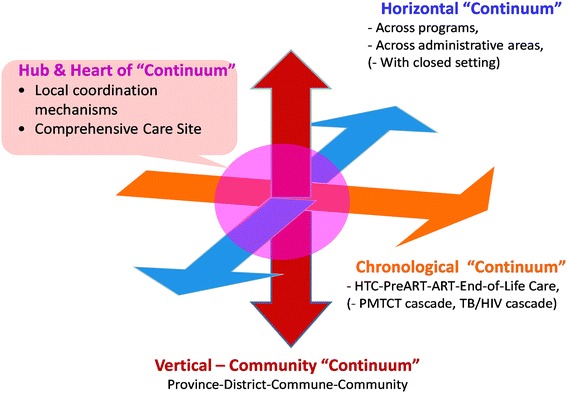
Methods: Each country formed a review team that provided published and unpublished information from the national HIV program. Four types of continuum were examined: (i) service linkages between key population outreach and HIV diagnosis (vertical-community continuum); (ii) chronic care provision across HIV diagnosis and treatment (chronological continuum); (iii) linkages between HIV and other health services (horizontal continuum); and (iv) comprehensive care sites coordinating care provision (hub and heart of continuum).
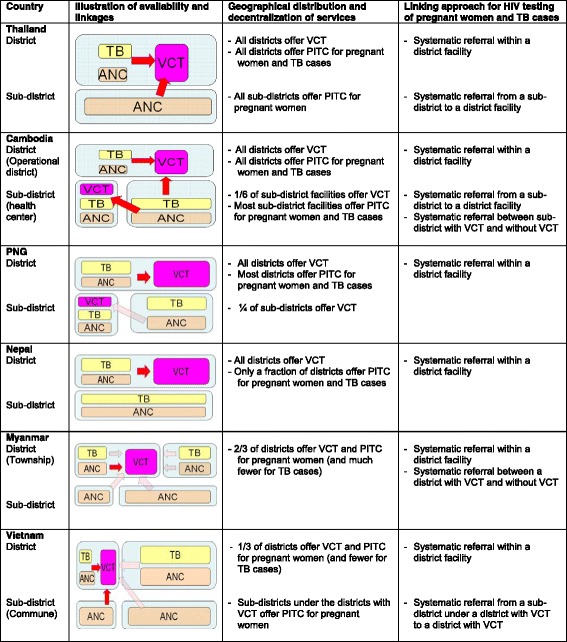
Results: Regarding the vertical-community continuum, all districts had voluntary counselling and testing (VCT) in all countries except for Myanmar and Vietnam. In these two countries, limited VCT availability was a constraint for referring key populations reached. All countries monitored HIV testing coverage among key populations. Concerning the chronological continuum, the proportion of districts/townships having antiretroviral treatment (ART) was less than 70% except in Thailand, posing a barrier for accessing pre-ART/ART care. Mechanisms for providing chronic care and monitoring retention were less developed for VCT/pre-ART process compared to ART process in all countries. On the horizontal continuum, the availability of HIV testing for tuberculosis patients and pregnant women was limited and there were sub-optimal linkages between tuberculosis, antenatal care and HIV services except for Cambodia and Thailand. These two countries indicated higher HIV testing coverage than other countries. Regarding hub and heart of continuum, all countries had comprehensive care sites with different degrees of community involvement.
Conclusions: The analytical framework was useful to identify similarities and considerable variations in service availability and linking approaches across the countries. The study findings would help each country critically adapt and adopt global recommendations on HIV service decentralization, linkages and integration. Especially, the findings would inform cross-fertilization among the countries and national HIV program reviews to determine county-specific measures for maximizing HIV case detection and retention.
Figures
References
-
- Joint United Nations Programme on HIV/AIDS . HIV in Asia and the Pacific: UNAIDS Report 2013. Bangkok: Joint United Nations Programme on HIV/AIDS; 2013. - PubMed
-
- Joint United Nations Programme on HIV/AIDS . Getting to Zero: UNAIDS Strategy 2011–2015. Geneva: Joint United Nations Programme on HIV/AIDS; 2010.
-
- World Health Organization . Global Health Sector Strategy on HIV/AIDS 2011–2015. Geneva: World Health Organization; 2011.
-
- The Global Fund to Fight AIDS, Tuberculosis and Malaria . The Global Fund Annual Report 2011. Geneva: The Global Fund to Fight AIDS, Tuberculosis and Malaria; 2011.
-
- World Health Organization and Joint United Nations Programme on HIV/AIDS . The treatment 2.0 framework for action: catalysing the next phase of treatment, care and support. Geneva: World Health Organization; 2011.
MeSH terms
Grants and funding
LinkOut - more resources
Full Text Sources
Other Literature Sources
Medical
