. 2015 Jun 12;290(24):15185-96.
doi: 10.1074/jbc.M115.644476. Epub 2015 Apr 22.

Streptozotocin Stimulates the Ion Channel TRPA1 Directly: INVOLVEMENT OF PEROXYNITRITE

Affiliations

Streptozotocin Stimulates the Ion Channel TRPA1 Directly: INVOLVEMENT OF PEROXYNITRITE

David A Andersson et al. J Biol Chem. .

Abstract

Streptozotocin (STZ)-induced diabetes is the most commonly used animal model of diabetes. Here, we have demonstrated that intraplantar injections of low dose STZ evoked acute polymodal hypersensitivities in mice. These hypersensitivities were inhibited by a TRPA1 antagonist and were absent in TRPA1-null mice. In wild type mice, systemic STZ treatment (180 mg/kg) evoked a loss of cold and mechanical sensitivity within an hour of injection, which lasted for at least 10 days. In contrast, Trpa1(-/-) mice developed mechanical, cold, and heat hypersensitivity 24 h after STZ. The TRPA1-dependent sensory loss produced by STZ occurs before the onset of diabetes and may thus not be readily distinguished from the similar sensory abnormalities produced by the ensuing diabetic neuropathy. In vitro, STZ activated TRPA1 in isolated sensory neurons, TRPA1 cell lines, and membrane patches. Mass spectrometry studies revealed that STZ oxidizes TRPA1 cysteines to disulfides and sulfenic acids. Furthermore, incubation of tyrosine with STZ resulted in formation of dityrosine, suggesting formation of peroxynitrite. Functional analysis of TRPA1 mutants showed that cysteine residues that were oxidized by STZ were important for TRPA1 responsiveness to STZ. Our results have identified oxidation of TRPA1 cysteine residues, most likely by peroxynitrite, as a novel mechanism of action of STZ. Direct stimulation of TRPA1 complicates the interpretation of results from STZ models of diabetic sensory neuropathy and strongly argues that more refined models of diabetic neuropathy should replace the use of STZ.

Keywords: diabetes; dorsal root ganglia; pain; reactive nitrogen species; reactive oxygen species; streptozotocin; transient receptor potential channels (TRP channels).


Figures

FIGURE 1.
FIGURE 1.
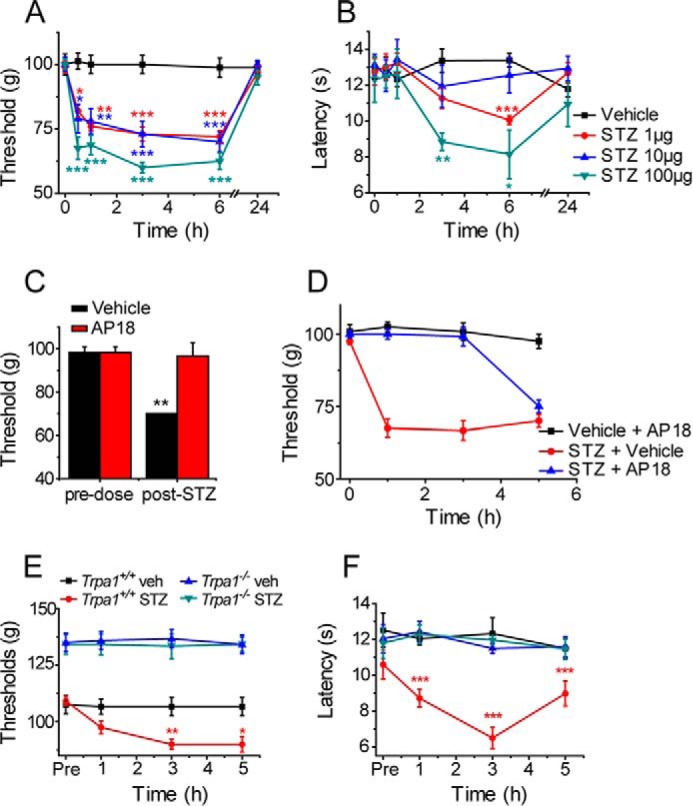
STZ is pronociceptive. Intraplantar injections of STZ reduced the paw pressure test withdrawal threshold (A) and cold-plate withdrawal latency (B) in mice (n = 6). C, effect of STZ (1 μg, i.pl.) on the paw withdrawal threshold in mice, measured 30 min after administration of AP18 (2.5 mg/kg i.p., red columns) or vehicle (black columns). AP18 or vehicle was administered 5 h after STZ (n = 3). D, local intraplantar AP18 (5 μg) inhibited the STZ-evoked mechanical hyperalgesia when co-administered with 1 μg of STZ (n = 6). STZ (1 μg) evoked mechanical (E) and heat (F) hyperalgesia in wild type but not in Trpa1−/− mice (n = 6). Data are mean ± S.E. of the indicated number of mice; *, p < 0.05; **, p < 0.01; ***, p < 0.001 compared with vehicle (veh), Tukey's HSD test, or t test (C)).
FIGURE 2.
FIGURE 2.
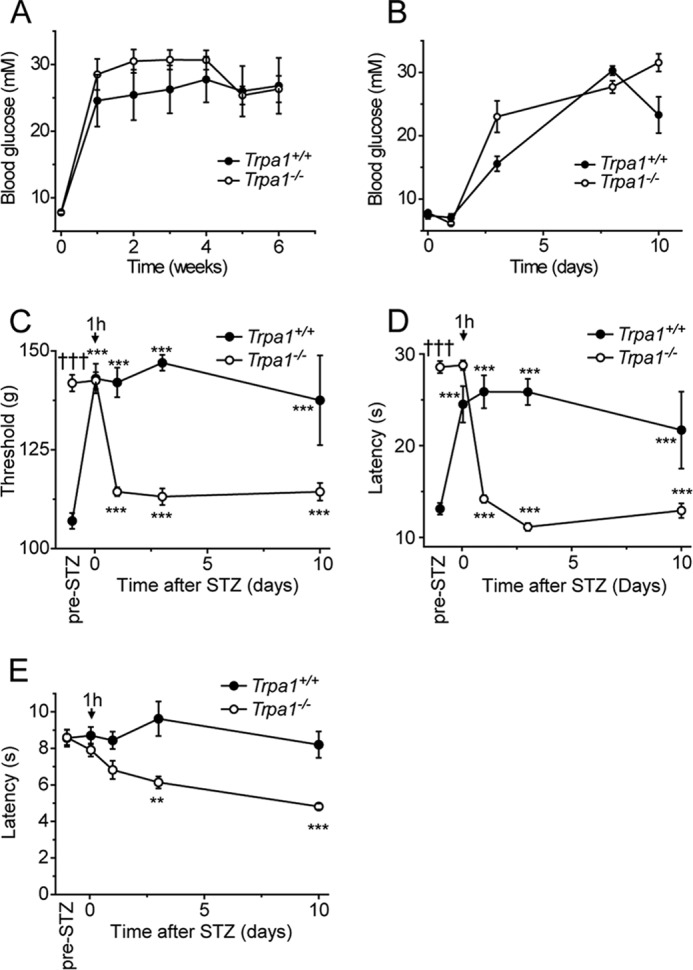
Systemic STZ treatment evokes TRPA1-dependent hypoalgesia. A, intraperitoneal injections of STZ (180 mg/kg) induce hyperglycemia of similar severity and duration in Trpa1+/+ and Trpa1−/− mice. B, early time course of STZ-evoked hyperglycemia is similar in wild type and Trpa1−/− mice. Hyperglycemia is established about 3 days after STZ administration. Within 1 h of STZ (180 mg/kg) injection, wild type mice developed mechanical (C) and cold (D) hyposensitivity, which lasted for at least 10 days. STZ increased the sensitivity to cold and mechanical stimulation in Trpa1−/− mice after 24 h. E, STZ was without effect on the sensitivity to noxious heat in wild type mice but elicited a progressive thermal hyperalgesia in Trpa1−/− mice. Data are mean ± S.E. of n = 4–8; **, p < 0.01; ***, p < 0.001 compared with preinjection value; †††, p < 0.001 compared with wild type, Tukey's HSD test.
FIGURE 3.
FIGURE 3.
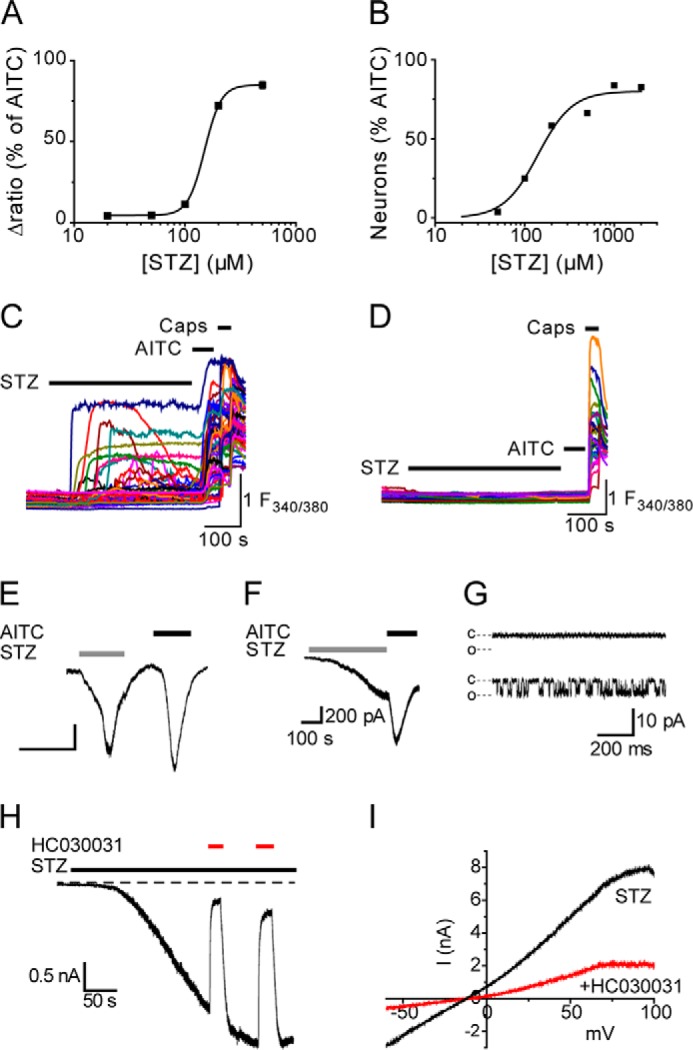
STZ stimulates TRPA1. A, concentration-dependent [Ca2+]i increases evoked by STZ in mTRPA1 CHO cells loaded with Fura-2. Data are the mean percentages ± S.E. (n = 168–648 cells per concentration) of the maximal response amplitude produced by a subsequent challenge with AITC (50 μm). B, concentration-dependent [Ca2+]i responses evoked by STZ in DRG neurons. Data points show the percentage of AITC-sensitive neurons that also responded to an initial challenge with STZ (n = 117–236 AITC-sensitive DRG neurons per concentration). Application of STZ (0.5 mm) stimulated [Ca2+]i responses in TRPA1-positive (AITC-sensitive) neurons cultured from Trpa1+/+ mice (C) but was without effect on [Ca2+]i in neurons from Trpa1−/− mice (D). Fura-2 emission intensity ratio is indicated by F340/380. STZ (1 mm)-induced current responses recorded from mTRPA1 CHO cells (E, n = 5), AITC-sensitive DRG neurons (F, representative of n = 4), and excised inside-out patches from TRPA1 CHO cells (G). In G, the top trace indicates a lack of single channel activity prior to STZ application; the bottom trace shows STZ-evoked channel activity. The closed and open channel current levels are indicated by c and o (the trace is representative of n = 3 patches). Currents were recorded at a holding potential of −60 mV. H, TRPA1 currents evoked by STZ in CHO cells were reversibly inhibited by HC030031 (50 μm, representative of n = 5). I, current-voltage relationship of TRPA1 current evoked by STZ in the presence and absence of HC030031 (50 μm). Experiments with HC030031 were performed under Ca2+-free conditions.
FIGURE 4.
FIGURE 4.
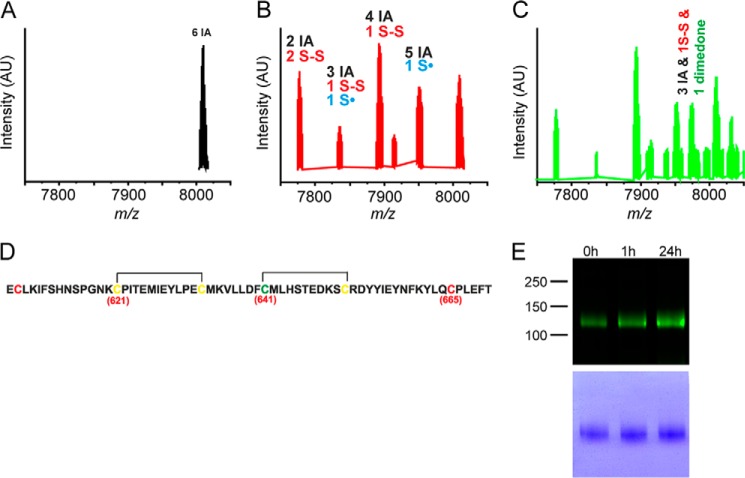
STZ oxidizes critical cysteine residues of TRPA1 N terminus. A, MS spectrum of the TRPA1 peptide used in the study. B, MS spectrum of peptide (50 μm) treated with STZ (500 μm) for 75 min. After the reaction, the remaining free cysteines were blocked with IA. C, dimedone trapping of sulfenic acid formed in the reaction of STZ and the peptide. AU, arbitrary units. D, actual positions of the two disulfide bonds formed when TRPA1 peptide was exposed to STZ. The positions of critical cysteines are indicated by the numbers given in parentheses. Cysteines marked yellow are found to form intramolecular disulfides. The cysteine residue, which also forms sulfenic acid and is observed in MS analysis as labeled with dimedone, is marked green. For more details see Figs. 5 and 6 and Table 1. E, TRPA1 protein purified from DRGs collected from control mice (0 h) contained a basal level of disulfides. STZ increased the content of oxidized thiols in TRPA1 protein at 1 and 24 h after injection. The lower panel indicates the total protein load.
FIGURE 5.
FIGURE 5.
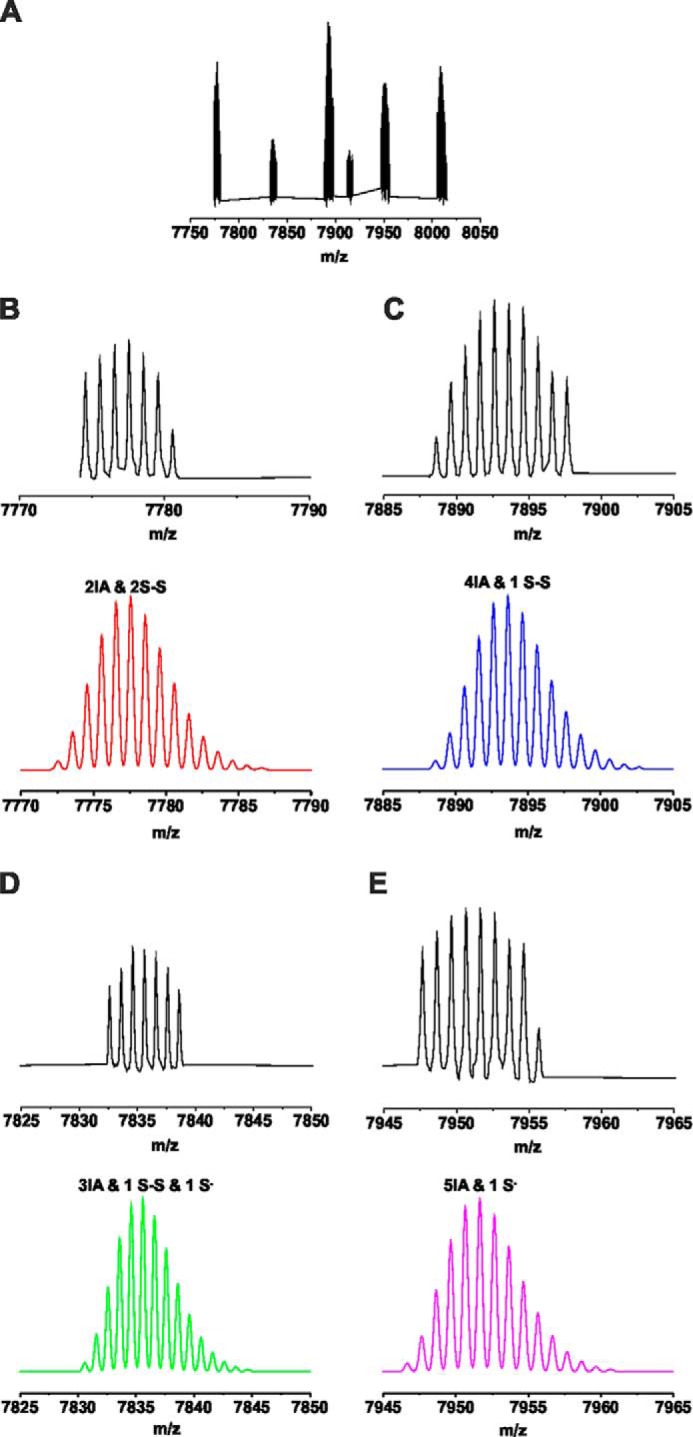
Speciation of the peaks observed by MS analysis of STZ-treated TRPA1 peptide. A, observed spectrum. B–E, peak assignment based on the isotopic distribution prediction. Upper panels (black) correspond to the measured peaks, and the lower panels (red, blue, green, and pink) represent the isotopic distribution prediction for the modification marked on each panel, obtained by the Data Analysis software (Bruker Daltonics).
FIGURE 6.
FIGURE 6.
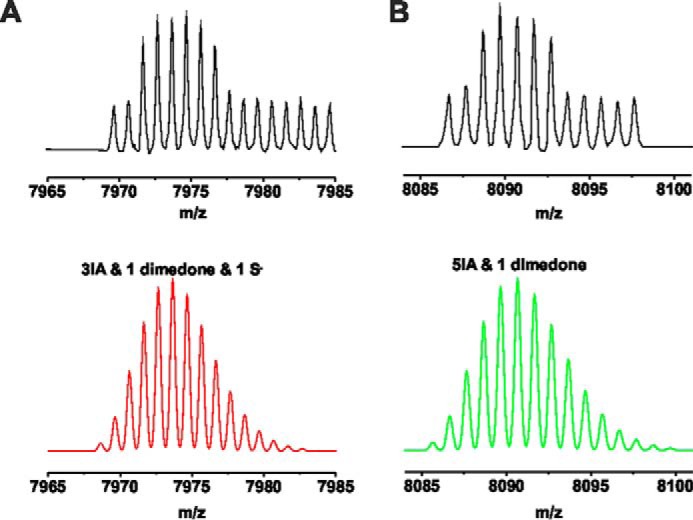
Peak assignments for the STZ + dimedone-treated TRPA1 peptide. A and B, upper figure (black) corresponds to the measured peaks, and the lower figure (red and green) represents the isotopic distribution prediction for the modification marked on each panel, obtained by the Data Analysis software (Bruker Daltonics).
FIGURE 7.
FIGURE 7.
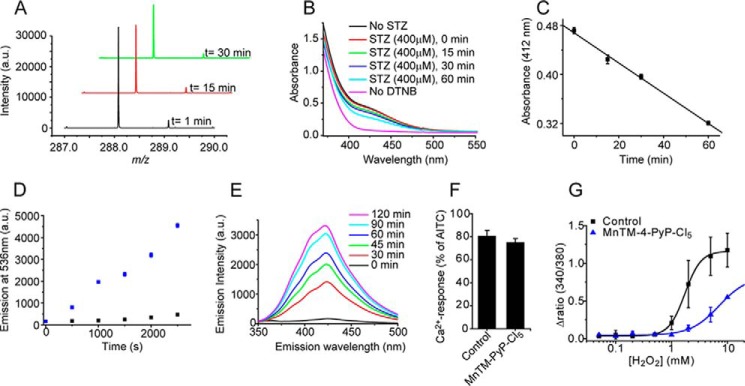
STZ decomposes spontaneously to give a peroxynitrite-like product. A, time-resolved MS spectrum of the parent STZ ion, [STZ + Na]+ at m/z 288.08. B and C, STZ-induced oxidation of cysteine thiols. Cysteine (40 μm) was incubated with STZ (400 μm), and the amount of free thiols was determined by Ellman's reagent (5,5′-dithiobis(nitrobenzoic acid) (DTNB)) at different time points. The time-dependent decay of the 412-nm product indicates STZ-induced oxidation of thiols (n = 3 experiments, data points are mean ± S.E.). D, STZ-induced oxidation of dihydrorhodamine to the fluorescent product, rhodamine 123 (n = 3 experiments, data points are mean ± S.E.). E, fluorescence spectra of tyrosine incubated with STZ, indicating the formation of dityrosine. Black is the control spectrum of 1 mm tyrosine before the addition of STZ. Red to pink, spectra collected at different time points after the addition of 10 mm STZ. F, superoxide dismutase mimetic MnTM-PyP-Cl5 (10 μm) did not reduce STZ (0.5 mm)-evoked [Ca2+]i responses in TRPA1 CHO cells (p > 0.05, n = 4 coverslips with at least 20 cells). G, MnTM-PyP-Cl5 inhibits H2O2 evoked [Ca2+]i responses in CHO cells expressing mTRPA1 (n = 3 experiments, each run in triplicate wells). Data points in G are the mean ± S.E. from one representative experiment. a.u., arbitrary units.
FIGURE 8.
FIGURE 8.
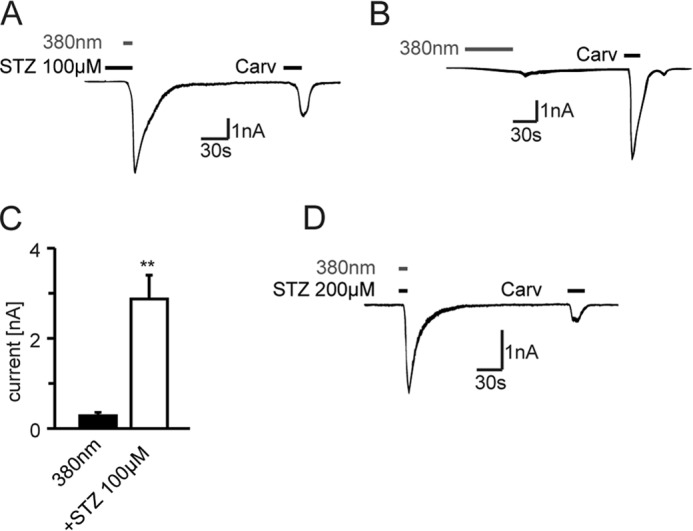
Irradiation with UV light (380 nm) enhances STZ-induced inward currents. A, STZ (100 μm) induced immediate inward currents in hTRPA1-transfected HEK cells, when cells were irradiated with 380 nm for 10 s. No inward currents were recorded by a brief application of STZ 100 μm (20 s) alone. B, continuous irradiation with UV light (380 nm, 60 s) activates TRPA1, but with a slower onset and to a lesser extent (C) than in combination with STZ 100 μm (**, p < 0.004, Mann-Whitney U test, n = 6). D, combination of STZ (200 μm) and fluorescent light (380 nm, 10 s) leads to immediate inward currents in TRPA1-expressing HEK cells. Carv, carvacrol.
FIGURE 9.
FIGURE 9.
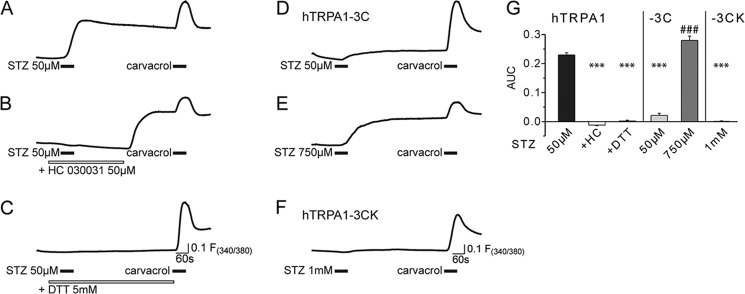
STZ activation of TRPA1 involves modification of intracellular cysteine residues. STZ (50 μm) stimulated [Ca2+]i responses in hTRPA1-expressing HEK293 cells loaded with Fura-2 (A). Application of the TRPA1 antagonist HC030031 inhibited [Ca2+]i responses, but a marked rebound increase in [Ca2+]i was seen after the antagonist was removed (B). The reducing agent dithiothreitol (5 mm) abolished STZ-evoked [Ca2+]i responses (C). In HEK 293t cells transfected with the human TRPA1, the C621S/C641S/C665S mutant channel (−3C) [Ca2+]i responses to stimulation with STZ (50 μm) were strongly reduced (D). Higher concentrations of STZ (750 μm) still produced [Ca2+]i responses in cells expressing the triple cysteine mutant channel (E). STZ (1 mm) failed to induce [Ca2+]i responses in cells expressing the hTRPA1-3C/K710R (−3CK) mutant channel (F). Application of carvacrol (250 μm, for 30 s) was used as a positive control to confirm channel function in A–F. G, quantification of the results presented in A–F. The bar chart demonstrates the area under the curve (AUC) of the fluorescence ratio signals 60 s following STZ stimulation in wild type hTRPA1, the mutant hTRPA1-3C, and hTRPA1-3CK cells. The data in A–G show the mean responses of n = 120–448 cells, S.E. have been omitted in A–F for clarity. ***, p < 0.001 compared with control; ###, p ≤ 0.001 compared with hTRPA1-3C 50 μm STZ; or analysis of variance followed by HSD post hoc test.
SCHEME 1.
SCHEME 1.
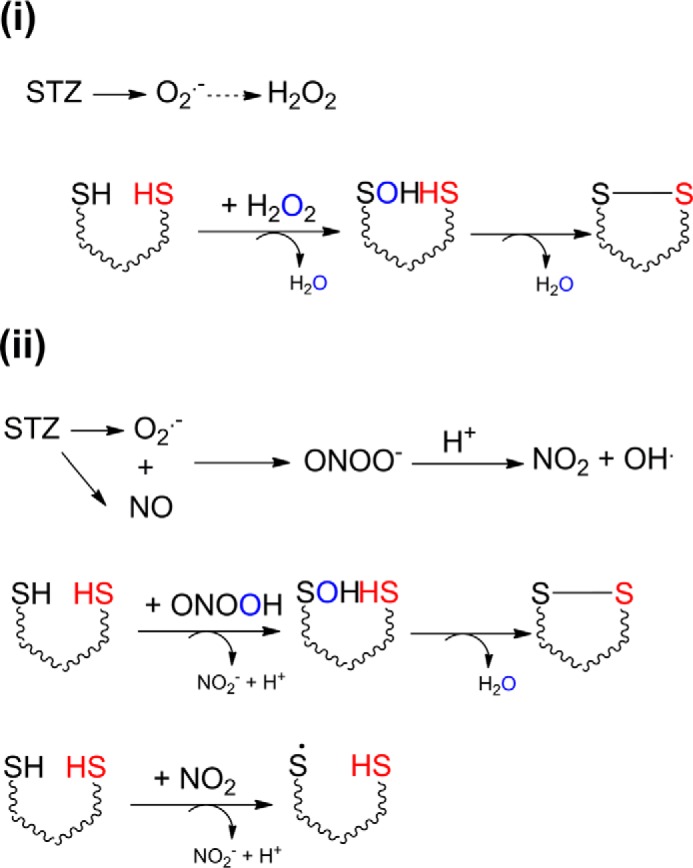
Two possible pathways for STZ decomposition, which could lead to TRPA1 activation, are as follows: (i) STZ decomposes to give superoxide, which forms H2O2, or (ii) STZ decomposes to give both NO and superoxide, which react immediately to give peroxynitrite.

References

    1. Edwards J. L., Vincent A. M., Cheng H. T., Feldman E. L. (2008) Diabetic neuropathy: mechanisms to management. Pharmacol. Ther. 120, 1–34 - PMC - PubMed
    1. Forbes J. M., Cooper M. E. (2013) Mechanisms of diabetic complications. Physiol. Rev. 93, 137–188 - PubMed
    1. Vincent A. M., Callaghan B. C., Smith A. L., Feldman E. L. (2011) Diabetic neuropathy: cellular mechanisms as therapeutic targets. Nat. Rev. Neurol. 7, 573–583 - PubMed
    1. Dworkin R. H., O'Connor A. B., Backonja M., Farrar J. T., Finnerup N. B., Jensen T. S., Kalso E. A., Loeser J. D., Miaskowski C., Nurmikko T. J., Portenoy R. K., Rice A. S., Stacey B. R., Treede R. D., Turk D. C., Wallace M. S. (2007) Pharmacologic management of neuropathic pain: evidence-based recommendations. Pain 132, 237–251 - PubMed
    1. Obrosova I. G. (2009) Diabetic painful and insensate neuropathy: pathogenesis and potential treatments. Neurotherapeutics 6, 638–647 - PMC - PubMed

Publication types

MeSH terms

LinkOut - more resources