


Review
doi: 10.1038/nature14438.
The origin and early phylogenetic history of jawed vertebrates
Affiliations
- PMID: 25903631
- PMCID: PMC4648279
- DOI: 10.1038/nature14438
Item in Clipboard
Review
The origin and early phylogenetic history of jawed vertebrates
Nature.
.
Abstract
Fossils of early gnathostomes (or jawed vertebrates) have been the focus of study for nearly two centuries. They yield key clues about the evolutionary assembly of the group's common body plan, as well the divergence of the two living gnathostome lineages: the cartilaginous and bony vertebrates. A series of remarkable new palaeontological discoveries, analytical advances and innovative reinterpretations of existing fossil archives have fundamentally altered a decades-old consensus on the relationships of extinct gnathostomes, delivering a new evolutionary framework for exploring major questions that remain unanswered, including the origin of jaws.
Figures

Discs mark palaeogeographic positions of early jawed vertebrate localities characterized by abundant fossils, high fidelity preservation, or both. Palaeogeographic reconstructions by R. Blakey (Colorado Plateau Geosystems, Inc.). Taxonomic breakdown of gnathostome diversity within sites indicated by associated pie charts (size scaled to reported species richness). Localities are: 1, Yulungssu Formation, China; 2, Miakao Formation, China; 3, Kuanti Formation, China; 4, Anderson River, Canada; 5, MOTH, Canada; 6, Belén Formation, Bolivia; 7, Turin Hill/Tillywhandland, UK; 8, Hunsrück Slate; 9, Xitun and Guijiatun formations, China; 10, Pongsongchong and Xujiachong formations, China; 11, Wee Jasper/Burrinjuck, Australia; 12, Orcadian Basin, UK; 13, Wood Bay Group, Spitsbergen; 14, Cleveland Shale, USA; 15, Aztec Siltstone, Antarctica; 16, Mt Howitt, Australia; 17, Gogo, Australia; 18, Wildungen, Germany; 19, Bergisch-Gladbach, Germany; 20, Miguasha, Canada. Vignettes depict scenes based on key fossil sites: Gogo, Australia (left) and Cleveland Shale, USA (right) in the late Middle-Late Devonian; the Xitun Formation, China (left) and Orcadian Basin, UK (right) in the Early-early Middle Devonian; and the Kuanti Formation, China (left and right). Paintings by B. Choo (Flinders University).
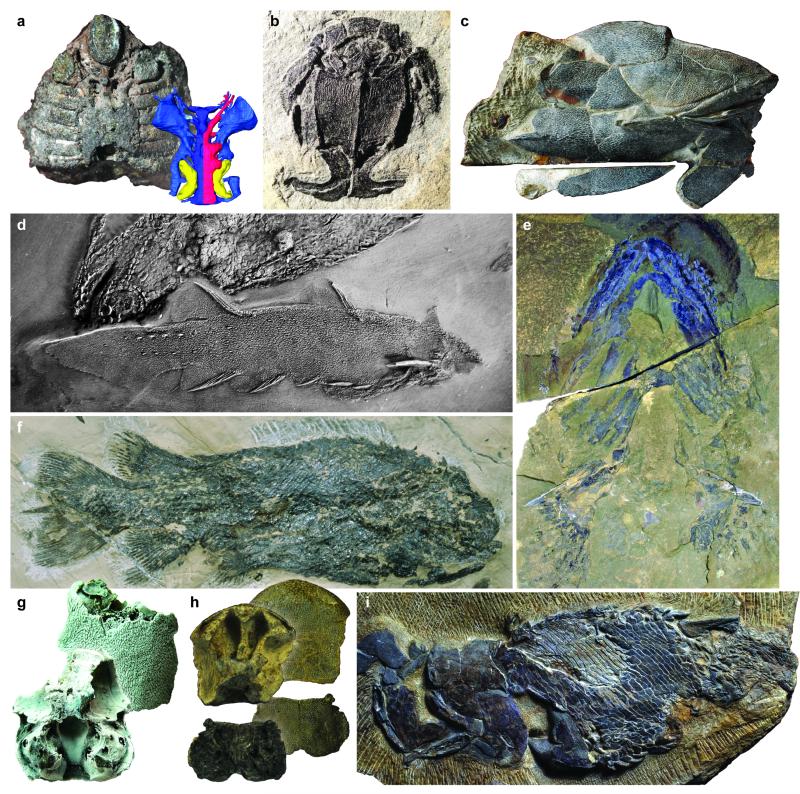
a, high-fidelity virtual models of the Silurian galeaspid Shuyu reveal cranial architecture in jawless relatives of jawed vertebrates. b, claspers in most placoderm groups, including antiarchs like Microbrachius shown here, raise questions about placoderm relationships and the evolution of vertebrate reproductive strategies. c, osteichthyan-like pattern of bones in the Silurian placoderm Entelognathus suggest that the last common ancestor of all modern jawed vertebrates was clad in a bony-fish-like skeleton. d, stunningly preserved acanthodians from the Early Devonian MOTH locality of Canada challenge their monophyly, suggesting affinities with chondrichthyans. e, pectoral-fin spines and tooth whorls with fused bases in the Early Devonian chondrichthyan Doliodus are features typically associated with acanthodians. f, the Early Devonian osteichthyan Dialipina shows a puzzling combination of traits despite being initially identified from isolated scales as a ray-finned fish. g, Early Devonian braincase attributed to the osteichthyan Ligulalepis. h, braincase of Psarolepis, an Early Devonian lobe-finned osteichthyan from China represented by isolated bones including spines of the kind associated with chondrichthyans, placoderms and acanthodians. i, the surprising reconstruction of Psarolepis was corroborated by the discovery of the more complete and even more ancient Guiyu, from the late Silurian of China.

Topology based on Giles et al., with some taxa pruned for clarity and modifications showing presumed phylogenetic positions of key extant lineages. Also shown are key early jawed vertebrates or putative jawed vertebrates with uncertain affinities to the crown group. The minimum age of the gnathostome crown could be profoundly recalibrated if Skiichthys is confirmed as a crown-group gnathostome. Ages shown across the top are in hundreds of millions of years.
References
-
- Janvier P. Early vertebrates. Clarendon Press; 1996. [A masterful summary—rather than original piece of research—providing a window on the ‘state of the art’ immediately preceding the major changes to our understanding of relationships among early gnathostomes that took place over the past two decades; still an indispensible and accessible resource.]
-
- Ahlberg P, Trinajstic K, Johanson Z, Long J. Pelvic claspers confirm chondrichthyan-like internal fertilization in arthrodires. Nature. 2009;460:888–889. [The direct evidence of claspers in arthrodires renewed the palaeobiological significance of placoderms regarding internal fertilisation, but potentially weakens the case for their paraphyly.] - PubMed
-
- Miller RF, Cloutier R, Turner S. The oldest articulated chondrichthyan from the Early Devonian period. Nature. 2003;425:501–504. [Oldest record of an articulated chondrichthyan and first example with paired fin spines, initiating the dissolution support for acanthodian monophyly.] - PubMed
Publication types
MeSH terms
Grants and funding
LinkOut - more resources
Full Text Sources
Other Literature Sources
