. 2015 Apr 24:14:60.
doi: 10.1186/s12934-015-0246-0.

Iterative carotenogenic screens identify combinations of yeast gene deletions that enhance sclareol production

Affiliations

Iterative carotenogenic screens identify combinations of yeast gene deletions that enhance sclareol production

Fotini A Trikka et al. Microb Cell Fact. .

Abstract

Background: Terpenoids (isoprenoids) have numerous applications in flavors, fragrances, drugs and biofuels. The number of microbially produced terpenoids is increasing as new biosynthetic pathways are being elucidated. However, efforts to improve terpenoid production in yeast have mostly taken advantage of existing knowledge of the sterol biosynthetic pathway, while many additional factors may affect the output of the engineered system.

Results: Aiming to develop a yeast strain that can support high titers of sclareol, a diterpene of great importance for the perfume industry, we sought to identify gene deletions that improved carotenoid, and thus potentially sclareol, production. Using a carotenogenic screen, the best 100 deletion mutants, out of 4,700 mutant strains, were selected to create a subset for further analysis. To identify combinations of deletions that cooperate to further boost production, iterative carotenogenic screens were applied, and each time the top performing gene deletions were further ranked according to the number of genetic and physical interactions known for each specific gene. The gene selected in each round was deleted and the resulting strain was employed in a new round of selection. This approach led to the development of an EG60 derived haploid strain combining six deletions (rox1, dos2, yer134c, vba5, ynr063w and ygr259c) and exhibiting a 40-fold increase in carotenoid and 12-fold increase in sclareol titers, reaching 750 mg/L sclareol in shake flask cultivation.

Conclusion: Using an iterative approach, we identified novel combinations of yeast gene deletions that improve carotenoid and sclareol production titers without compromising strain growth and viability. Most of the identified deletions have not previously been implicated in sterol pathway control. Applying the same approach using a different starting point could yield alternative sets of deletions with similar or improved outcome.


Figures
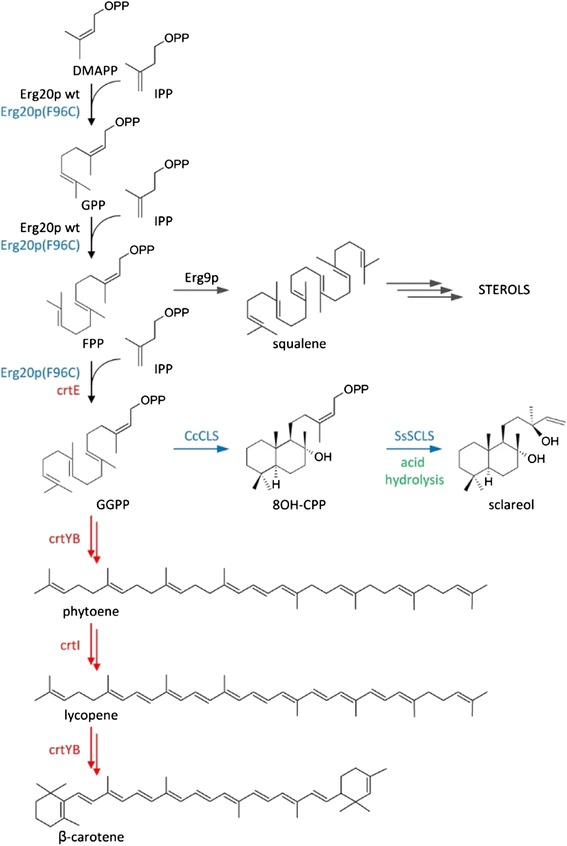
Figure 1
Figure 1
Pathway describing sclareol and carotenoid biosynthesis in yeast. Erg20p catalyzes the formation of C15 farnesyl pyrophosphate molecules (FPP) for isoprenoid and sterol biosynthesis. A variant (F96C) enzyme was previously engineered to catalyze geranylgeranyl pyrophosphate synthesis (GGPP). Fusion of ERG20 (F96C) to the Cistus creticus 8-hydroxy copalyl diphosphate synthase (CcCLS) generates 8-OH-CPP, which in turn is converted to sclareol either through spontaneous hydrolysis in the acidified culture medium or enzymatically by the Salvia sclarea sclareol synthase (SsSCLS). In carotenoid biosynthesis the inserted carotenogenic pathway cassette of X. dendrorhous expresses the the GGPP synthase (encoded by the crtE gene), the bifunctional enzyme phytoene synthase/lycopene cyclase (encoded by the crtYB gene) and phytoene desaturase (encoded by the crtI gene).
Figure 2
Figure 2
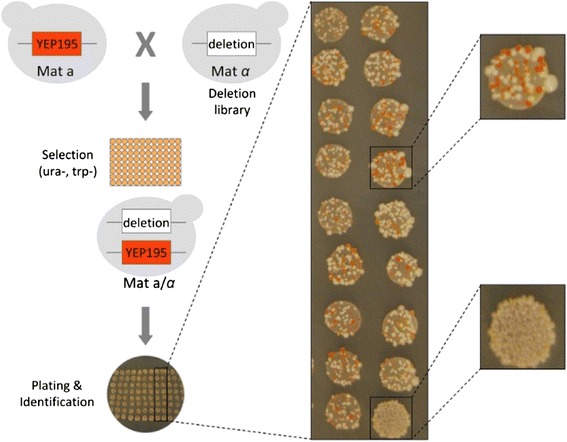
Screening assay to identify heterozygous deletions in yeast which enhance carotenoid biosynthesis. Mat a yeast cells harbouring a chromosomally integrated cassette YEplac195-YB/I/E expressing the GGPP synthase (crtE), the phytoene synthase/lycopene cyclase (crtYB) and the phytoene desaturase (crtI) genes from Xanthophyllomyces dendrorhous were mated with the Mat α yeast deletion strain library. Diploid cells were selected and plated. Colonies exhibiting higher percentage of intensely red colonies were selected out for characterization.
Figure 3
Figure 3
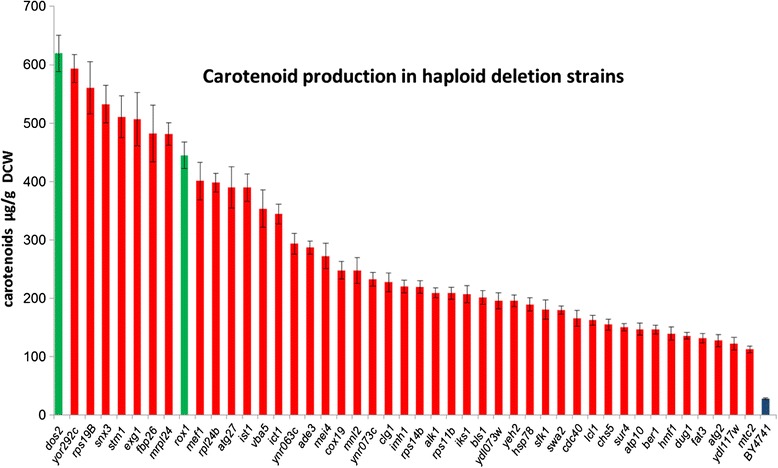
Carotenoid production in selected haploid deletion strains. The selected haploid deletion strains were transformed with YEplac195-YB/I/E plasmid. Cells were grown in 50 ml glucose CM-uracil for 5 days. Carotenoids were extracted from liquid cultures and quantified. In green, dos2, the highest producing deletion and rox1, a previously identified enhancer of carotenoid biosynthesis. The wild type BY4741 parental is shown in blue color.
Figure 4
Figure 4
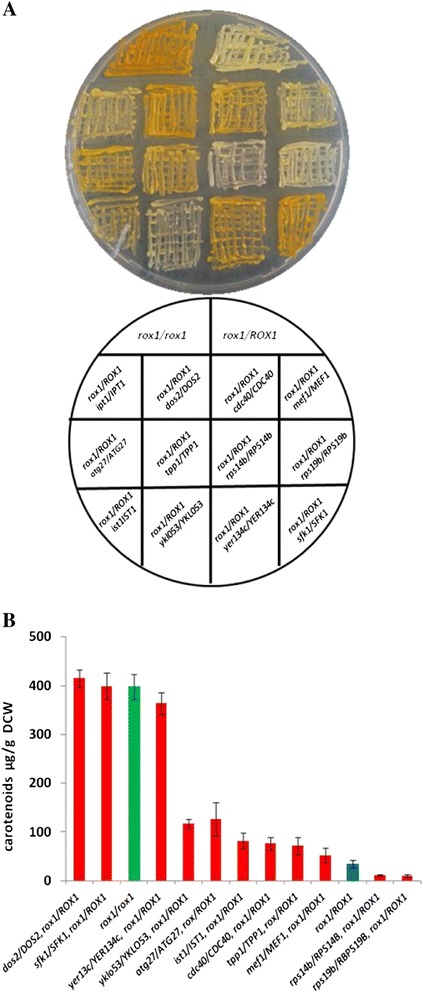
Combined heterozygous deletions can cooperate to enhance carotenoid yields. (A) Selected representative double heterozygous deletion strains expressing crtYB/crtI/crtE. L to R. 1st row: rox1/rox1 positive control; rox1/ROX1 All test strains bellow are heterozygous mutants for rox1 and the additional deletion tested; 2nd row: ipt1; dos2; cdc40; mef1; 3rd row: atg27; tpp1; rps14b; rps19b; 4th row: ist1; ykl053; yer134c; sfk1, (Β) Quantification of extracted carotenoids from three independent cultures of the diploid double heterozygous deletion strains grown in 50 ml glucose CM-U, W. The diploid homozygous rox1/rox1 is shown in red.
Figure 5
Figure 5
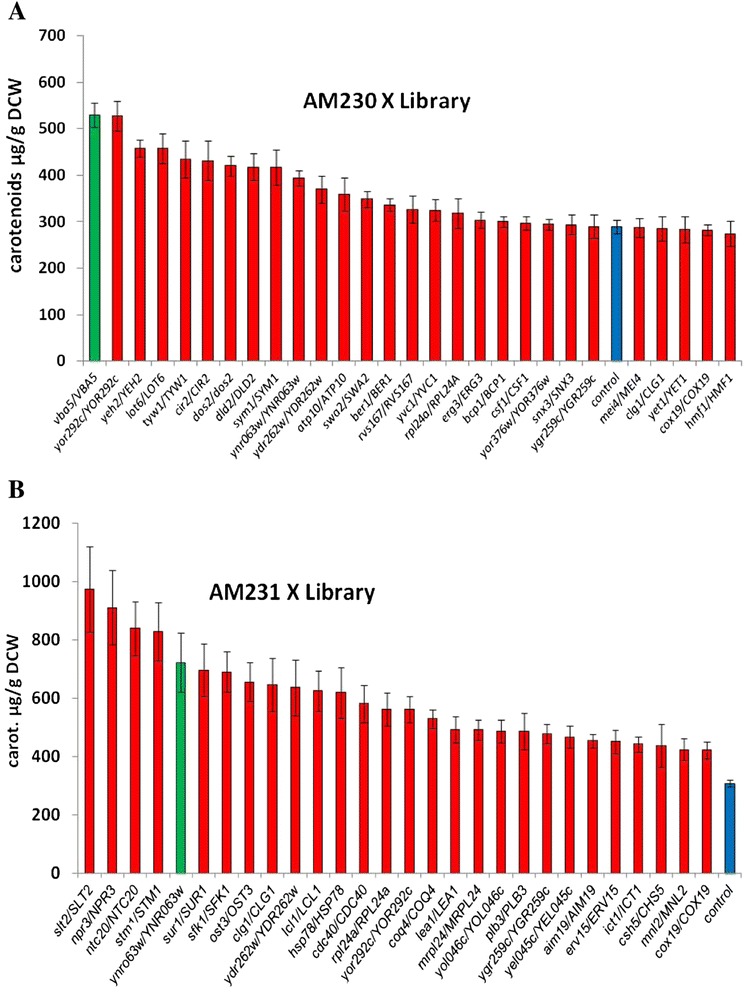
Carotenoid quantification in 4- and 5- heterozygous deletion strains. (A) Strain AM230 (rox1, dos2, yer134c) expressing crtYB/crtI/crtE was mated to the set of deletion strains, grown and carotenoids were extracted and quantified. The selected vba5 deletion is shown in green color. Control 3-deletion heterozygous strain is shown in blue; (B) Strain AM231 (rox1, dos2, yer134c, vba5) expressing crtYB/crtI/crtE was mated to the set of deletion strains as above. In green ynr063w selected for additional improvement. Control 4-deletion heterozygous strain is shown in blue.
Figure 6
Figure 6
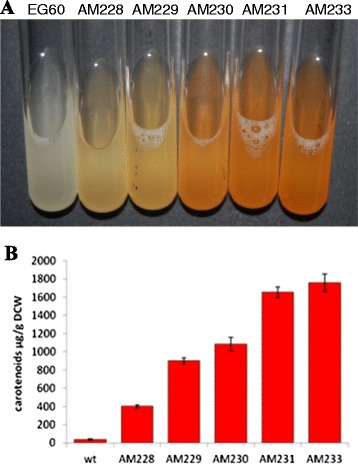
Carotenoid production of improved haploid strains. (A) Color formation in yeast cultures due to carotenoids formed in liquid cultures of two independent cultures of AM233 versus control wild type BY4741 cells; (B) wild type EG60, AM228 (rox1), AM229 (rox1, dos2), AM230 (rox1, dos2, yer134c) and AM231 (rox1, dos2, yer134c, vba5), AM233 (rox1, dos2, yer134c, vba5, ynr063w) expressing crtYB/crtI/crtE were grown in independent triplicate cultures and carotenoids were extracted and quantified. Tandem deletions lead to substantial yield improvements.
Figure 7
Figure 7
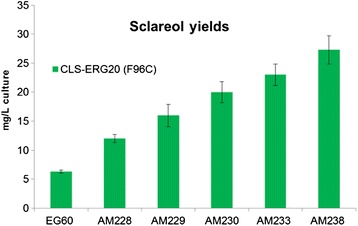
Sclareol titers in engineered yeast strains expressing CLS-ERG20 (F96C). Wild type EG60, AM228, AM229, AM230, AM233 and AM238 cells expressing CLS-ERG20 (F96C) were grown in 5 ml cultures in a roller drum for 24 hours. Subsequently, 500 μl dodecane overlay was added to the media and further incubated for 48 hours. The dodecane phase was analyzed by GC-MS and sclareol was quantified by GC-FID.
Figure 8
Figure 8
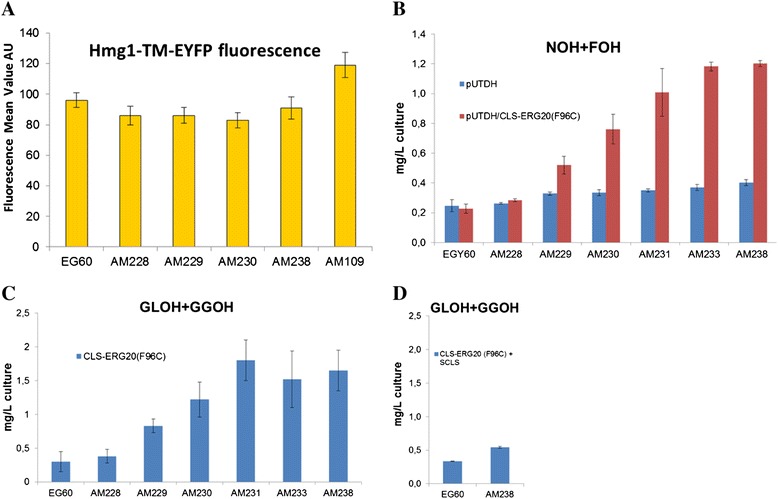
Assessing the state of the mevalonate pathway in engineered strains. (A) The transmembrane domain (1–667) of HMG1 which is regulated by proteolytic degradation was fused to EYFP and expressed by a stable promoter. The mean fluorescence from 50.000 cells per culture in triplicate was measured by flow cytometry. Increased Hmgp stability does not play a role in observed strain improvements; (B) Excess FPP and GGPP which is not converted by CLS to 8OH-CPP can be released in the medium and hydrolyzed to farnesol (FOH) and nerolidol (NOH) from FPP, and geranyllinalool (GLOH) and geranylgeraniol (GGOH) from GGPP. These metabolites were quantified in the engineered strains. Cells carrying empty vector show a small increase in NOH, FOH levels at each successive modification. Expression of CLS-ERG20 (F96C) leads a substantial increase subsequent to the second genetic perturbation (AM229); (C) GLOH + GGOH are increasing after the second perturbation; (D) co-expression of CLS-ERG20 (F96C) with SCLS reduced the levels of released GLOH + GGOH, as substrate is efficiently converted to sclareol.
Figure 9
Figure 9
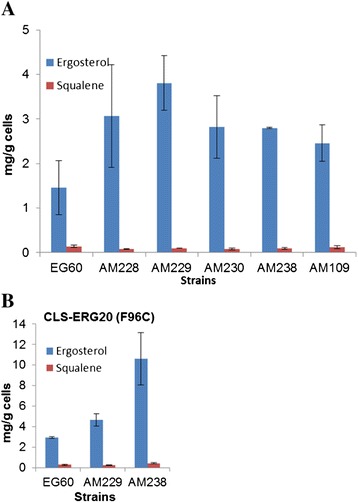
Increased ergosterol yield in engineered strains. (A) Ergosterol and squalene quantification in strains EG60, AM228, AM229, AM230, AM238 and AM109 cells; (B) Ergosterol and squalene quantification in EG60, AM229, AM238 cells overexpressing CLS-ERG20 (F96C).
Figure 10
Figure 10
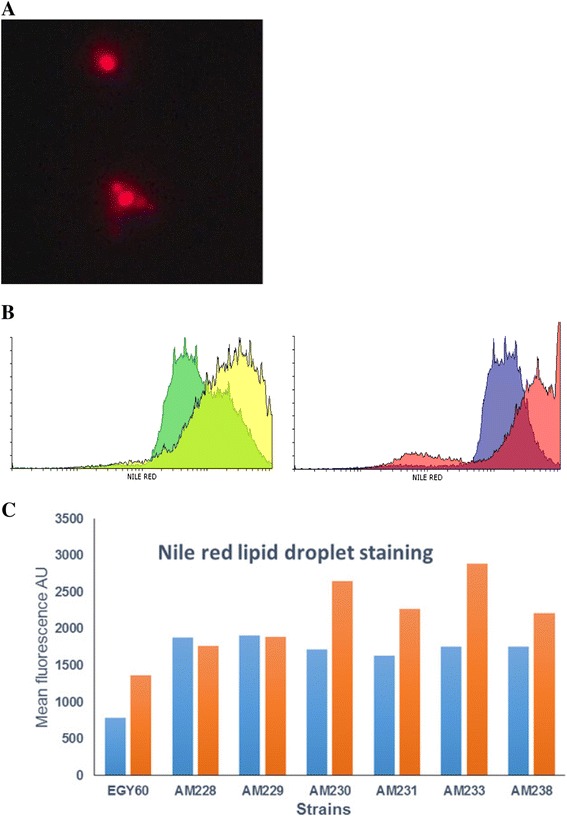
Lipid droplet quantification in the engineered strains. (A) Lipid droplet accumulation in 5 days old culture of yeast visualized by Nile red staining; (B) Overlays of flow cytometry analysis in EG60 cells (left) with empty vector (green) or expressing CLS-ERG20 (F96C) (yellow), and AM238 cells (right) with empty vector (blue) or expressing CLS-ERG20 (F96C) (red); (C) Mean fluorescence values of strains carrying empty vector (blue) or expressing CLS-ERG20 (F96C) (orange). 50.000 cells were counted from each strain.
Figure 11
Figure 11
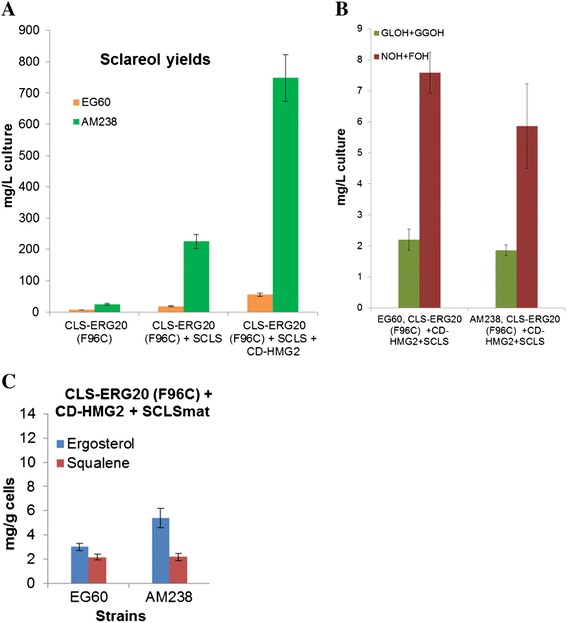
Maximizing sclareol titers in AM238 cells. (A) EG60 and AM238 cells expressing CLS-ERG20 (F96C) only, CLS-ERG20 (F96C) with sclareol synthase SCLS, and CLS-ERG20 (F96C), SCLS with CD-HMG2. The engineered iterative perturbations generated a strain producing 12-fold higher sclareol levels than wild type cells; (B) Released NOH + FOH and GLOH + GGOH in EG60 and AM238 cells expressing the three plasmids. A reduction of released terpenols is seen in AM238 cells indicating a more efficient substrate conversion to sclareol; (C) Ergosterol and squalene levels in EG60 and AM238 cells expressing the three plasmids. Ergosterol levels are reduced by half in AM238 cells co-expressing SCLS and CD-HMG2, compared to CLS-ERG20 (F96C) only. Squalene levels are significantly increased by CD-HMG2 expression.
Figure 12
Figure 12
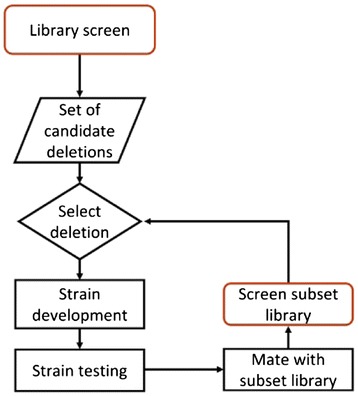
Outline of iterative approach to identify novel combinations of gene deletions improving carotenoid and sclareol production.

References

    1. Vickers CE, Bongers M, Liu Q, Delatte T, Bouwmeester H. Metabolic engineering of volatile isoprenoids in plants and microbes. Plant Cell Environ. 2014;37(8):1753–75. doi: 10.1111/pce.12316. - DOI - PubMed
    1. Paddon CJ, Westfall PJ, Pitera DJ, Benjamin K, Fisher K, McPhee D, et al. High-level semi-synthetic production of the potent antimalarial artemisinin. Nature. 2013;496:528–32. doi: 10.1038/nature12051. - DOI - PubMed
    1. WHO Malaria Policy Advisory Committee and Secretariat Malaria policy advisory committee to the WHO: conclusions and recommendations of september 2012 meeting. Malar J. 2013;11:424. doi: 10.1186/1475-2875-11-424. - DOI - PMC - PubMed
    1. Ro DK, Paradise EM, Ouellet M, Fisher KJ, Newman KL, Ndungu JM, et al. Production of the antimalarial drug precursor artemisinic acid in engineered yeast. Nature. 2006;440:940–3. doi: 10.1038/nature04640. - DOI - PubMed
    1. Saloustros E, Mavroudis D, Georgoulias V. Paclitaxel and docetaxel in the treatment of breast cancer. Expert Opin Pharmacother. 2008;9:2603–16. doi: 10.1517/14656566.9.15.2603. - DOI - PubMed

Publication types

MeSH terms