


A cluster randomised trial of cloth masks compared with medical masks in healthcare workers
- PMID: 25903751
- PMCID: PMC4420971
- DOI: 10.1136/bmjopen-2014-006577
A cluster randomised trial of cloth masks compared with medical masks in healthcare workers
Abstract
Objective: The aim of this study was to compare the efficacy of cloth masks to medical masks in hospital healthcare workers (HCWs). The null hypothesis is that there is no difference between medical masks and cloth masks.
Setting: 14 secondary-level/tertiary-level hospitals in Hanoi, Vietnam.
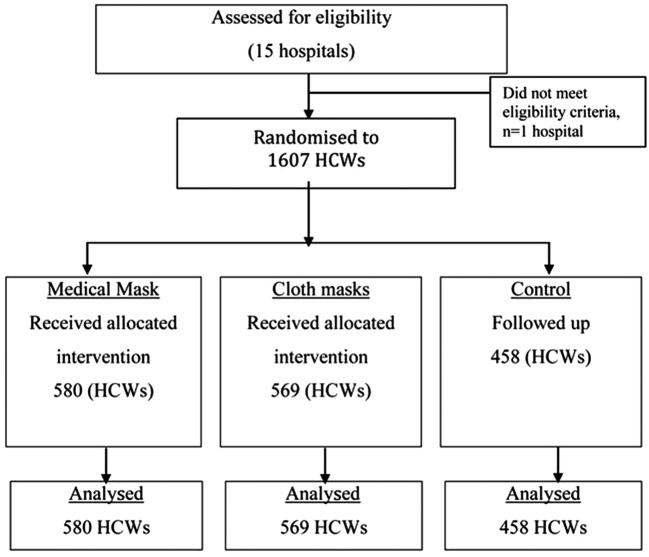
Participants: 1607 hospital HCWs aged ≥18 years working full-time in selected high-risk wards.
Intervention: Hospital wards were randomised to: medical masks, cloth masks or a control group (usual practice, which included mask wearing). Participants used the mask on every shift for 4 consecutive weeks.
Main outcome measure: Clinical respiratory illness (CRI), influenza-like illness (ILI) and laboratory-confirmed respiratory virus infection.
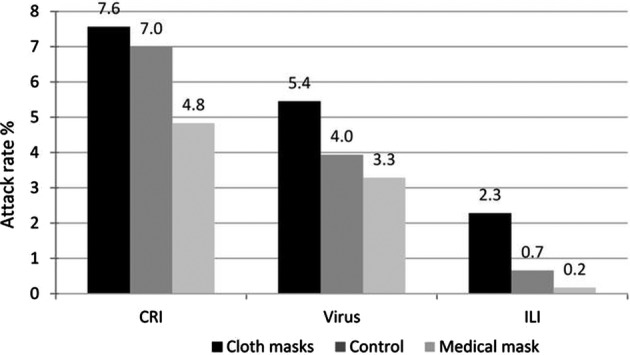
Results: The rates of all infection outcomes were highest in the cloth mask arm, with the rate of ILI statistically significantly higher in the cloth mask arm (relative risk (RR)=13.00, 95% CI 1.69 to 100.07) compared with the medical mask arm. Cloth masks also had significantly higher rates of ILI compared with the control arm. An analysis by mask use showed ILI (RR=6.64, 95% CI 1.45 to 28.65) and laboratory-confirmed virus (RR=1.72, 95% CI 1.01 to 2.94) were significantly higher in the cloth masks group compared with the medical masks group. Penetration of cloth masks by particles was almost 97% and medical masks 44%.
Conclusions: This study is the first RCT of cloth masks, and the results caution against the use of cloth masks. This is an important finding to inform occupational health and safety. Moisture retention, reuse of cloth masks and poor filtration may result in increased risk of infection. Further research is needed to inform the widespread use of cloth masks globally. However, as a precautionary measure, cloth masks should not be recommended for HCWs, particularly in high-risk situations, and guidelines need to be updated.
Trial registration number: Australian New Zealand Clinical Trials Registry: ACTRN12610000887077.
Keywords: Cloth mask; Influenza.
Published by the BMJ Publishing Group Limited. For permission to use (where not already granted under a licence) please go to http://group.bmj.com/group/rights-licensing/permissions.
Figures
References
-
- World Health Organization (WHO). Global Alert and Response (GAR), Pandemic (H1N1) 2009—update 76 (cited 27 Apr 2012). http://www.who.int/csr/don/2009_11_27a/en/index.html
-
- World Health Organization (WHO). Human infection with avian influenza A(H7N9) virus—update (cited 8 May 2013). http://www.who.int/csr/don/2013_05_07/en/index.html
-
- Bermingham A, Chand MA, Brown CS et al. Severe respiratory illness caused by a novel coronavirus, in a patient transferred to the United Kingdom from the Middle East, September 2012. Euro Surveill 2012;17:20290. - PubMed
-
- World Health Organization (WHO). Global Alert and Response (GAR). Ebola virus disease update—west Africa 2014 (cited 28 Aug 2014). http://www.who.int/csr/don/2014_08_28_ebola/en/
Publication types
MeSH terms
Substances
Associated data
LinkOut - more resources
Full Text Sources
Other Literature Sources
Medical
