. 2015 Apr 22;35(16):6307-17.
doi: 10.1523/JNEUROSCI.3481-14.2015.

Spinal dopaminergic projections control the transition to pathological pain plasticity via a D1/D5-mediated mechanism

Affiliations

Spinal dopaminergic projections control the transition to pathological pain plasticity via a D1/D5-mediated mechanism

Ji-Young V Kim et al. J Neurosci. .

Abstract

The mechanisms that lead to the maintenance of chronic pain states are poorly understood, but their elucidation could lead to new insights into how pain becomes chronic and how it can potentially be reversed. We investigated the role of spinal dorsal horn neurons and descending circuitry in plasticity mediating a transition to pathological pain plasticity suggesting the presence of a chronic pain state using hyperalgesic priming. We found that when dorsal horn neurokinin 1 receptor-positive neurons or descending serotonergic neurons were ablated before hyperalgesic priming, IL-6- and carrageenan-induced mechanical hypersensitivity was impaired, and subsequent prostaglandin E2 (PGE2) response was blunted. However, when these neurons were lesioned after the induction of priming, they had no effect on the PGE2 response, reflecting differential mechanisms driving plasticity in a primed state. In stark contrast, animals with a spinally applied dopaminergic lesion showed intact IL-6- and carrageenan-induced mechanical hypersensitivity, but the subsequent PGE2 injection failed to cause mechanical hypersensitivity. Moreover, ablating spinally projecting dopaminergic neurons after the resolution of the IL-6- or carrageenan-induced response also reversed the maintenance of priming as assessed through mechanical hypersensitivity and the mouse grimace scale. Pharmacological antagonism of spinal dopamine D1/D5 receptors reversed priming, whereas D1/D5 agonists induced mechanical hypersensitivity exclusively in primed mice. Strikingly, engagement of D1/D5 coupled with anisomycin in primed animals reversed a chronic pain state, consistent with reconsolidation-like effects in the spinal dorsal horn. These findings demonstrate a novel role for descending dopaminergic neurons in the maintenance of pathological pain plasticity.

Keywords: chronic pain; descending modulation; dopamine; nociceptive plasticity; reconsolidation; substance P.


Figures

Figure 1.
Figure 1.
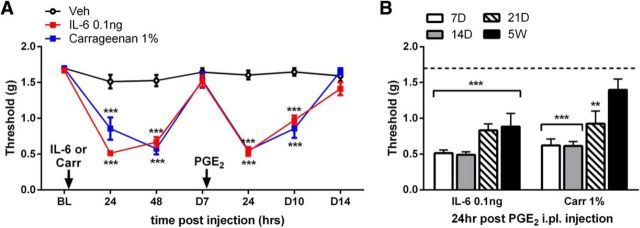
IL-6 and carrageenan can establish hyperalgesic priming that persists for weeks. A, Intraplantar injection of IL-6 and carrageenan caused mechanical hypersensitivity that lasted for at least 48 h. After a complete recovery from IL-6 and carrageenan, PGE2 was injected into the same paw, which caused mechanical hypersensitivity only in animals exposed previously to IL-6 and carrageenan. B, PGE2 injection precipitated mechanical hypersensitivity for at least 5 weeks after IL-6 and up to 3 weeks after carrageenan injection. **p < 0.01; ***p < 0.001 (two-way ANOVA with Bonferroni post hoc test). n = 6–8 mice per group.
Figure 2.
Figure 2.
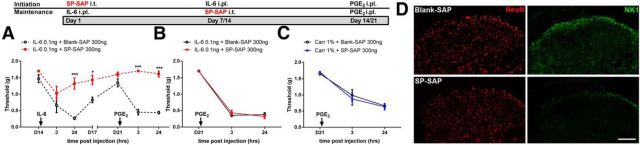
NK1 projection neurons differentially control the initiation and maintenance of hyperalgesic priming. A, Intrathecal injection of SP-SAP 14 d before IL-6 intraplantar injection prevented IL-6-induced mechanical hypersensitivity. B, C, SP-SAP, given 7 d after IL-6 (B) or carrageenan (C) injection failed to reverse hyperalgesic priming. D, Spinal dorsal horn NK1 immunoreactivity was reduced by SP-SAP treatment. *p < 0.05; ***p < 0.001 (two-way ANOVA with Bonferroni post hoc test). n = 6–8 mice per group. Scale bar, 100 μm.
Figure 3.
Figure 3.
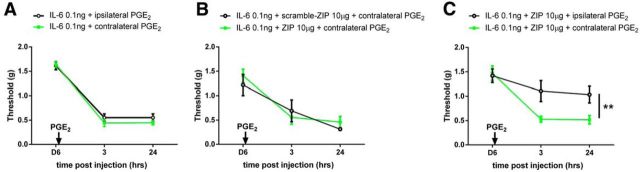
IL-6 induces bilateral priming. A, Intraplantar injection of PGE2 ipsilateral or contralateral to the previous IL-6 injection produced prolonged mechanical hyperalgesia. n = 4 per group. B, Animals that received intrathecal injection of ZIP or scramble ZIP developed mechanical sensitive to contralateral injection of PGE2. C, The same dose of ZIP reversed ipsilateral priming, but not contralateral priming. n = 6 mice per group (B, C). **p < 0.01 (two-way ANOVA with Bonferroni post hoc test).
Figure 4.
Figure 4.
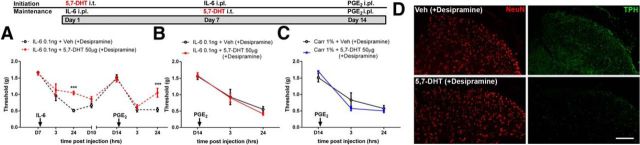
5-HT neurons differentially influence the initiation and maintenance of hyperalgesic priming. A, A 5-HT lesion before IL-6 injection reduced the initial IL-6 response and hyperalgesic priming. B–D, Conversely, ablation of 5-HT neurons after priming with IL-6 (B) or carrageenan (C) had no effect on the maintenance of priming but reduced TPH staining in the spinal dorsal horn (D). ***p < 0.001 (two-way ANOVA with Bonferroni post hoc test). n = 6–8 mice per group. Scale bar, 100 μm.
Figure 5.
Figure 5.
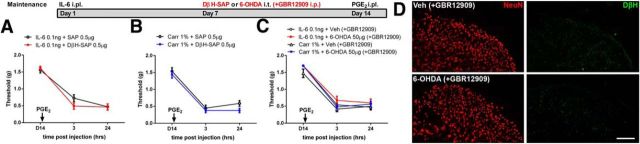
Ablation of NE neurons does not affect hyperalgesic priming. A, DβH-SAP injection into the spinal cord 7 d after IL-6 treatment failed to influence hyperalgesic priming precipitated by intraplantar injection of PGE2. B, DβH-SAP also did not influence carrageenan-induced priming. C, Treatment with 6-OHDA and GBR12909 to induce a selective NE ablation in the spinal cord also did not affect hyperalgesic priming induced by either IL-6 or carrageenan. D, DβH immunoreactivity was reduced 7 d after treatment in the spinal dorsal horn of 6-OHDA and GBR12909-treated animals. n = 6–8 mice per group. Scale bar, 100 μm.
Figure 6.
Figure 6.
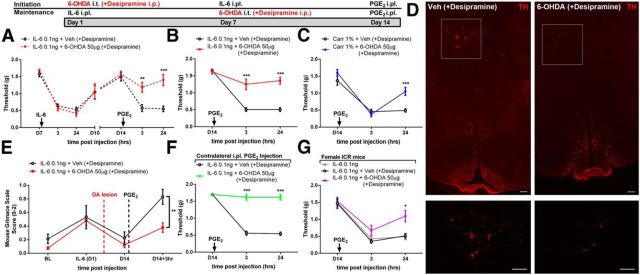
Dopaminergic neurons control hyperalgesic priming. A–C, DA lesion 7 d before IL-6 injection blocked hyperalgesic priming (A), and DA lesion 7 d after IL-6 (B) or carrageenan (C) injection reversed the maintenance of hyperalgesic priming. D, This spinally directed DA lesion reduced A11 hypothalamic DA neurons (6-OHDA + desipramine). E–G, DA lesion after IL-6 injection also attenuated the PGE2-induced increase in grimace scores in primed mice (E), contralateral priming (F), and priming in female mice (G, n = 5 per group). n = 6–8 mice per group in A–F. *p < 0.05; **p < 0.01; ***p < 0.001 (two-way ANOVA with Bonferroni post hoc test). Scale bar, 100 μm.
Figure 7.
Figure 7.
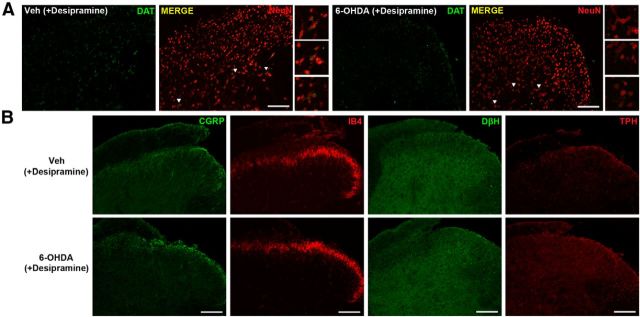
6-OHDA (+ desipiramine)-directed DA lesion is highly selective for dopamine. A, B, Spinal DA lesion (6-OHDA + desipramine) significantly reduced DAT immunoreactivity 7 d after the treatment (A) but did not disrupt (B) other monoamine neurotransmitters (TPH and DβH) or primary C fiber marker (CGRP and IB4) expression. Images are representative of n = 3 mice per group. Scale bar, 100 μm.
Figure 8.
Figure 8.
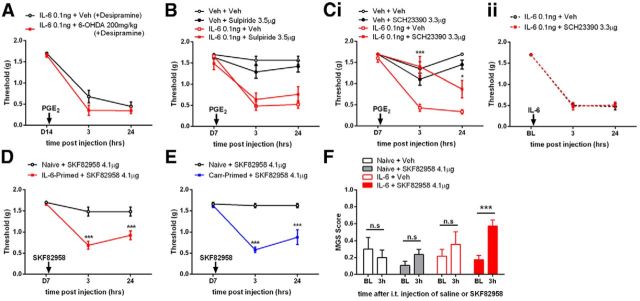
D1/D5 receptors mediate hyperalgesic priming. A, A peripherally restricted DA lesion 7 d after IL-6 injection did not interfere with maintenance of hyperalgesic priming precipitated by PGE2 injection on day 14 after IL-6. B, Ci, Spinal injection of the D2 antagonist sulpiride at the time of PGE2 injection did not affect hyperalgesic priming (B), whereas the D1/D5 antagonist SCH23380 blocked PGE2 precipitation of priming (Ci). Cii, The D1/D5 antagonist SCH23380 given spinally at the time of IL-6 injection failed to influence IL-6-mediated acute mechanical hypersensitivity. D, Intrathecal injection of the D1/D5 agonist SKF82958 precipitated mechanical hypersensitivity only in animals primed with IL-6. n = 6–8 mice per group. The experiment in D was performed with male and female mice. E, Intrathecal injection of the D1/D5 agonist SKF82958 precipitated mechanical hypersensitivity only in animals primed with carrageenan. n = 6–8 mice per group. F, Intrathecal injection of the D1/D5 agonist SKF82958 induced grimacing only in mice previously exposed to IL-6 compared to baseline measures taken 3 h before intrathecal injection. Mice received IL-6 or vehicle (Veh) (naive) into the hindpaw 7 d previously. Naive + veh, n = 3; naive + SKF82958, n = 4; IL-6 + veh, n = 6; IL-6 + SKF82958, n = 10. *p < 0.05; **p < 0.01; ***p < 0.001 (two-way ANOVA with Bonferroni post hoc test).
Figure 9.
Figure 9.
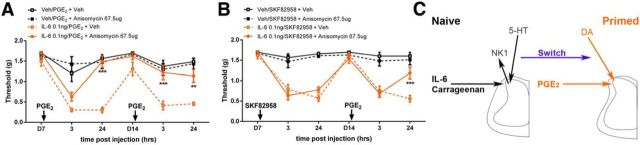
Precipitation of hyperalgesic priming renders the maintenance phase reversible by protein synthesis inhibition. A, In IL-6 primed mice, anisomycin intrathecal injection paired with intraplantar PGE2 injection rapidly reversed the maintenance of hyperalgesic priming. B, Spinal injection of anisomycin at the time of D1/D5 agonist treatment in primed animals likewise reversed the maintenance of hyperalgesic priming when mice were subsequently challenged with intraplantar PGE2. C, Schematic illustrating plasticity mechanisms mediating maintenance of hyperalgesic priming. Acute pain plasticity induced by IL-6 or carrageenan requires NK1-positive projection neurons and descending 5-HT neurons for its full expression. However, following the transition to a primed state, neither NK1-positive nor serotonergic neurons are required for the continued presence of PGE2 precipitation of priming. Instead, descending dopaminergic input to spinal D1/D5 receptors controls the maintenance phase of hyperalgesic priming. n = 5–8 mice per group. All experiments were performed with male and female mice. **p < 0.01; ***p < 0.001 (two-way ANOVA with Bonferroni post hoc test).

References

    1. Abdallah K, Artola A, Monconduit L, Dallel R, Luccarini P. Bilateral descending hypothalamic projections to the spinal trigeminal nucleus caudalis in rats. PLoS One. 2013;8:e73022. doi: 10.1371/journal.pone.0073022. - DOI - PMC - PubMed
    1. Abraham WC, Williams JM. LTP maintenance and its protein synthesis-dependence. Neurobiol Learn Mem. 2008;89:260–268. doi: 10.1016/j.nlm.2007.10.001. - DOI - PubMed
    1. Aley KO, Messing RO, Mochly-Rosen D, Levine JD. Chronic hypersensitivity for inflammatory nociceptor sensitization mediated by the epsilon isozyme of protein kinase C. J Neurosci. 2000;20:4680–4685. - PMC - PubMed
    1. Asiedu MN, Tillu DV, Melemedjian OK, Shy A, Sanoja R, Bodell B, Ghosh S, Porreca F, Price TJ. Spinal protein kinase M zeta underlies the maintenance mechanism of persistent nociceptive sensitization. J Neurosci. 2011;31:6646–6653. doi: 10.1523/JNEUROSCI.6286-10.2011. - DOI - PMC - PubMed
    1. Bardin L. The complex role of serotonin and 5-HT receptors in chronic pain. Behav Pharmacol. 2011;22:390–404. doi: 10.1097/FBP.0b013e328349aae4. - DOI - PubMed

Publication types

MeSH terms

LinkOut - more resources