


Relationship between Motor Symptoms, Cognition, and Demographic Characteristics in Treated Mild/Moderate Parkinson's Disease
- PMID: 25905783
- PMCID: PMC4407885
- DOI: 10.1371/journal.pone.0123231
Relationship between Motor Symptoms, Cognition, and Demographic Characteristics in Treated Mild/Moderate Parkinson's Disease
Abstract
Background: Although Parkinson's disease (PD) is a progressive neurodegenerative disorder characterized primarily by motor symptoms, PD patients, at all stages of the disease, can experience cognitive dysfunction. However, the relationships between cognitive and motor symptoms and specific demographic characteristics are not well defined, particularly for patients who have progressed to requiring dopaminergic medication.
Objective: To examine relationships between motor and cognitive symptoms and various demographic factors in mild to moderate, PD patients requiring anti-PD medication.
Methods: Cognitive function was assessed in 94 subjects with a variety of neuropsychological tests during baseline evaluations as part of an experimental treatment study. Data were analyzed in relation to Unified Parkinson's Disease Rating Scale motor scores and demographic variables.
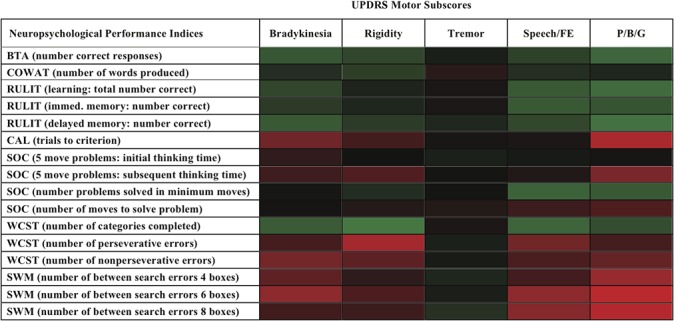
Results: Of the UPDRS subscores analyzed, posture/balance/gait was associated with the highest number of adverse cognitive outcomes followed by speech/facial expression, bradykinesia, and rigidity. No associations were detected between any of the cognitive performance measures and tremor. Motor functioning assessed in the "off" condition correlated primarily with disease duration; neuropsychological performance in general was primarily related to age.
Conclusion: In PD patients who have advanced to requiring anti-PD therapies, there are salient associations between axial signs and cognitive performance and in particular, with different aspects of visuospatial function suggesting involvement of similar circuits in these functions. Associations between executive functions and bradykinesia also suggest involvement similar circuits in these functions.
Conflict of interest statement
Figures
References
-
- Caviness JN, Driver-Dunckley E, Connor DJ, Sabbagh MN, Hentz JG, Noble B, et al. (2007) Defining mild cognitive impairment in Parkinson's disease. Movement Disorders: 22: 1272–1277. - PubMed
-
- Lange KW, Robbins TW, Marsden CD, James M, Owen AM, Paul GM (1992) L-dopa withdrawal in Parkinson's disease selectively impairs cognitive performance in tests sensitive to frontal lobe dysfunction. Psychopharmacology 107: 394–404. - PubMed
-
- Owen AM, James M, Leigh PN, Summers BA, Marsden CD, Quinn NP, et al. (1992) Fronto-striatal cognitive deficits at different stages of Parkinson's disease. Brain: 115 (Pt 6): 1727–1751. - PubMed
Publication types
MeSH terms
Grants and funding
LinkOut - more resources
Full Text Sources
Other Literature Sources
Medical
