Comparing the Relative Efficacy of Narrative vs Nonnarrative Health Messages in Reducing Health Disparities Using a Randomized Trial
- PMID: 25905845
- PMCID: PMC4566521
- DOI: 10.2105/AJPH.2014.302332
Comparing the Relative Efficacy of Narrative vs Nonnarrative Health Messages in Reducing Health Disparities Using a Randomized Trial
Abstract
Objectives: We compared the relative efficacy of a fictional narrative film to a more traditional nonnarrative film in conveying the same health information.
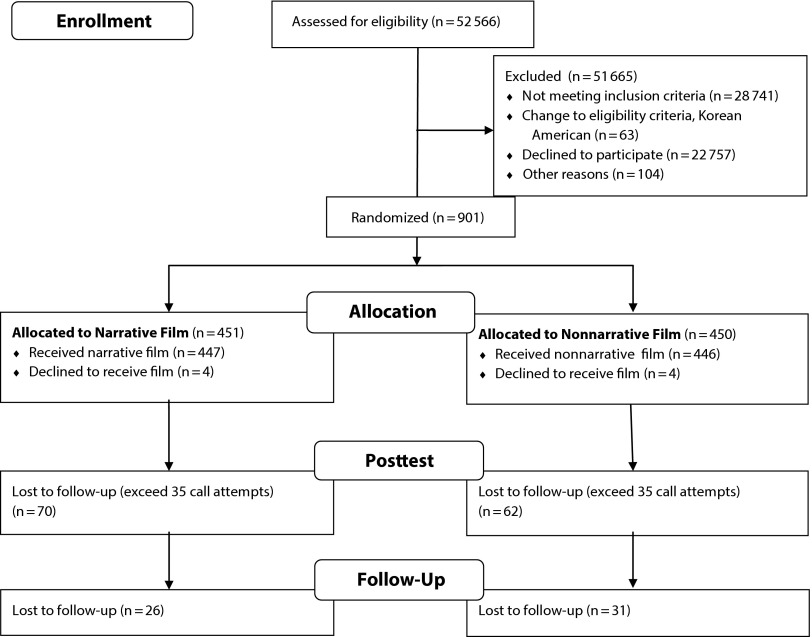
Methods: We used a random digit dial procedure to survey the cervical cancer-related knowledge, attitudes, and behavior of non-Hispanic White, Mexican American, and African American women, aged 25 to 45 years, living in Los Angeles, California, from 2011 to 2012. Participants (n = 704) were randomly assigned to view either a narrative or nonnarrative film containing the same information about how cervical cancer could be prevented or detected, and they were re-contacted 2 weeks and 6 months later.
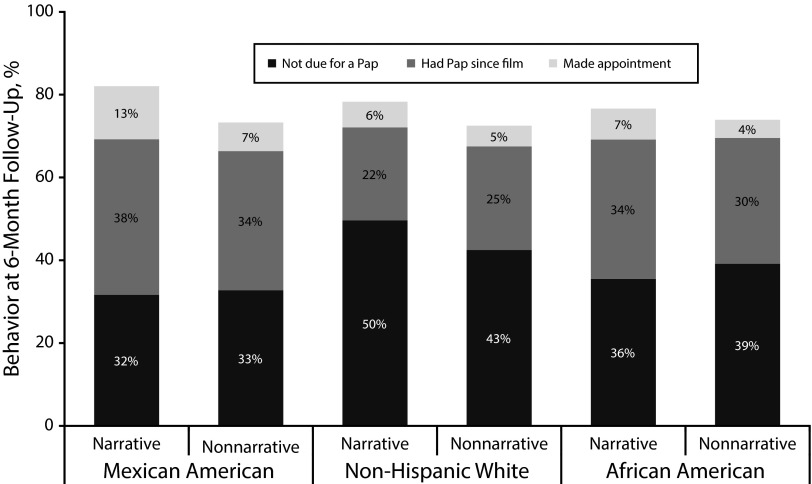
Results: At 2 weeks, both films produced a significant increase in cervical cancer-related knowledge and attitudes, but these effects were significantly higher for the narrative film. At 6 months, viewers of both films retained greater than baseline knowledge and more positive attitudes toward Papanicolaou (Pap) tests, but women who saw the narrative were significantly more likely to have had or scheduled a Pap test. The narrative was particularly effective for Mexican American women, eliminating cervical cancer screening disparities found at baseline.
Conclusions: Narratives might prove to be a useful tool for reducing health disparities.
Figures
References
-
- Disparities–Healthy People 2020. HealthyPeople.gov Web site. Available at: http://www.healthypeople.gov/2020/about/disparitiesAbout.aspx. Accessed June 10, 2014.
-
- National Institutes of Health. Fact sheet: health disparities. Available at: http://report.nih.gov/nihfactsheets/Pdfs/HealthDisparities(NIMHD).pdf. Accessed June 10, 2014.
-
- Viswanath K, Emmons KM. Health communication and communication inequalities in addressing cancer disparities. In: Koh HK, editor. Toward the Elimination of Cancer Disparities. New York, NY: Springer; 2009. pp. 277–298.
-
- Guttman N, Salmon CT. Guilt, fear, stigma and knowledge gaps: ethical issues in public health communication interventions. Bioethics. 2004;18(6):531–552. - PubMed
Publication types
MeSH terms
Grants and funding
LinkOut - more resources
Full Text Sources
Medical
Research Materials