


Enterovirus Encephalitis Increases the Risk of Attention Deficit Hyperactivity Disorder: A Taiwanese Population-based Case-control Study
- PMID: 25906098
- PMCID: PMC4602682
- DOI: 10.1097/MD.0000000000000707
Enterovirus Encephalitis Increases the Risk of Attention Deficit Hyperactivity Disorder: A Taiwanese Population-based Case-control Study
Abstract
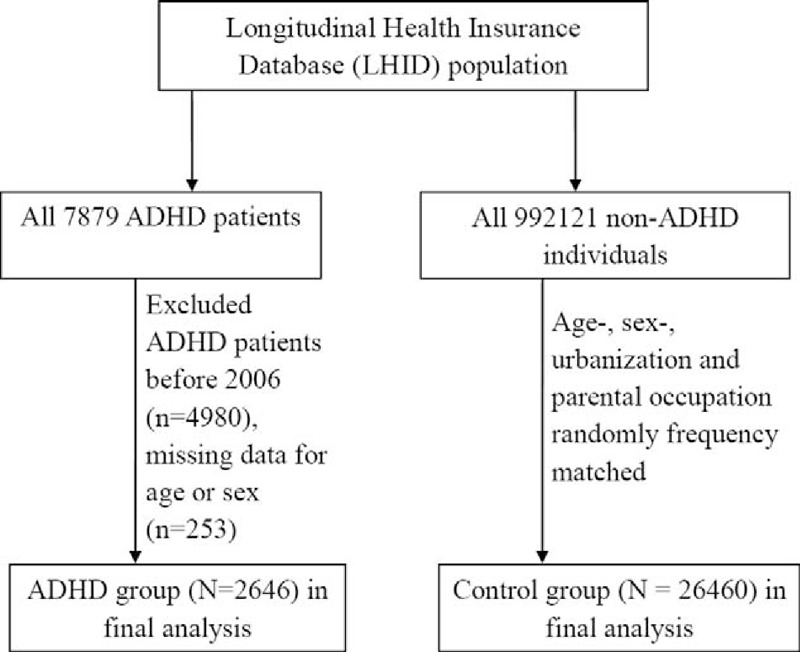
Enterovirus (EV) infection is a major public health issue throughout the world with potential neurological complications. This study evaluated the relationship between attention deficit hyperactivity disorder (ADHD) and EV encephalitis in children.Data of reimbursement claims from the National Health Insurance Research Database of Taiwan were used in a population-based case-control design. The study comprised 2646 children with ADHD who were matched according to sex, age, urbanization level of residence, parental occupation, and baseline year, to people without ADHD at a ratio of 1:10. The index date of the ADHD group was the ADHD date of diagnosis. Histories of EV infections before the index dates were collected and recategorized according to the severity of infection.Compared with children without EV infection, the children with mild EV infection had a 1.16-fold increased risk of ADHD (odds ratio [OR] = 1.16, 95% confidence interval [CI] = 1.07-1.26), and the children with severe EV infection had a greater risk of ADHD (OR = 2.82, 95% CI = 1.05-7.57). The results also revealed a significant correlation between ADHD and the severity of EV infection (P for trend = 0.0001).Patients with EV encephalitis have an increased risk of developing ADHD. Although most EV encephalitis in children has a favorable prognosis, it may be associated with significant long-term neurological sequelae, even in children considered fully recovered at discharge. Neuropsychological testing should be recommended for survivors of childhood EV encephalitis. The causative factors between EV encephalitis and the increased risk of ADHD require further investigation.
Conflict of interest statement
The authors declare no conflicts of interest.
Figures
References
-
- Mental health in the United States: Prevalence of diagnosis and medication treatment for attention-deficit/hyperactivity disorder. United States, 2003. MMWR 2005; 54:842–847. - PubMed
-
- Biederman J, Faraone SV. Current concepts on the neurobiology of attention-deficit/hyperactivity disorder. J Atten Disord 2002; 6:S7–S16. - PubMed
-
- Livingston RB, Fulton JF, Delgado JMR. Fulton JF, et al. Stimulation and regional ablation of orbital surface of frontal lobe. The Frontal Lobes. Baltimore, MD: Williams & Wilkins Company; 1948; 27:405-420. - PubMed
-
- Millichap JG, et al. Historical overview of ADHD. Progress in Pediatric Neurology, III 1997; Chicago, IL: PNB, 195–201.
-
- English T. The after effects of head injuries. Lancet 1904; 1:485–489.
Publication types
MeSH terms
LinkOut - more resources
Full Text Sources
Medical
