Multicenter Study
. 2015 Apr 23;10(4):e0123626.
doi: 10.1371/journal.pone.0123626. eCollection 2015.

Cluster Analysis in Patients with GOLD 1 Chronic Obstructive Pulmonary Disease

Affiliations
Multicenter Study

Cluster Analysis in Patients with GOLD 1 Chronic Obstructive Pulmonary Disease

Philippe Gagnon et al. PLoS One. .

Abstract

Background: We hypothesized that heterogeneity exists within the Global Initiative for Chronic Obstructive Lung Disease (GOLD) 1 spirometric category and that different subgroups could be identified within this GOLD category.

Methods: Pre-randomization study participants from two clinical trials were symptomatic/asymptomatic GOLD 1 chronic obstructive pulmonary disease (COPD) patients and healthy controls. A hierarchical cluster analysis used pre-randomization demographics, symptom scores, lung function, peak exercise response and daily physical activity levels to derive population subgroups.

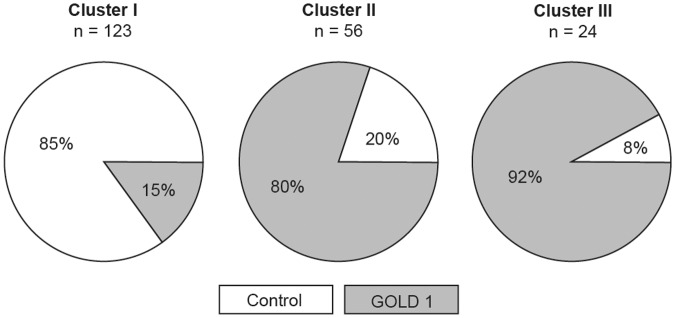
Results: Considerable heterogeneity existed for clinical variables among patients with GOLD 1 COPD. All parameters, except forced expiratory volume in 1 second (FEV1)/forced vital capacity (FVC), had considerable overlap between GOLD 1 COPD and controls. Three-clusters were identified: cluster I (18 [15%] COPD patients; 105 [85%] controls); cluster II (45 [80%] COPD patients; 11 [20%] controls); and cluster III (22 [92%] COPD patients; 2 [8%] controls). Apart from reduced diffusion capacity and lower baseline dyspnea index versus controls, cluster I COPD patients had otherwise preserved lung volumes, exercise capacity and physical activity levels. Cluster II COPD patients had a higher smoking history and greater hyperinflation versus cluster I COPD patients. Cluster III COPD patients had reduced physical activity versus controls and clusters I and II COPD patients, and lower FEV1/FVC versus clusters I and II COPD patients.

Conclusions: The results emphasize heterogeneity within GOLD 1 COPD, supporting an individualized therapeutic approach to patients.

Trial registration: www.clinicaltrials.gov. NCT01360788 and NCT01072396.


Conflict of interest statement

Competing Interests: The authors of this manuscript have the following competing interests: PG declares that he has no competing interests. RC is a consultant for Boehringer Ingelheim, Forest and Novartis. He has served on advisory boards for Boehringer Ingelheim and Forest, and has received payment for lectures including service on speakers’ bureaus from AstraZeneca, Boehringer Ingelheim, Forest, Novartis and Pfizer. He has received payment for development of educational presentations from Boehringer Ingelheim. His institution has received grants from Boehringer Ingelheim, Forest, GlaxoSmithKline and Novartis. DS declares that he has no competing interests. JP reports grants from Boehringer Ingelheim, Inc., personal fees from Boehringer Ingelheim, Inc., non-financial support from Boehringer Ingelheim, Inc., personal fees from Actelion, during the conduct of the study. In addition, he has a patent US 7,628,732 and a patent US 7,927,251 issued. SP is a clinician scientist of the Fonds de la Recherche en Santé du Québec. He has served on advisory boards for Actelion, Eli Lilly, GlaxoSmithKline and Pfizer and has received payment for lectures from Actelion and Eli Lilly. His institution has received grants from Actelion, Bayer and GlaxoSmithKline. JM is a clinician scientist of the Fonds de la Recherche en Santé du Québec and declares that she has no competing interests. JB is a recipient of a CIHR/Rx&D Collaborative Research Program Operating Grants (# 93326) for The Canadian Cohort of Obstructive Lung Disease (CanCOLD). He received research funding via the Research Institute of the McGill University Health Centre, from AstraZeneca, Boehringer Ingelheim, GlaxoSmithKline, Merck, Novartis, Nycomed, Pfizer and Theratechnologies; and has served on speakers, consultation panels and/or advisory boards for the above listed pharmaceutical companies. DEO has served on advisory boards for Boehringer Ingelheim, GlaxoSmithKline, Pfizer and Roche. He has received payment for lectures including service on speakers’ bureaus from Boehringer Ingelheim, GlaxoSmithKline and Pfizer. His institution has received grants from AstraZeneca, Boehringer Ingelheim, GlaxoSmithKline, Novartis, Nycomed and Pfizer. FM holds a GSK/CIHR Research Chair on COPD at Université Laval. He is a consultant for Boehringer Ingelheim. He has served on advisory boards for Boehringer Ingelheim, GlaxoSmithKline and Pfizer and has received payment for lectures including service on speakers bureaus from Boehringer Ingelheim, GlaxoSmithKline, Nycomed and Pfizer. His institution has received grants from Boehringer Ingelheim and GlaxoSmithKline. This does not alter the authors' adherence to PLOS ONE policies on sharing data and materials.

Figures

Fig 1
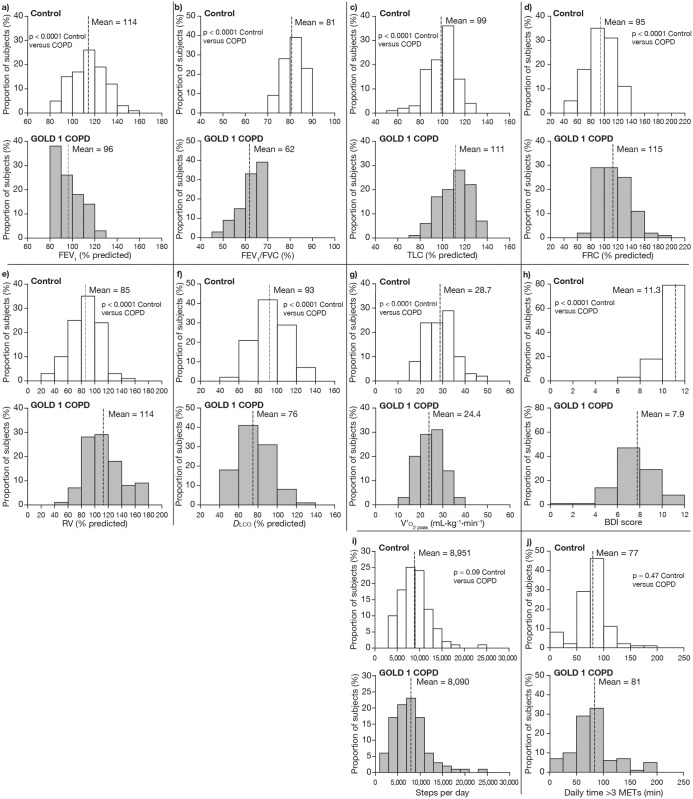
Fig 1. Frequency distributions for pulmonary function, peak V′o2, BDI score and physical activity.
a) forced expiratory volume in 1 second (FEV1); b) FEV1/forced vital capacity (FVC) ratio; c) total lung capacity (TLC); d) functional residual capacity (FRC); e) residual volume (RV); f) diffusion capacity (D lco); g) peak oxygen uptake (V′o 2 peak); h) baseline dyspnea index (BDI) score; i) number of steps per day; j) and daily time spent in physical activity >3 metabolic equivalents (METs). GOLD: Global Initiative for Chronic Obstructive Lung Disease.
Fig 2
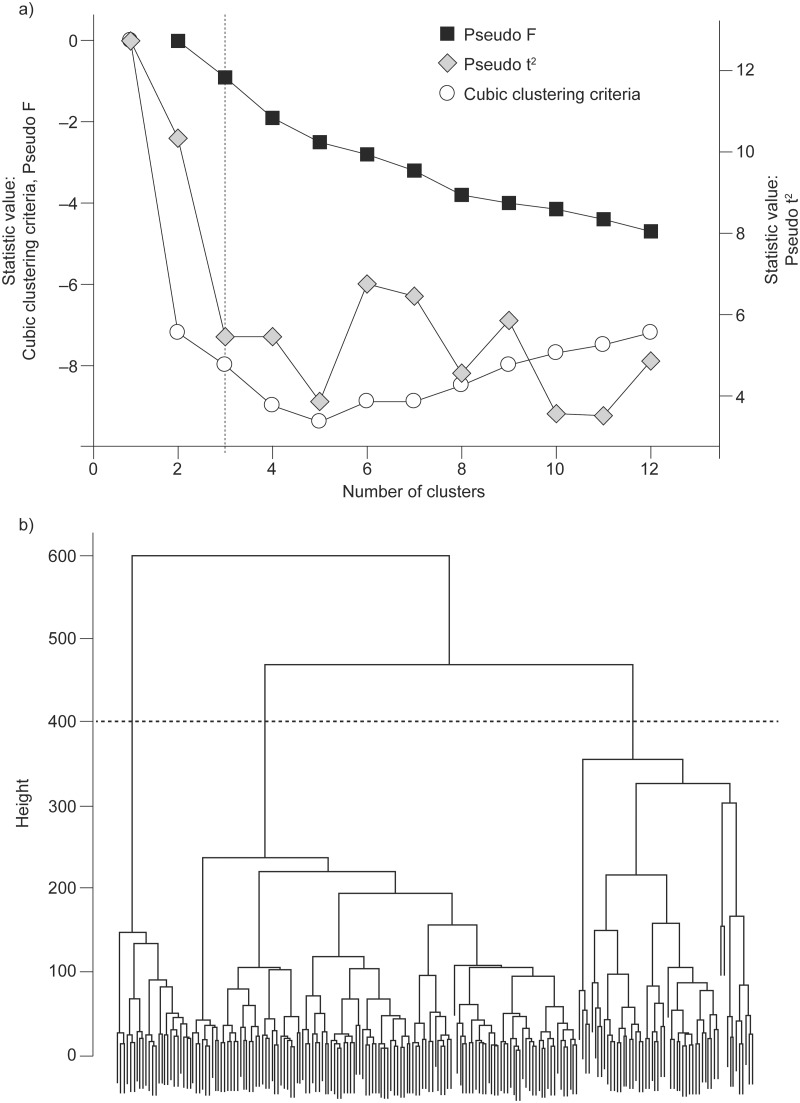
Fig 2. Determination of the number of clusters.
a) Using three statistics (the statistical value of pseudo F statistic and cubic clustering criterion are reported on the left Y axis while the statistical value for pseudo t2 statistic is reported on the right Y axis) and b) hierarchical Ward’s clustering method.
Fig 3
Fig 3. Proportion of controls subjects and patients with GOLD grade 1 COPD within each cluster.
Fig 4
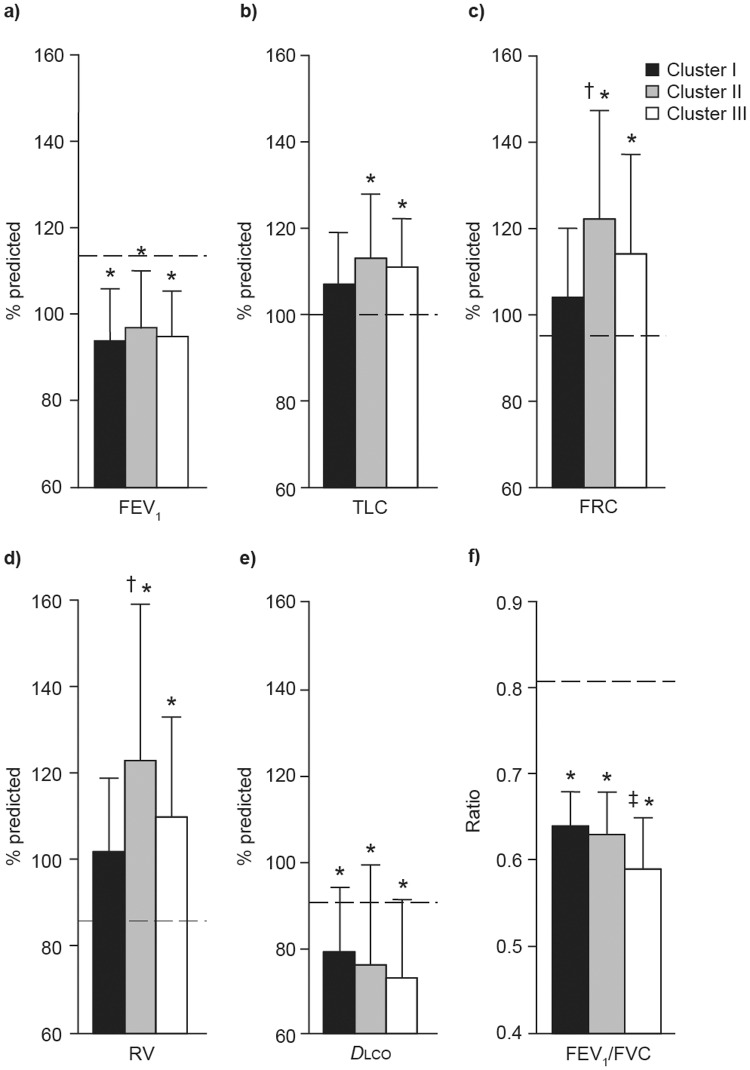
Fig 4. Pulmonary function parameters expressed as percentage of predicted values by cluster.
a) forced expiratory volume in 1 second (FEV1); b) total lung capacity (TLC); c) functional residual volume (FRC); d) residual volume (RV); and e) diffusion capacity (D lco); as well as f) FEV1/forced vital capacity (FVC) ratio by cluster of patients with Global Initiative for Chronic Obstructive Lung Disease (GOLD) grade 1 chronic obstructive pulmonary disease. Values are mean ± SD. Dashed lines represent mean values in control subjects. *p<0.01 versus healthy controls; p<0.05 versus cluster I; p<0.01 versus cluster I and II.
Fig 5
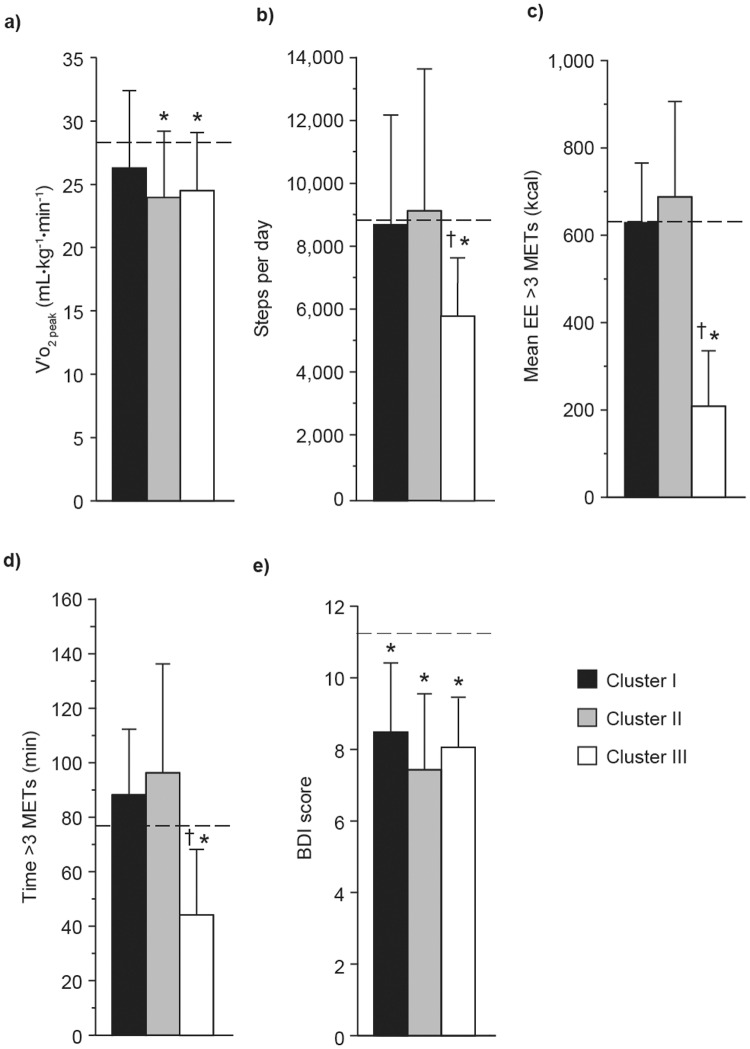
Fig 5. V′o2 peak relative to body weight and daily physical activity levels by cluster.
a) Peak oxygen consumption (V′o 2 peak) relative to body weight; b) mean steps per day; c) mean daily energy expenditure (EE); d) mean daily time >3 metabolic equivalents (METs); and e) baseline dyspnea index (BDI) score by cluster of patients with Global Initiative for Chronic Obstructive Lung Disease (GOLD) grade 1 chronic obstructive pulmonary disease. Values are mean ± SD. Dashed lines represent mean values in control subjects. *p<0.01 versus controls subjects; p<0.05 versus cluster I and II.

References

    1. Global Initiative for Chronic Obstructive Lung Disease. Global strategy for the diagnosis, management, and prevention of chronic obstructive pulmonary disease. January 2014. Available: http://www.goldcopd.org/uploads/users/files/GOLD_Report_2014_Jan23.pdf. Accessed 29 April 2014.
    1. Vestbo J, Hurd SS, Agusti AG, Jones PW, Vogelmeier C, Anzueto A, et al. Global strategy for the diagnosis, management, and prevention of chronic obstructive pulmonary disease: GOLD executive summary. Am J Respir Crit Care Med. 2013;187: 347–365. 10.1164/rccm.201204-0596PP - DOI - PubMed
    1. Burgel PR, Paillasseur JL, Caillaud D, Tillie-Leblond I, Chanez P, Escamilla R, et al. Clinical COPD phenotypes: a novel approach using principal component and cluster analyses. Eur Respir J. 2010;36: 531–539. 10.1183/09031936.00175109 - DOI - PubMed
    1. Buist AS, McBurnie MA, Vollmer WM, Gillespie S, Burney P, Mannino DM, et al. International variation in the prevalence of COPD (the BOLD Study): a population-based prevalence study. Lancet. 2007;370: 741–750. - PubMed
    1. Global Initiative for Chronic Obstructive Lung Disease. Global strategy for the diagnosis, management, and prevention of chronic obstructive pulmonary disease. November 2006. Available: http://www.goldcopd.org/uploads/users/files/GOLDReport2006_0122.pdf. Accessed 29 April 2014.

Publication types

Associated data