. 2015 Nov;49(22):1452-60.
doi: 10.1136/bjsports-2014-094573. Epub 2015 Apr 23.

Three distinct mechanisms predominate in non-contact anterior cruciate ligament injuries in male professional football players: a systematic video analysis of 39 cases

Affiliations

Three distinct mechanisms predominate in non-contact anterior cruciate ligament injuries in male professional football players: a systematic video analysis of 39 cases

Markus Waldén et al. Br J Sports Med. 2015 Nov.

Abstract

Background: Current knowledge on anterior cruciate ligament (ACL) injury mechanisms in male football players is limited.

Aim: To describe ACL injury mechanisms in male professional football players using systematic video analysis.

Methods: We assessed videos from 39 complete ACL tears recorded via prospective professional football injury surveillance between 2001 and 2011. Five analysts independently reviewed all videos to estimate the time of initial foot contact with the ground and the time of ACL tear. We then analysed all videos according to a structured format describing the injury circumstances and lower limb joint biomechanics.

Results: Twenty-five injuries were non-contact, eight indirect contact and six direct contact injuries. We identified three main categories of non-contact and indirect contact injury situations: (1) pressing (n=11), (2) re-gaining balance after kicking (n=5) and (3) landing after heading (n=5). The fourth main injury situation was direct contact with the injured leg or knee (n=6). Knee valgus was frequently seen in the main categories of non-contact and indirect contact playing situations (n=11), but a dynamic valgus collapse was infrequent (n=3). This was in contrast to the tackling-induced direct contact situations where a knee valgus collapse occurred in all cases (n=3).

Conclusions: Eighty-five per cent of the ACL injuries in male professional football players resulted from non-contact or indirect contact mechanisms. The most common playing situation leading to injury was pressing followed by kicking and heading. Knee valgus was frequently seen regardless of the playing situation, but a dynamic valgus collapse was rare.

Keywords: ACL; Anterior cruciate ligament; Football; Prevention; Soccer.


Figures

Figure 1
Figure 1
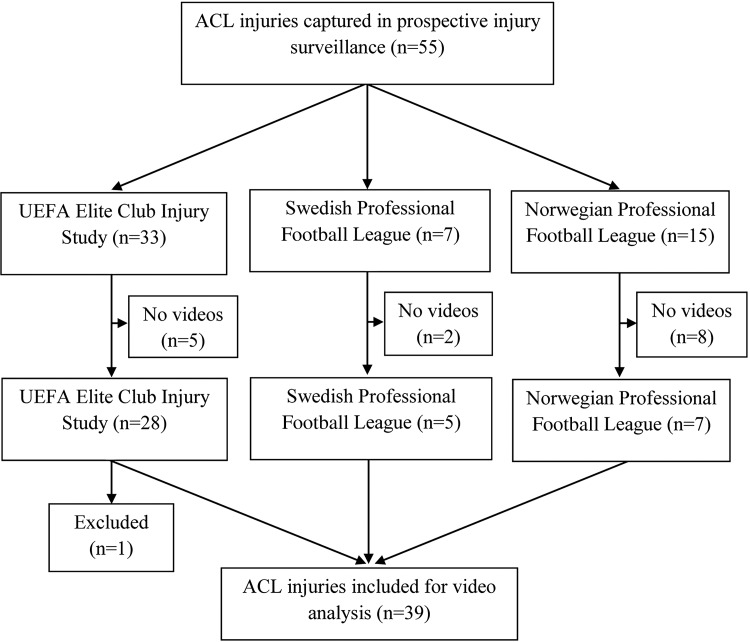
Flow chart showing the process to obtain video sequences of anterior cruciate ligament injuries in prospective injury surveillance of men's professional football players (January 2001–June 2011).
Figure 2
Figure 2
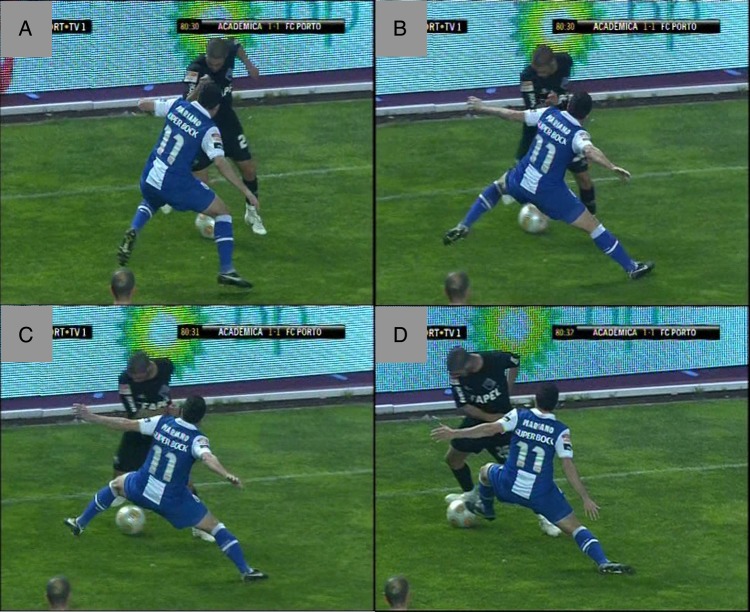
Non-contact pressing mechanism (right knee). (A) At−160 ms, the defending player is running forward at high speed towards the opponent in possession of the ball. (B) At initial contact, he strikes the pitch with his right heel and makes a sidestep cut in an effort to reach the ball or to tackle the opponent, but no player contact. (C) At 80 ms, he rotates the trunk towards his left leg and puts the entire load on his right leg. (D) At 240 ms the right hip and knee joints are in abducted positions and the ankle joint is in eversion (dynamic valgus without collapse).
Figure 3
Figure 3
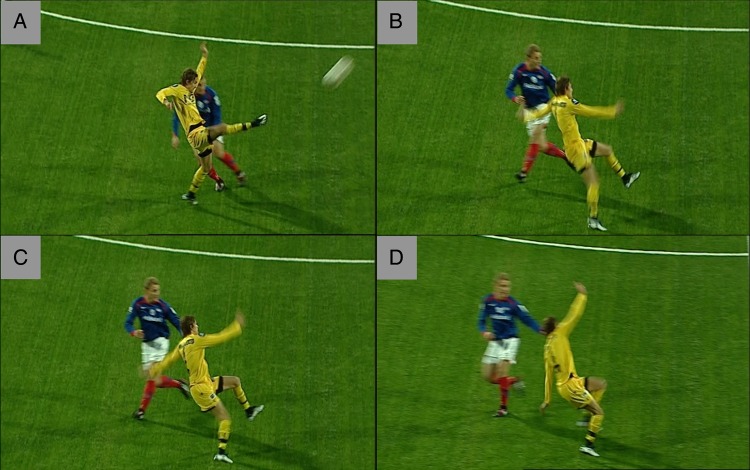
Non-contact kicking mechanism (right knee). (A) At−220 ms, the player is clearing the ball with his right foot. (B) At initial contact, he strikes the pitch with the forefoot and rotates the trunk to the left. (C) At 40 ms, being out of balance backwards, he puts the entire load on his right leg. (D) At 140 ms, his right knee joint is abducted and the ankle joint is in eversion (dynamic valgus without collapse).
Figure 4
Figure 4
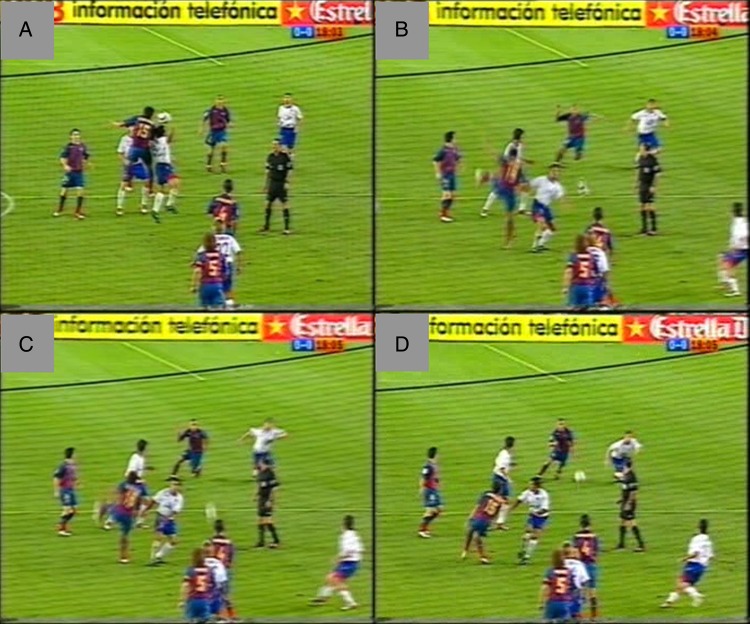
Non-contact heading mechanism (right knee). (A) At−306 ms, the player wins a heading duel while having trunk-to trunk contact in the air with his opponent. (B) At initial contact, he lands at high vertical speed on his right leg striking the pitch with the forefoot. (C) At 80 ms, being out of balance both backwards and sideways, he puts the entire load on his right leg. (D) At 186 ms, his right knee joint clearly give way in substantial abduction (dynamic valgus collapse).
Figure 5
Figure 5
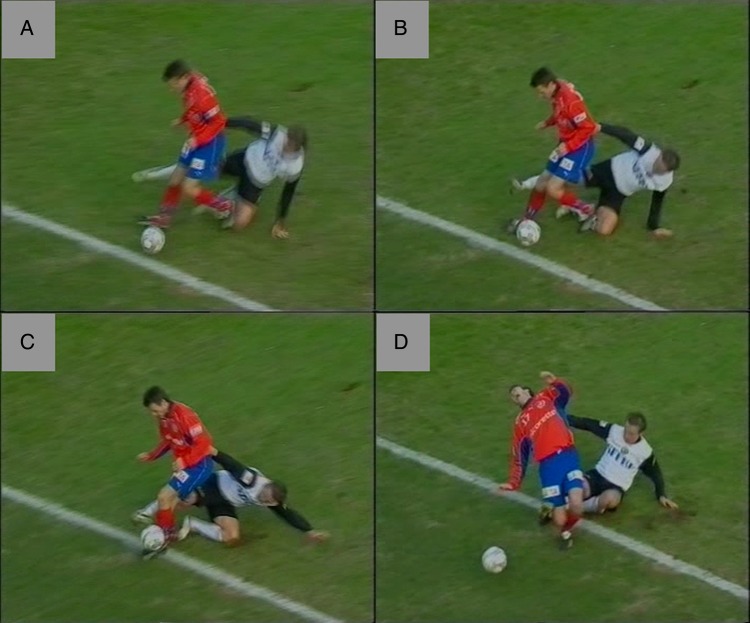
Direct contact mechanism (right knee). (A) At−60 ms, the player is jogging forward at slow speed towards the sideline trying to screen the ball from the opponent. (B) At initial contact, he strikes the pitch with his right heel and holds the trunk in a neutral position. (C) At 140 ms, having the entire load on his right leg, he is tackled from behind with forceful lateral impact to the knee joint. (D) At 440 ms, he falls backwards and his right knee clearly give way in substantial abduction (dynamic valgus collapse).

References

    1. Busfield BT, Kharrazi FD, Starkey C, et al. Performance outcomes of anterior cruciate ligament reconstruction in the National Basketball Association. Arthroscopy 2009;25:825–30. 10.1016/j.arthro.2009.02.021 - DOI - PubMed
    1. Shah VM, Andrews JR, Fleisig GS, et al. Return to play after anterior cruciate ligament reconstruction in National Football League athletes. Am J Sports Med 2010;38:2233–9. 10.1177/0363546510372798 - DOI - PubMed
    1. Waldén M, Hägglund M, Magnusson H, et al. Anterior cruciate ligament injury in elite football: a prospective three-cohort study. Knee Surg Sports Traumatol Arthrosc 2011;19:11–19. 10.1007/s00167-010-1170-9 - DOI - PubMed
    1. Erickson BJ, Harris JD, Cvetanovich GL, et al. Performance and return to sport after anterior cruciate ligament reconstruction in male Major League Soccer players. Orthop J Sports Med 2013;1:2325967113497189. - PMC - PubMed
    1. Ekstrand J, Hägglund M, Kristenson K, et al. Fewer ligament injuries but no preventive effect on muscle injuries and severe injuries: an 11-year follow-up of the UEFA Champions League injury study. Br J Sports Med 2013;47:732–7. 10.1136/bjsports-2013-092394 - DOI - PubMed

Publication types