


Model demonstrates functional purpose of the nasal cycle
- PMID: 25907572
- PMCID: PMC4416271
- DOI: 10.1186/s12938-015-0034-4
Model demonstrates functional purpose of the nasal cycle
Abstract
Background: Despite the occurrence of the nasal cycle being well documented, the functional purpose of this phenomenon is not well understood. This investigation seeks to better understand the physiological objective of the nasal cycle in terms of airway health through the use of a computational nasal air-conditioning model.
Method: A new state-variable heat and water mass transfer model is developed to predict airway surface liquid (ASL) hydration status within each nasal airway. Nasal geometry, based on in-vivo magnetic resonance imaging (MRI) data is used to apportion inter-nasal air flow.
Results: The results demonstrate that the airway conducting the majority of the airflow also experiences a degree of ASL dehydration, as a consequence of undertaking the bulk of the heat and water mass transfer duties. In contrast, the reduced air conditioning demand within the other airway allows its ASL layer to remain sufficiently hydrated so as to support continuous mucociliary clearance.
Conclusions: It is quantitatively demonstrated in this work how the nasal cycle enables the upper airway to accommodate the contrasting roles of air conditioning and the removal of entrapped contaminants through fluctuation in airflow partitioning between each airway.
Figures
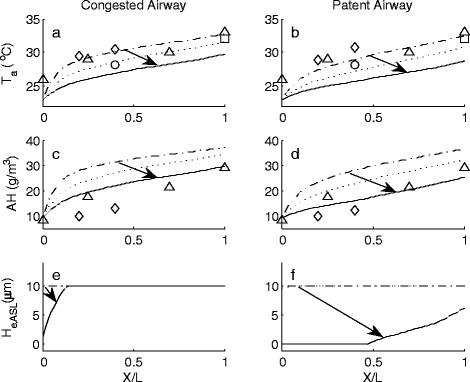
 = commencement of inhalation,
  = intermediate value,
  = maximal reduction during inhalation. ∆ = Keck et al. [7], ○ = Wiesmiller et al. [57], ◊ = Lindemann et al. [58], □ = Lindemann et al. [59].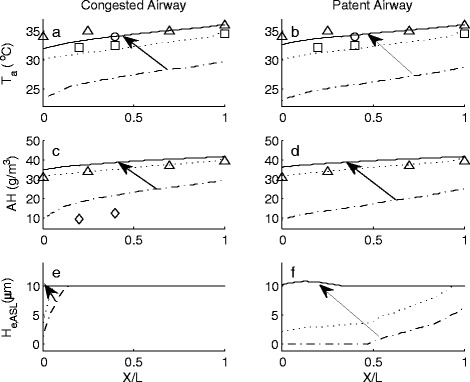
 = commencement of exhalation,
  = intermediate value,
  = maximal increase during exhalation. ∆ = Keck et al. [7], ○ = Wiesmiller et al. [57], □ = Lindemann et al. [59].
References
-
- Bartley J. Breathing matters: a New Zealand guide. 1. Auckland: Random House; 2006.
Publication types
MeSH terms
LinkOut - more resources
Full Text Sources
Other Literature Sources
