


Globalization of continuing professional development by journal clubs via microblogging: a systematic review
- PMID: 25908092
- PMCID: PMC4424319
- DOI: 10.2196/jmir.4194
Globalization of continuing professional development by journal clubs via microblogging: a systematic review
Abstract
Background: Journal clubs are an essential tool in promoting clinical evidence-based medical education to all medical and allied health professionals. Twitter represents a public, microblogging forum that can facilitate traditional journal club requirements, while also reaching a global audience, and participation for discussion with study authors and colleagues.
Objective: The aim of the current study was to evaluate the current state of social media-facilitated journal clubs, specifically Twitter, as an example of continuing professional development.
Methods: A systematic review of literature databases (Medline, Embase, CINAHL, Web of Science, ERIC via ProQuest) was performed according to Preferred Reporting Items for Systematic Reviews and Meta-Analyses (PRISMA) guidelines. A systematic search of Twitter, the followers of identified journal clubs, and Symplur was also performed. Demographic and monthly tweet data were extracted from Twitter and Symplur. All manuscripts related to Twitter-based journal clubs were included. Statistical analyses were performed in MS Excel and STATA.
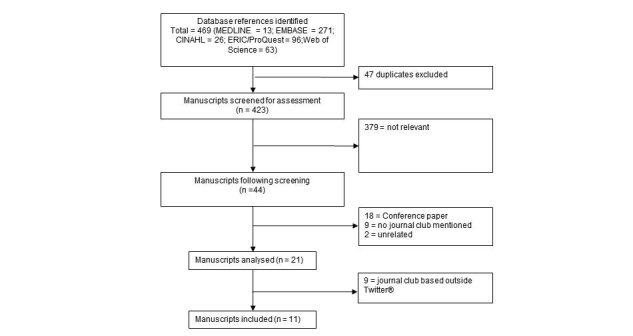
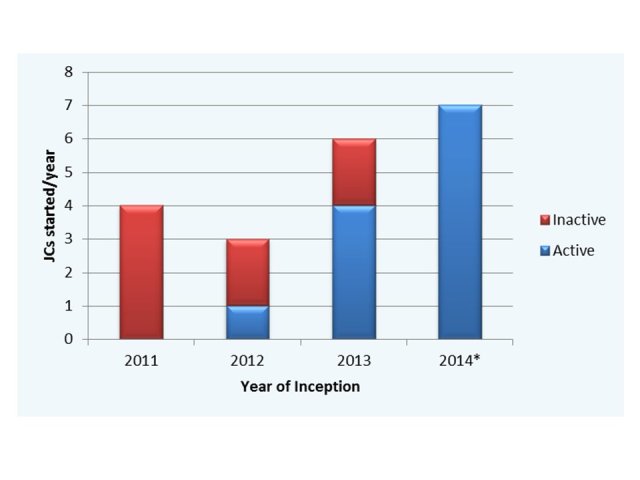
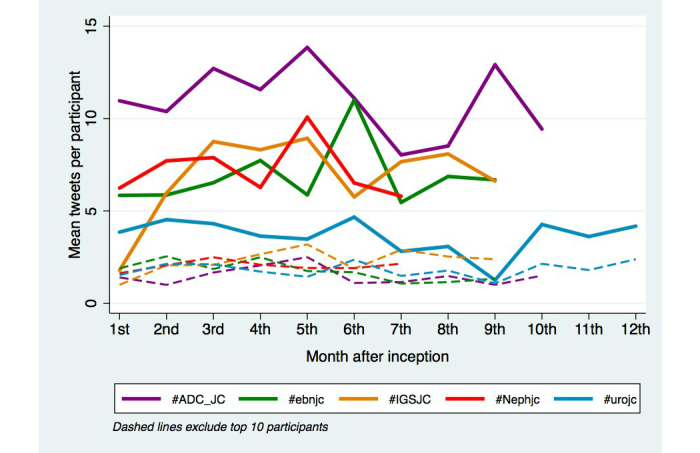
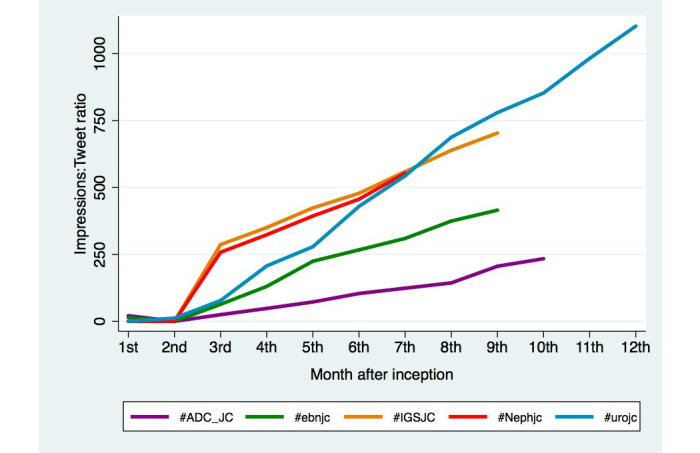
Results: From a total of 469 citations, 11 manuscripts were included and referred to five Twitter-based journal clubs (#ALiEMJC, #BlueJC, #ebnjc, #urojc, #meded). A Twitter-based journal club search yielded 34 potential hashtags/accounts, of which 24 were included in the final analysis. The median duration of activity was 11.75 (interquartile range [IQR] 19.9, SD 10.9) months, with 7 now inactive. The median number of followers and participants was 374 (IQR 574) and 157 (IQR 272), respectively. An overall increasing establishment of active Twitter-based journal clubs was observed, resulting in an exponential increase in total cumulative tweets (R(2)=.98), and tweets per month (R(2)=.72). Cumulative tweets for specific journal clubs increased linearly, with @ADC_JC, @EBNursingBMJ, @igsjc, @iurojc, and @NephJC, and showing greatest rate of change, as well as total impressions per month since establishment. An average of two tweets per month was estimated for the majority of participants, while the "Top 10" tweeters for @iurojc showed a significantly lower contribution to overall tweets for each month (P<.005). A linearly increasing impression:tweet ratio was observed for the top five journal clubs.
Conclusions: Twitter-based journal clubs are free, time-efficient, and publicly accessible means to facilitate international discussions regarding clinically important evidence-based research.
Keywords: continuing medical education; continuing professional development; journal club; social media; systematic review.
Conflict of interest statement
Conflicts of Interest: None declared.
Figures
Comment in
-
Twitter-Based Journal Clubs: Additional Facts and Clarifications.J Med Internet Res. 2015 Sep 16;17(9):e216. doi: 10.2196/jmir.4639. J Med Internet Res. 2015. PMID: 26376668 Free PMC article. No abstract available.
-
Response to "Twitter-Based Journal Clubs: Some Additional Facts and Clarifications".J Med Internet Res. 2015 Sep 18;17(9):e217. doi: 10.2196/jmir.4786. J Med Internet Res. 2015. PMID: 26385506 Free PMC article. No abstract available.
References
-
- Linzer M. The journal club and medical education: over one hundred years of unrecorded history. Postgrad Med J. 1987 Jun;63(740):475–8. http://pmj.bmj.com/cgi/pmidlookup?view=long&pmid=3324090 - PMC - PubMed
-
- Sidorov J. How are internal medicine residency journal clubs organized, and what makes them successful? Arch Intern Med. 1995 Jun 12;155(11):1193–7. - PubMed
-
- Alguire P C. A review of journal clubs in postgraduate medical education. J Gen Intern Med. 1998 May;13(5):347–53. http://europepmc.org/abstract/MED/9613892 - PMC - PubMed
Publication types
MeSH terms
LinkOut - more resources
Full Text Sources
Other Literature Sources
