Review
. 2015 Apr 24;116(9):1561-78.
doi: 10.1161/CIRCRESAHA.115.303565.

Modulating the vascular response to limb ischemia: angiogenic and cell therapies

Affiliations
Review

Modulating the vascular response to limb ischemia: angiogenic and cell therapies

John P Cooke et al. Circ Res. .

Abstract

The age-adjusted prevalence of peripheral arterial disease in the US population has been estimated to approach 12%. The clinical consequences of occlusive peripheral arterial disease include pain on walking (claudication), pain at rest, and loss of tissue integrity in the distal limbs; the latter may ultimately lead to amputation of a portion of the lower extremity. Surgical bypass techniques and percutaneous catheter-based interventions may successfully reperfuse the limbs of certain patients with peripheral arterial disease. In many patients, however, the anatomic extent and distribution of arterial occlusion is too severe to permit relief of pain and healing of ischemic ulcers. No effective medical therapy is available for the treatment of such patients, for many of whom amputation represents the only hope for alleviation of symptoms. The ultimate failure of medical treatment and procedural revascularization in significant numbers of patients has led to attempts to develop alternative therapies for ischemic disease. These strategies include administration of angiogenic cytokines, either as recombinant protein or as gene therapy, and more recently, to investigations of stem/progenitor cell therapy. The purpose of this review is to provide an outline of the preclinical basis for angiogenic and stem cell therapies, review the clinical research that has been done, summarize the lessons learned, identify gaps in knowledge, and suggest a course toward successfully addressing an unmet medical need in a large and growing patient population.

Keywords: angiogenesis; genetic therapy; microvessels; progenitor cell; stem cells; vasculogenesis.


Figures

Figure
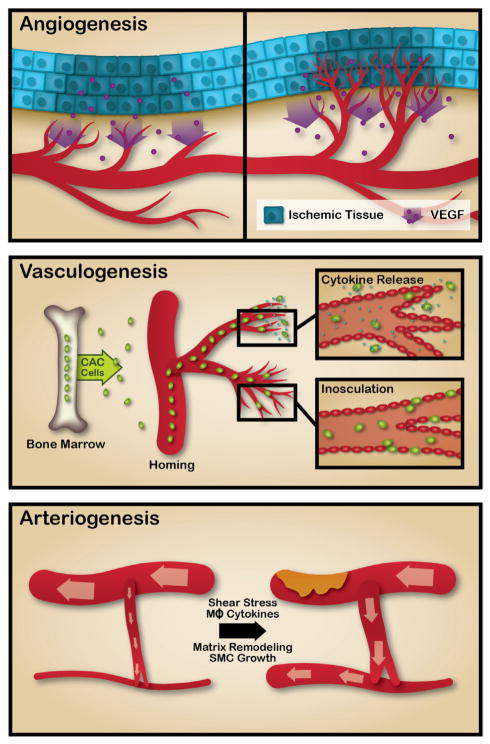
Figure. Angiogenesis is triggered by reduced oxygen delivery to the tissue, which induces the elaboration by ischemic cells of angiogenic factors such as vascular endothelial growth factor (VEGF)
Angiogenesis is characterized by capillary sprouting, endothelial cell migration, proliferation, and luminogenesis to generate new capillaries. Adult vasculogenesis is mediated by the action of circulating cells such as endothelial progenitor cells (EPCs). EPCs are a heterogenous population of cells, largely of hematopoietic lineage, and are characterized by cell-surface antigen markers including CD34, CD133, and VEGF receptor 2 (VEGFR-2). These circulating cells contribute to the expansion of the microvasculature via multiple mechanisms, secretion of paracrine factors playing a prominent role. A small subset of these cells seem to incorporate into the vasculature (inosculation). Arteriogenesis is a positive remodeling of pre-existing collateral channels in the limb. There is little to no flow through these narrow, high resistance channels in healthy individuals. However, when major conduits become severely narrowed or occluded, more flow becomes directed through the collateral channels. Under the influence of vascular shear stress, the diameter of these channels increase. This positive remodeling seems to be because of endothelial factors, as well as infiltrating macrophages. The remodeling process is characterized by dynamic restructuring of the extracellular matrix with degradation and synthesis; vascular smooth muscle cell apoptosis as well as proliferation, which lead to an increased diameter and thickness of the vessel.

References

    1. Folkman J. Tumor angiogenesis: therapeutic implications. N Engl J Med. 1971;285:1182–1186. doi: 10.1056/NEJM197111182852108. - DOI - PubMed
    1. Raval Z, Losordo DW. Cell therapy of peripheral arterial disease: from experimental findings to clinical trials. Circ Res. 2013;112:1288–1302. doi: 10.1161/CIRCRESAHA.113.300565. - DOI - PMC - PubMed
    1. Lawall H, Bramlage P, Amann B. Treatment of peripheral arterial disease using stem and progenitor cell therapy. J Vasc Surg. 2011;53:445–453. doi: 10.1016/j.jvs.2010.08.060. - DOI - PubMed
    1. Casey DP, Joyner MJ. Skeletal muscle blood flow responses to hypoperfusion at rest and during rhythmic exercise in humans. J Appl Physiol (1985) 2009;107:429–437. doi: 10.1152/japplphysiol.00331.2009. - DOI - PMC - PubMed
    1. Duncker DJ, Bache RJ. Regulation of coronary blood flow during exercise. Physiol Rev. 2008;88:1009–1086. doi: 10.1152/physrev.00045.2006. - DOI - PubMed

Publication types

MeSH terms

Substances