


Etiology of Acute Diarrhea in Tunisian Children with Emphasis on Diarrheagenic Escherichia coli: Prevalence and Identification of E. coli Virulence Markers
- PMID: 25909062
- PMCID: PMC4401059
Etiology of Acute Diarrhea in Tunisian Children with Emphasis on Diarrheagenic Escherichia coli: Prevalence and Identification of E. coli Virulence Markers
Abstract
Background: Diarrheal diseases can be caused by viral, bacterial and parasitic infections. This paper provides a preliminary image of diarrhea with regards to etiology and epidemiologic factors in Tunisian children less than five years of age.
Methods: Overall, 124 diarrhoeal stools were collected from patients suffering from acute diarrhea and 54 stool samples from healthy children. All stools were examined for the presence of enteric pathogens.
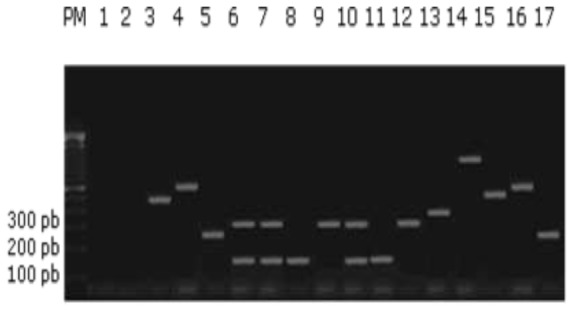
Results: In diarrheagenic children, 107 pathogenic bacteria were isolated (12 Salmonella spp. (9.7%) and 95 diarrheagenic Escherichia coli strains (76.6%): 29 enteroaggregative E.coli (EAEC) (23.4%), 15 enteroinvasive E.coli (EIEC) (12.1%), 17 enteropathogenic E.coli (EPEC) (13.7%), 26 enterotoxigenic E.coli (ETEC) (21%) and 2 enterohemoragic E.coli (EHEC) (1.6%). However, in the control group, 23 pathogenic E.coli strains were isolated (42.6%): 8 EAEC (14.8%), 12 EIEC (22.2%) and 3 EPEC (5.5%). Among diarrheagenic E.coli (DEC), only ETEC strains were significantly recovered from diarrheagenic children than from healthy controls (P < 0.0003). Group A rotavirus was identified in 33.9% (n=42) of diarrheagenic children and in 11.1% among the control group (n=6). Concerning norovirus, 8.9% (n=11) of the samples collected from diarrheagenic children and 9.2% (n=5) from the control group were positive. The prevalence of rotaviruses and Salmonella spp were also significantly higher in patients with diarrhea than in controls (P = 0.002 and P < 0.019, respectively). Finally, enteropathogenic parasites (Entamoeba coli and cryptosporidium Oocystes) were isolated from 4.8% and 9.2% of diarrheagenic and control children, respectively.
Conclusion: These results provide baseline data about the relative importance of different enteropathogens in Tunisian children.
Keywords: Children; Diagnosis; Diarrhea; Enteric pathogens; Escherichia coli; Tunisia.
Figures
References
-
- Musher DM, Musher BL (2004). Contagious acute gastrointestinal infections. N Engl J Med, 351: 2417–2427. - PubMed
-
- Baudry B, Savarino SJ, Vial P, Kaper JB, Levine MM (1990). A sensitive and specific DNA probe to identify enteroaggregative Escherichia coli, a recently discovered diarrheal pathogen. J Infect Dis, 161: 1249–1251. - PubMed
-
- Jertborn M, Svennerhalm AM (1991). Enterotoxtin-producing bacteria isolated from Swedish travelers with diarrhea. Scand J Infect Dis, 23: 473–479. - PubMed
-
- Tate JE, Burton AH, Boschi-Pinto C, Steele AD, Duque J, Parashar UD (2012). 2008 estimate of worldwide rotavirus-associated mortality in children younger than 5 years before the introduction of universal rotavirus vaccination programmes: a systematic review and meta-analysis. Lancet Infect Dis, 12(2): 136–141. - PubMed
LinkOut - more resources
Full Text Sources
Research Materials
Miscellaneous