. 2015 Apr;2(4):353-61.
doi: 10.1002/acn3.175. Epub 2015 Feb 6.

Identification of distinct circulating exosomes in Parkinson's disease

Affiliations

Identification of distinct circulating exosomes in Parkinson's disease

Paul R Tomlinson et al. Ann Clin Transl Neurol. 2015 Apr.

Abstract

Objective: Whether circulating microvesicles convey bioactive signals in neurodegenerative diseases remains currently unknown. In this study, we investigated the biochemical composition and biological function of exosomes isolated from sera of patients with Parkinson's disease (PD).

Methods: Proteomic analysis was performed on microvesicle preparations from grouped samples of patients with genetic and sporadic forms of PD, amyotrophic lateral sclerosis, and healthy subjects. Nanoparticle-tracking analysis was used to assess the number and size of exosomes between patient groups. To interrogate their biological effect, microvesicles were added to primary rat cortical neurons subjected to either nutrient deprivation or sodium arsenite.

Results: Among 1033 proteins identified, 23 exosome-associated proteins were differentially abundant in PD, including the regulator of exosome biogenesis syntenin 1. These protein changes were detected despite similar exosome numbers across groups suggesting that they may reflect exosome subpopulations with distinct functions. Accordingly, we showed in models of neuronal stress that Parkinson's-derived microvesicles have a protective effect.

Interpretation: Collectively, these data suggest for the first time that immunophenotyping of circulating exosome subpopulations in PD may lead to a better understanding of the systemic response to neurodegeneration and the development of novel therapeutics.


Figures
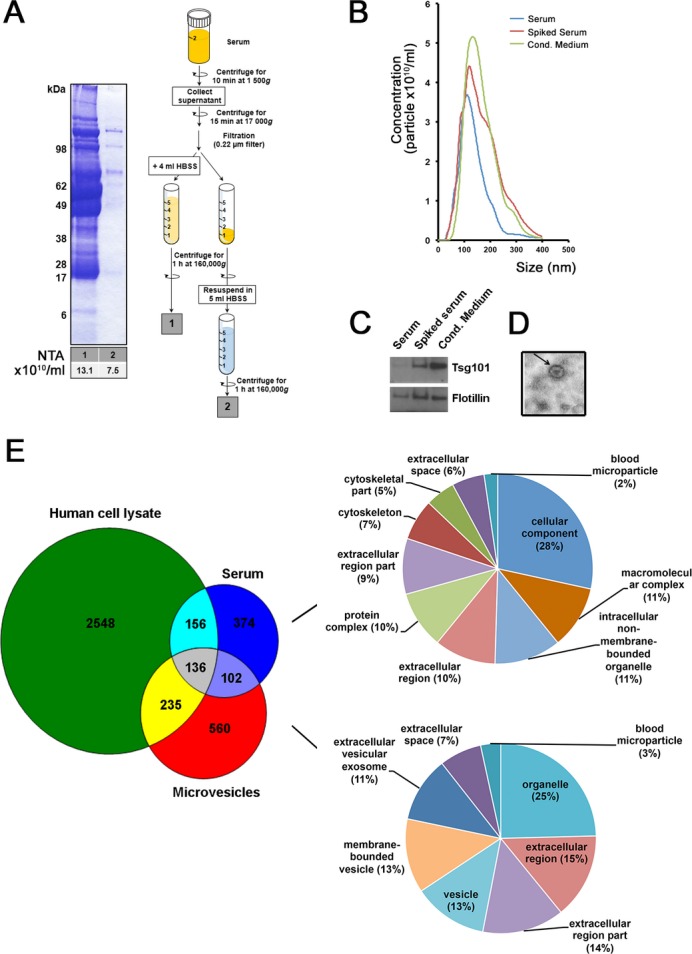
Figure 1
Figure 1
Isolation and characterization of circulating microvesicles. (A) Flow diagram showing the extraction method used and Coomassie staining of the final microvesicle preparation. Note that an additional wash step significantly reduces the number of contaminant proteins without major changes in microvesicle numbers. (B) Nanoparticle-tracking analysis of serum microvesicles revealed a major peak at the size corresponding to exosomes isolated from NSC34-conditioned media, whereas spike-in experiments showed a further increment in microvesicles of the same size. (C) Immunoblotting confirmed the presence of the exosome markers flotillin1 and Tsg101 both in cell-conditioned media and serum preparations (D) Electron microscopy showed membrane-bound microvesicles, negatively stained with 2% aqueous uranyl acetate on a formvar film. (E) Venn diagram showing protein overlap between albumin/immunoglobulin depleted serum, serum microvesicles, and human cell lysates. Proteins were quantified using Oribtrap-Velos LC-MS/MS. The enrichment for serum-derived microvesicles enables the identification and quantitation of proteins that are not detected in routinely processed serum samples as shown by gene ontology analysis.
Figure 2
Figure 2
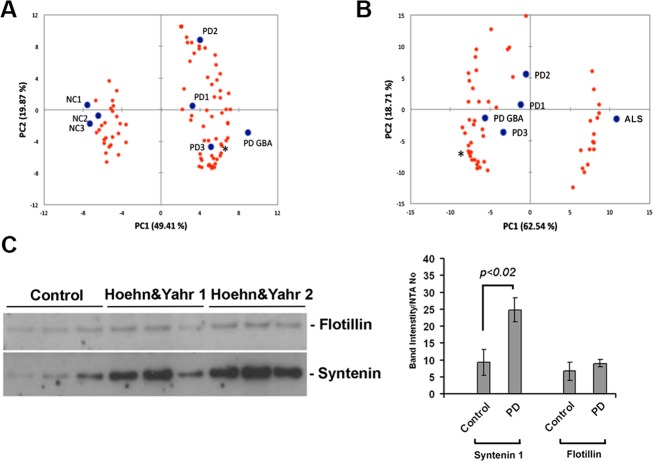
Differential proteomic composition of PD-derived microvesicles. (A) Significant protein differences were calculated after grouping of the samples into controls and PD (ANOVA P < 0.05). Principal component analysis (PCA) shows the separation of the analyzed samples (blue dots) and the loading of the 82 proteins (red dots). Syntenin 1 is marked with * (1.8-fold increase, P < 0.009). (B) Fifty-three proteins of the 82 proteins in (A) further separate PD from ALS samples (ANOVA P < 0.05). (C) Immunoblotting with specific antibodies against syntenin 1 confirmed the mass spectrometry finding in a separate group of early PD patients (Hoehn & Yahr 1 or 2) compared to controls (*< 0.02, t-test). PD, Parkinson's disease; ANOVA, analysis of variance; ALS, amyotrophic lateral sclerosis.
Figure 3
Figure 3
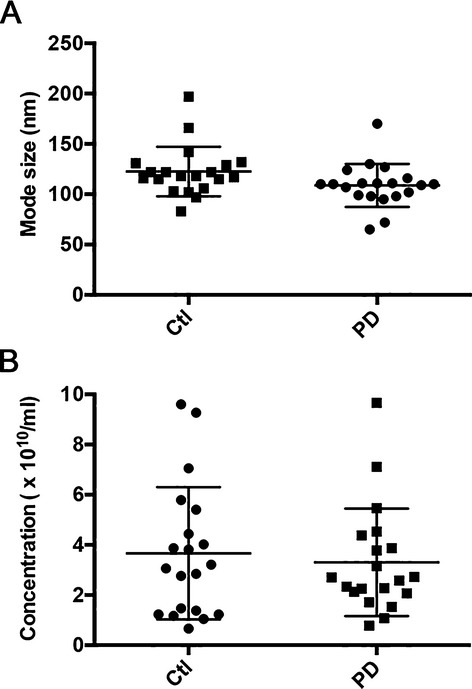
Microvesicle abundance and size do not differ between PD patients and controls. NTA was performed on microvesicles extracted from individual PD patient samples and healthy-matched controls (n = 20 per group). The NTA profiles showed a single peak that is typical of exosomes (100–120 nm) as demonstrated by the close mode size clustering of microvesicles from each sample (A). When averaged, the mean size (panel A) or concentration (B) of exosomes was not significantly different between the two groups. Error bars indicate standard deviation. PD, Parkinson's disease; NTA, nanoparticle-tracking analysis.
Figure 4
Figure 4
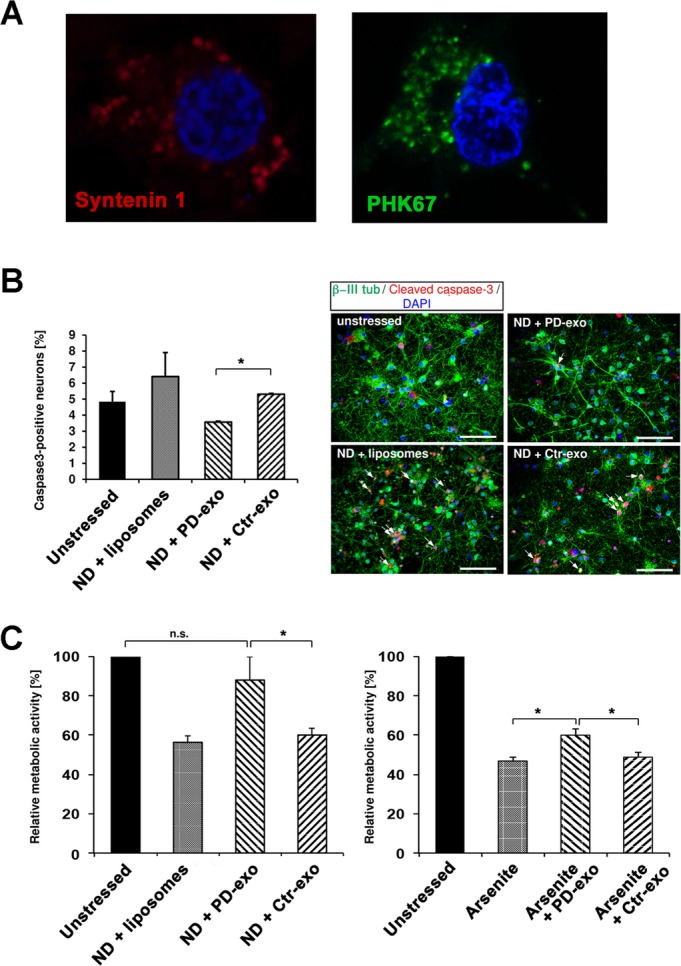
Parkinson's disease (PD)-derived microvesicles convey a neuroprotective effect. (A) Confocal images of human-specific anti-syntenin 1 (red) and 4‘,6-diamidino-2-phenylindole (nucleus, blue) staining showing uptake of human microvesicles in primary rat cortical neurons. Neuronal uptake was confirmed using exosomes prelabeled with the PHK67 fluorescent dye. (B) Caspase 3 activation was significantly reduced in neurons treated with PD-derived microvesicles compared to controls (n = 20 per group, P < 0.05). Representative images of caspase 3 and β-III tubulin doubly positive neurons under different experimental conditions. (C) Neuronal metabolic activity was assessed by the MTT assay in neurons pretreated with PD or control exosomes under conditions of either nutrient deprivation (left graph, n = 30 per group, < 0.05) or treatment with 0.5 mmol/L of sodium arsenite (right graph, n = 20 per group, < 0.05).

References

    1. Tofaris GK. Lysosome-dependent pathways as a unifying theme in Parkinson's disease. Mov Disord. 2012;27:1364–9. - PubMed
    1. Shannon KM, Keshavarzian A, Dodiya HB, et al. Is alpha-synuclein in the colon a biomarker for premotor Parkinson's disease? Evidence from 3 cases. Mov Disord. 2012;27:716–719. - PubMed
    1. Besong-Agbo D, Wolf E, Jessen F, et al. Naturally occurring α-synuclein autoantibody levels are lower in patients with Parkinson disease. Neurology. 2013;8:169–175. - PubMed
    1. Scherzer CR, Eklund AC, Morse LJ, et al. Molecular markers of early Parkinson's disease based on gene expression in blood. Proc Natl Acad Sci USA. 2007;104:955–960. - PMC - PubMed
    1. EL Andaloussi S, Mäger I, Breakefield XO, Wood MJ. Extracellular vesicles: biology and emerging therapeutic opportunities. Nat Rev Drug Discov. 2013;12:347–357. - PubMed