. 2015 May;78(5):1034-8.
doi: 10.1097/TA.0000000000000598.

SIRT1 mediates a primed response to immune challenge after traumatic lung injury

Affiliations

SIRT1 mediates a primed response to immune challenge after traumatic lung injury

Lane M Smith et al. J Trauma Acute Care Surg. 2015 May.

Abstract

Background: Pulmonary contusion (PC) is a common, potentially lethal injury that results in priming for exaggerated inflammatory responses to subsequent immune challenge like infection (second hit). The molecular mechanism of priming and the second hit phenomenon after PC remain obscure. With the use of a mouse model of PC, this study explores the role of sirtuin 1 (SIRT1), an NAD+-dependent deacetylase, in priming for a second hit after injury.

Methods: With the use of a mouse model of PC, injury-primed second-hit host responses were tested at 24 hours after PC by (1) in vivo infectious challenge of injured mice or (2) ex vivo inflammatory challenge of isolated immune cells from injured mice. SIRT activators or repressors were used to test for SIRT1 participation in these second-hit responses.

Results: PC-injured mice given an in vivo infectious challenge by cecal ligation and puncture (CLP) had significantly increased mortality compared with injury or infectious challenge alone. Isolated bronchoalveolar lavage (BAL) cells from injured mice given an ex vivo inflammatory challenge with bacterial lipopolysaccharide (LPS) had increased levels of tumor necrosis factor α messenger RNA compared with uninjured mice. We found that PC reduced SIRT1 protein, messenger RNA, and SIRT1 enzymatic activity in injured lung tissue. We also found decreased SIRT1 protein levels in BAL cells from injured mice. We further found that injured mice treated with a SIRT1 activator, resveratrol, showed significantly decreased polymorphonuclear leukocytes (PMN) in the BAL in response to intratracheal LPS and increased survival from CLP.

Conclusion: These results showed that PC decreased SIRT1 levels in the lung correlated with enhanced responses to infectious or inflammatory stimuli in injured mice. Treatment of injured mice with a SIRT1 activator, resveratrol, decreased LPS inflammatory response and increased survival after CLP. Our results suggest that SIRT1 participates in the second-hit response after injury.


Conflict of interest statement

All authors declare no conflicts of interest.

Figures
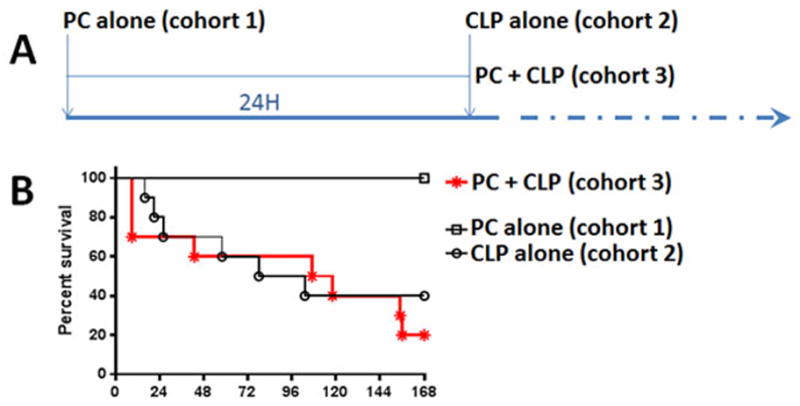
Figure 1
Figure 1. Injured mice show decrease survival after infectious challenge
Survival studies were performed on 3 cohorts as shown in (A). Mice received blunt chest trauma resulting in PC (PC alone, cohort 1), infectious challenge by CLP (CLP alone, cohort 2), or PC followed 24H later by CLP (PC+CLP, cohort 3). n = 10 mice/cohort. Survival was followed for 7 days (168H) after CLP (B). Survival was significantly decreased (p=0.001) for injured mice with infection (20%) compared to injury (100%) or infection (40%) alone.
Figure 2
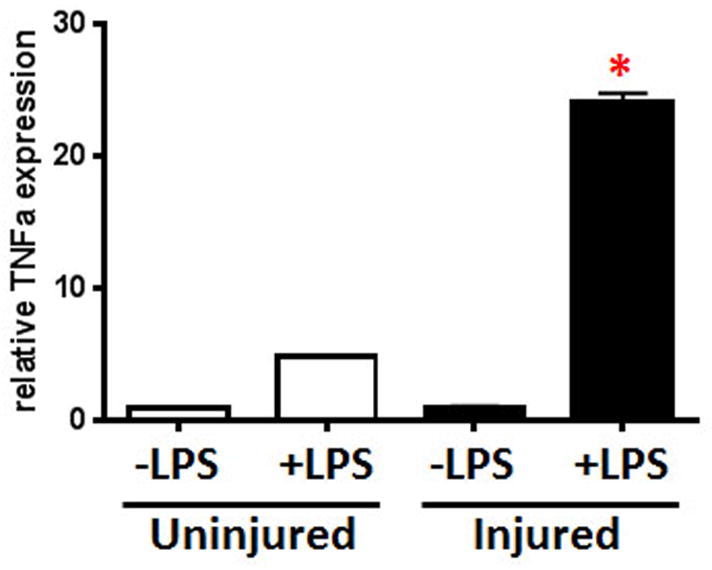
Figure 2. Isolated BAL cells from injured mice show increased inflammatory response after LPS challenge
BAL cells were isolated from Uninjured and Injured mice (24H) and inflammatory response to LPS (−/+LPS, 2H) determined by TNFa expression. Results shown are reported as relative TNFa expression using GAPDH mRNA as the internal control. n=2 for all groups except Injured+LPS where n=4; qPCR analyses were performed in duplicate; *p<0.0001 for Injured+LPS compared to Uninjured+LPS.
Figure 3
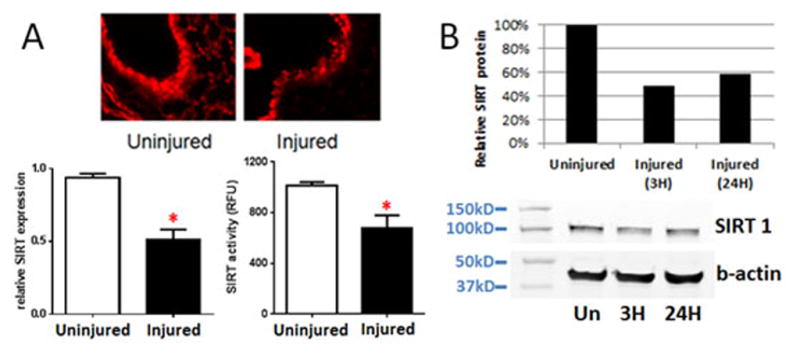
Figure 3. PC reduces SIRT1 levels in the injured lung
After 24 hours, lung tissue from injured mice was removed and compared to lung tissue from uninjured mice. Lung tissue (A) was fixed and stained for SIRT1 protein (upper panel) or processed for RNA analysis (lower left) or SIRT activity (lower right). A representative section of uninjured (n=1) and injured (n=3) lung is shown. PCR results shown are reported as relative SIRT expression using GAPDH mRNA as the internal control (n=8, *p<0.0001). SIRT activity results are reported as specific SIRT1 activity in RFU (n=3 uninjured; n=4 injured, *p<0.05). At 3 or 24 hours after PC, BAL cells from injured mice (n=4) were harvested, pooled and analyzed for SIRT1 protein (B). SIRT1 or b-actin (loading control) levels were quantitated by densitometric analysis of the immunoblot and reported as SIRT1 protein levels in injured mice relative to uninjured mice.
Figure 4
Figure 4. Injured mice treated with SIRT1 activator show improved survival after sepsis and decreased inflammatory responses in the injured lung
Uninjured (RES+CLP) and injured mice (PC+RES+CLP) were treated with resveratrol prior to CLP (A). Survival was significantly increased in PC+RES+CLP mice (n=10, 80% survival) compared to untreated PC+CLP mice (p=.001, compare with Fig. 1B). Resveratrol treatment did not improve survival in mice with CLP alone (n=8, 38% survival). Injured mice were treated with resveratrol prior to a 4H LPS challenge (B). PMN in the BAL were quantitated and showed a significant decrease (*p=0.001) compared to untreated mice. Results are reported as total BAL PMN (mean±SEM, n=6 mice/cohort).

References

    1. Watkins TR, Nathens AB, Cooke CR, Psaty BM, Maier RV, Cuschieri J, Rubenfeld GD. Acute respiratory distress syndrome after trauma: development and validation of a predictive model. Critical care medicine. 2012;40:2295–2303. - PMC - PubMed
    1. Hoth JJ, Wells JD, Jones SE, Yoza BK, McCall CE. Complement mediates a primed inflammatory response after traumatic lung injury. The journal of trauma and acute care surgery. 2014;76:601–608. discussion 608–609. - PMC - PubMed
    1. Lasanianos NG, Kanakaris NK, Dimitriou R, Pape HC, Giannoudis PV. Second hit phenomenon: existing evidence of clinical implications. Injury. 2011;42:617–629. - PubMed
    1. Chang HC, Guarente L. SIRT1 and other sirtuins in metabolism. Trends in endocrinology and metabolism: TEM. 2014;25:138–145. - PMC - PubMed
    1. Liu TF, Brown CM, El Gazzar M, McPhail L, Millet P, Rao A, Vachharajani VT, Yoza BK, McCall CE. Fueling the flame: bioenergy couples metabolism and inflammation. Journal of leukocyte biology. 2012;92:499–507. - PMC - PubMed

Publication types

MeSH terms