


Association of Prenatal Exposure to Persistent Organic Pollutants with Obesity and Cardiometabolic Traits in Early Childhood: The Rhea Mother-Child Cohort (Crete, Greece)
- PMID: 25910281
- PMCID: PMC4590761
- DOI: 10.1289/ehp.1409062
Association of Prenatal Exposure to Persistent Organic Pollutants with Obesity and Cardiometabolic Traits in Early Childhood: The Rhea Mother-Child Cohort (Crete, Greece)
Abstract
Background: Prenatal exposure to endocrine-disrupting chemicals such as persistent organic pollutants (POPs) may increase risk of obesity later in life.
Objective: We examined the relation of in utero POPs exposure to offspring obesity and cardiometabolic risk factors at 4 years of age in the Rhea mother-child cohort in Crete, Greece (n = 689).
Methods: We determined concentrations of polychlorinated biphenyls (PCBs), dichlorodiphenyldichloroethylene (DDE), and hexachlorobenzene (HCB) in first-trimester maternal serum. We measured child weight, height, waist circumference, skinfold thicknesses, blood pressure (BP), blood levels of lipids, C-reactive protein, and adipokines at 4 years of age. Childhood obesity was defined using age- and sex-specific cut points for body mass index (BMI) as recommended by the International Obesity Task Force.
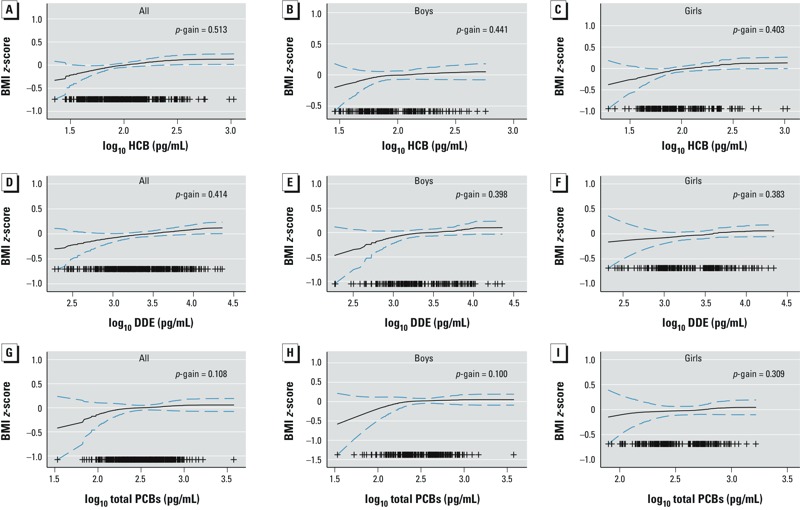
Results: On multivariable regression analyses, a 10-fold increase in HCB was associated with a higher BMI z-score (adjusted β = 0.49; 95% CI: 0.12, 0.86), obesity [relative risk (RR) = 8.14; 95% CI: 1.85, 35.81], abdominal obesity (RR = 3.49; 95% CI: 1.08, 11.28), greater sum of skinfold thickness (β = 7.71 mm; 95% CI: 2.04, 13.39), and higher systolic BP (β = 4.34 mmHg; 95% CI: 0.63, 8.05) at 4 years of age. Prenatal DDE exposure was associated with higher BMI z-score (β = 0.27; 95% CI: 0.04, 0.5), abdominal obesity (RR = 3.76; 95% CI: 1.70, 8.30), and higher diastolic BP (β = 1.79 mmHg; 95% CI: 0.13, 3.46). PCBs were not significantly associated with offspring obesity or cardiometabolic risk factors.
Conclusions: Prenatal exposure to DDE and HCB was associated with excess adiposity and higher blood pressure levels in early childhood.
Conflict of interest statement
The authors declare they have no actual or potential competing financial interests.
Figures
Comment in
-
Obesogen Holdover: Prenatal Exposure Predicts Cardiometabolic Risk Factors in Childhood.Environ Health Perspect. 2015 Oct;123(10):A265. doi: 10.1289/ehp.123-A265. Environ Health Perspect. 2015. PMID: 26421652 Free PMC article. No abstract available.
References
-
- Aminov Z, Haase RF, Pavuk M, Carpenter DO, Anniston Environmental Health Research Consortium 2013Analysis of the effects of exposure to polychlorinated biphenyls and chlorinated pesticides on serum lipid levels in residents of Anniston, Alabama. Environ Health 12108; 10.1186/1476-069X-12-108 - DOI - PMC - PubMed
-
- Arnold DL, Moodie CA, Collins BT, Zawidzka ZZ, Krewski DR. Two-generation chronic toxicity study with hexachlorobenzene in the rat. IARC Sci Publ. 1986;77:405–410. - PubMed
-
- Baillie-Hamilton PF. Chemical toxins: a hypothesis to explain the global obesity epidemic. J Altern Complement Med. 2002;8(2):185–192. - PubMed
-
- Chapados NA, Casimiro C, Robidoux MA, Haman F, Batal M, Blais JM, et al. Increased proliferative effect of organochlorine compounds on human preadipocytes. Mol Cell Biochem. 2012;365(1–2):275–278. - PubMed
-
- Chatzi L, Plana E, Daraki V, Karakosta P, Alegkakis D, Tsatsanis C, et al. Metabolic syndrome in early pregnancy and risk of preterm birth. Am J Epidemiol. 2009;170(7):829–836. - PubMed
Publication types
MeSH terms
Substances
Grants and funding
LinkOut - more resources
Full Text Sources
Other Literature Sources
Medical
Research Materials