. 2015 Jul;66(13):3855-63.
doi: 10.1093/jxb/erv187. Epub 2015 Apr 23.

LATERAL ROOT PRIMORDIA 1 of maize acts as a transcriptional activator in auxin signalling downstream of the Aux/IAA gene rootless with undetectable meristem 1

Affiliations

LATERAL ROOT PRIMORDIA 1 of maize acts as a transcriptional activator in auxin signalling downstream of the Aux/IAA gene rootless with undetectable meristem 1

Yanxiang Zhang et al. J Exp Bot. 2015 Jul.

Abstract

Only little is known about target genes of auxin signalling downstream of the Aux/IAA-ARF module. In the present study, it has been demonstrated that maize lateral root primordia 1 (lrp1) encodes a transcriptional activator that is directly regulated by the Aux/IAA protein ROOTLESS WITH UNDETECTABLE MERISTEM 1 (RUM1). Expression of lrp1 is confined to early root primordia and meristems and is auxin-inducible. Based on its primary protein structure, LRP1 is predicted to be a transcription factor. This notion is supported by exclusive LRP1 localization in the nucleus and its ability to activate downstream gene activity. Based on the observation that lrp1 transcription is completely repressed in the semi-dominant gain of function mutant rum1, it was demonstrated that the lrp1 promoter is a direct target of RUM1 proteins. Subsequently, promoter activation assays indicated that RUM1 represses the expression of a GFP reporter fused to the native promoter of lrp1. Constitutive repression of lrp1 in rum1 mutants is a consequence of the stability of mutated rum1 proteins which cannot be degraded by the proteasome and thus constitutively bind to the lrp1 promoter and repress transcription. Taken together, the repression of the transcriptional activator lrp1 by direct binding of RUM1 to its promoter, together with specific expression of lrp1 in root meristems, suggests a function in maize root development via the RUM1-dependent auxin signalling pathway.

Keywords: Aux/IAA; LATERAL ROOT PRIMORDIA 1 (LRP1); RUM1; crown root; differentiation zone; maize; transcriptional activator..


Figures

Fig. 1.
Fig. 1.
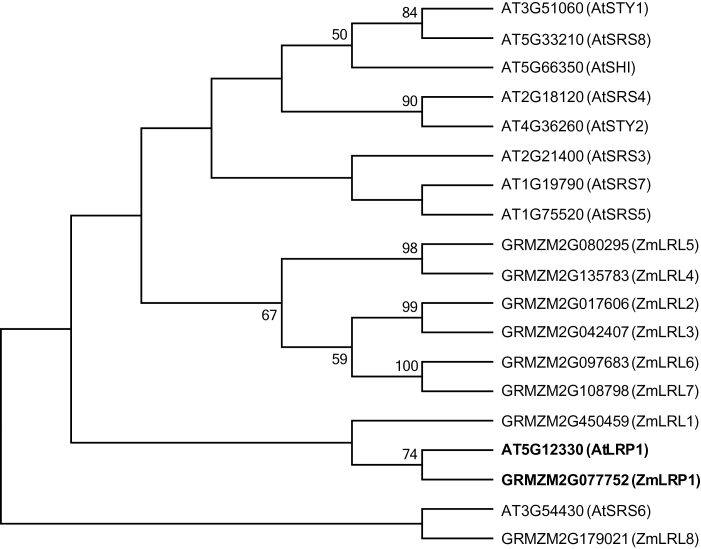
The plant-specific SRS protein family. Phylogenetic relationships of the maize and Arabidopsis SRS families were generated by MEGA5. Maize LRP1 and Arabidopsis AtLRP1 are highlighted in bold.
Fig. 2.
Fig. 2.
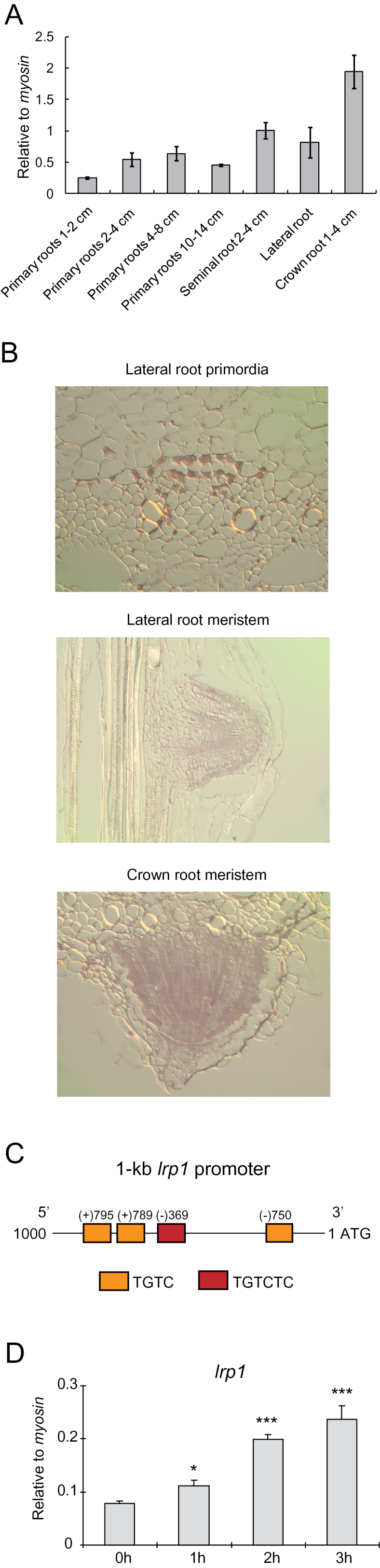
Expression patterns of lrp1 in root tissues. (A) qRT-PCR analyses demonstrated the expression of lrp1 in seven specific different root tissues. (B) In situ hybridization experiments revealed the expression of lrp1 in crown root meristems and lateral root primordia and meristems of maize roots. (C) AuxRE analysis of 1-kb lrp1 promoters of maize. TGTCTC is highlighted by a red box, and TGTC is denoted by a yellow box. (D) Expression of lrp1 in primary roots of wild-type seedlings after auxin treatment with 5 μM 1-NAA for 0, 1, 2, or 3h, assayed by qRT-PCR relative to myosin (*, P ≤0.05; **, P ≤0.01; ***, P ≤0.001; n=4). (This figure is available in colour at JXB online.)
Fig. 3.
Fig. 3.
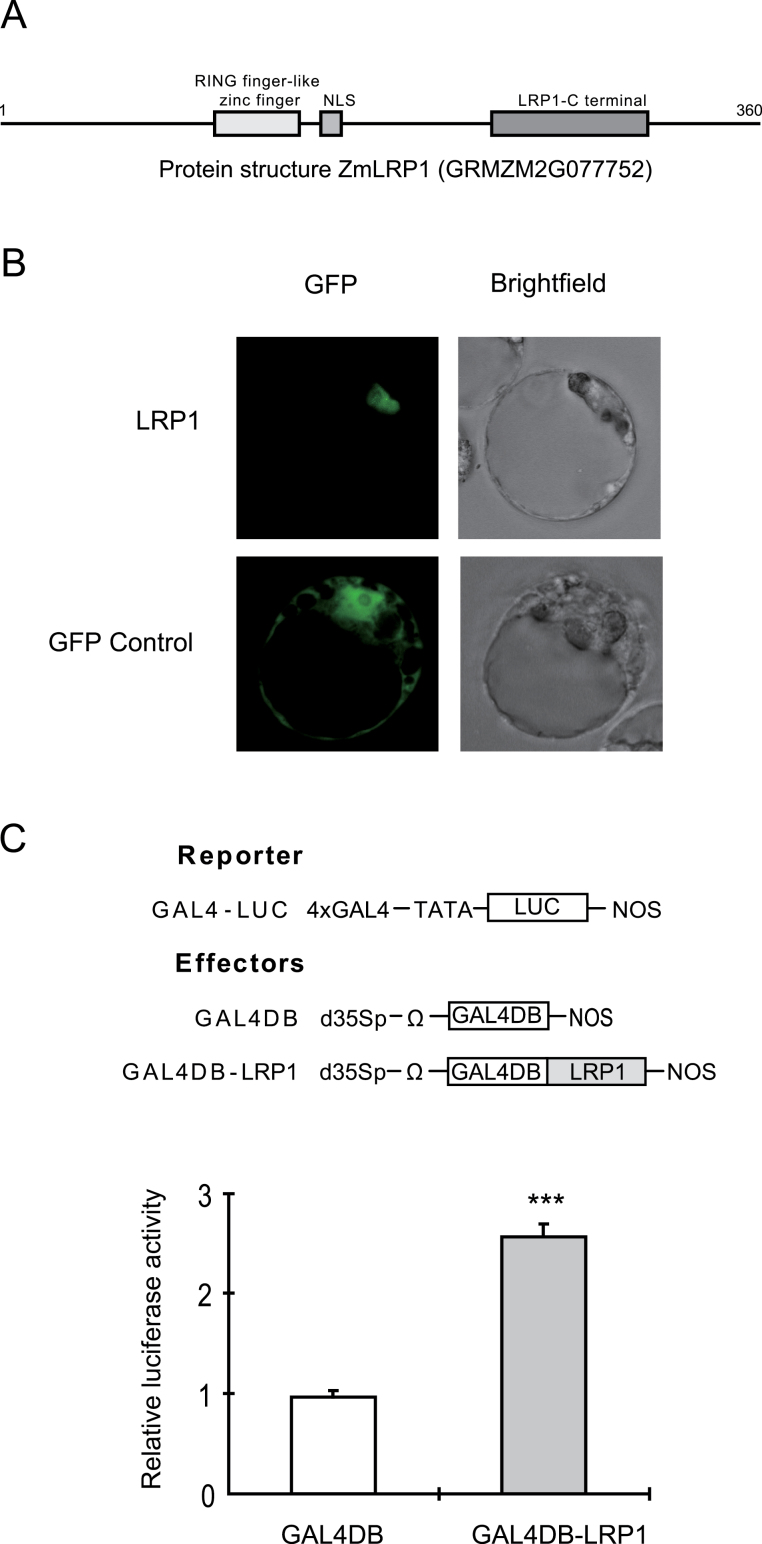
LRP1 acts as a transcriptional activator. (A) The protein structure of maize LRP1. The RING-like zinc finger domain, nuclear localization signal, and LRP1 C-terminal domain are shaded in grey. (B) Subcellular localization of LRP1. The GFP control proteins are localized in both the cytoplasm and the nucleus while the wild-type LRP1–GFP fusion protein localizes only to the nucleus. (C) LRP1 transient co-transfection assay. After co-transformation of Arabidopsis Col-0 protoplasts with the reporter construct GAL4-LUC, the effector construct GAL4DB and GAL4DB-LRP1, and the reference construct, the relative luciferase activities are assayed. All luciferase activities are expressed relative to values obtained with the GAL4DB control (GAL4DB set arbitrarily at 1). (This figure is available in colour at JXB online.)
Fig. 4.
Fig. 4.
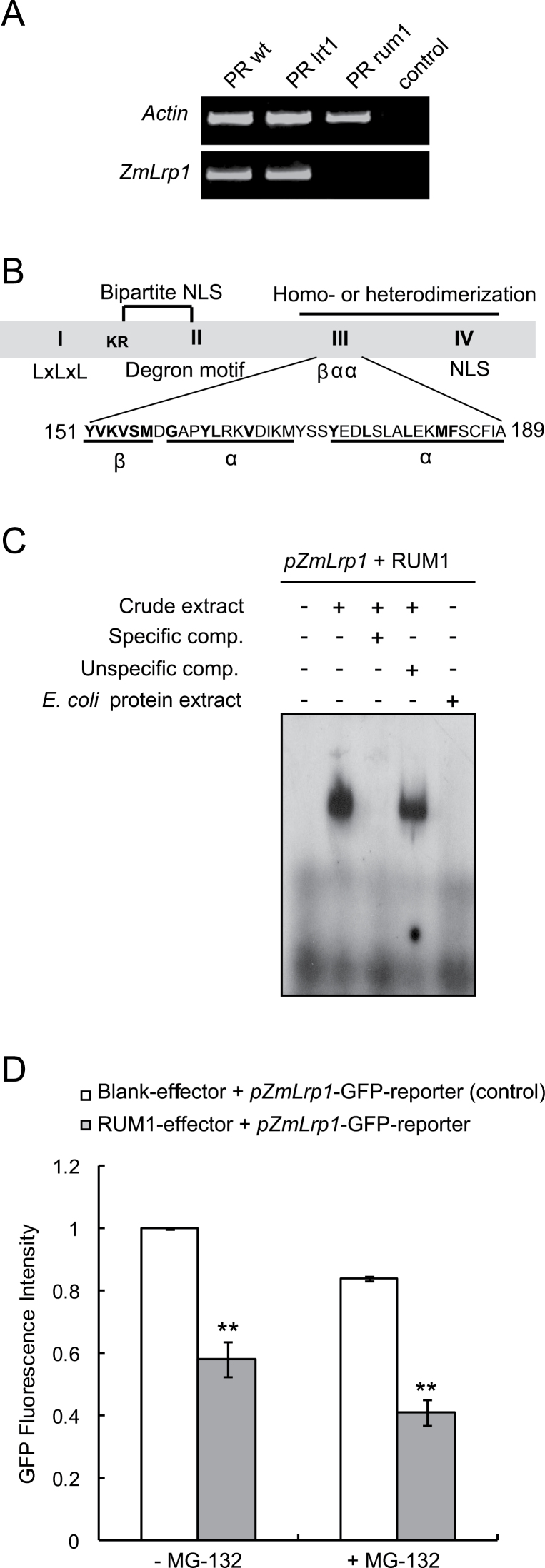
Molecular interaction of RUM1 with lrp1. (A) Semi-quantitative RT-PCR with cDNA based on RNA isolated from wild-type, lrt1 and rum1 primary roots (PR) indicates an absence of lrp1 transcripts in the primary root of the mutant rum1. The water control was negative. (B) Structure of RUM1 protein with conserved domains I, II, III, and IV. Domain I contains the sequence LxLxL which plays a putative role as transcriptional repressor (Tiwari et al., 2004). Degron motif GWPPV in Domain II is responsible for interaction with the SCFTIR complex. Domains III and IV are involved in homo or heterodimerization (Kim et al., 1997; Ulmasov et al., 1997). Domain III contains a βαα motif which is predicted to act in DNA-binding (Abel et al., 1994). The conserved hydrophobic residues characteristic of the predicted amphipathic βαα fold are in bold. (C) Direct binding of RUM1 to [γ-32P]-ATP labelled 75bp lrp1 promoter fragments containing a central AuxRE motif. A 50× excess of unlabelled 75bp probe was used as a specific competitor while a 50× excess of λ-DNA was used as an unspecific competitor. (D) lrp1 promoter activation by RUM1. RUM1 effector co-expressed with lrp1 promoter-driven GFP reporter gene (RUM1+pZmLrp1–GFP-reporter) in Arabidopsis protoplasts under standard conditions or MG-132 treatment after co-transformation. GFP fluorescence intensity was quantified by flow cytometry. The normalization of transformation efficiencies was performed according to Li et al. (2010a). The co-transformation of the blank-effector and pZmLrp1–GFP-reporter was used as a negative control. Statistical significance between the two experiments were determined by Student′s t test (*, P ≤0.05; **, P ≤0.01).

References

    1. Abel S. 2007. Auxin is surfacing. ACS Chemical Biology 2, 380–384. - PubMed
    1. Abel S, Oeller PW, Theologis A. 1994. Early auxin-induced genes encode short-lived nuclear proteins. Proceedings of the National Academy of Sciences, USA 91, 326–330. - PMC - PubMed
    1. Benjamins R, Scheres B. 2008. Auxin: the looping star in plant development. Annual Reviews in Plant Biology 59, 443–465. - PubMed
    1. Brendel V, Kurtz S, Walbot V. 2002. Comparative genomics of Arabidopsis and maize: prospects and limitations. Genome Biology 3, Reviews1005. - PMC - PubMed
    1. Dolan L, Janmaat K, Willemsen V, Linstead P, Poethig S, Roberts K, Scheres B. 1993. Cellular organization of the Arabidopsis thaliana root. Development 119, 71–84. - PubMed

Publication types

MeSH terms