. 2015 Oct;55(10):2464-72.
doi: 10.1111/trf.13134. Epub 2015 Apr 23.

Effects of nitric oxide and its congeners on sickle red blood cell deformability

Affiliations

Effects of nitric oxide and its congeners on sickle red blood cell deformability

Andrea M Belanger et al. Transfusion. 2015 Oct.

Abstract

Background: Sickle cell disease (SCD) is characterized by hemoglobin polymerization upon deoxygenation. Polymerization causes the sickle cells to become rigid and misshapen (sickling). Red blood cell (RBC) dehydration greatly increases polymerization. Cycles of sickling and unsickling cause an influx of calcium that leads to loss of potassium via the calcium-activated Gardos channel, which dehydrates the cells leading to increased polymerization. In this study the effects of nitric oxide (NO) and its congeners on RBC deformability were examined, focusing on sickle RBCs (sRBCs).

Study design and methods: RBCs from patients with SCD and from nonpatients were exposed to various compounds that release NO or its congeners. Intracellular calcium was increased using a calcium ionophore or cycling of oxygen tension for sRBCs. Deformability was measured by laser-assisted osmotic gradient ektacytometry.

Results: Consistent with a previous report, sodium nitroprusside (SNP) was found to protect against calcium-induced loss of deformability in normal RBCs, but (contrary to some previous reports) no effect of any NO donors was observed when calcium influx was not induced. Importantly, in studies of deoxygenation-induced dehydration of sRBCs, SNP resulted in substantial improvements in deformability (p = 0.036) and hydration (p = 0.024). Sodium nitrite showed similar trends. SNP was shown to have no effect on calcium influx, but reduced potassium efflux.

Conclusion: These data suggest that SNP and perhaps certain nitrogen oxides (like nitrite) inhibit the Gardos channel and may be able to protect sickle cells from dehydration and thereby improve outcome in the disease.


Conflict of interest statement

Conflicts of Interest: Dr. Kim-Shapiro and Gladwin are listed as co-authors on a patent application for use of nitrite in cardiovascular diseases.

Figures
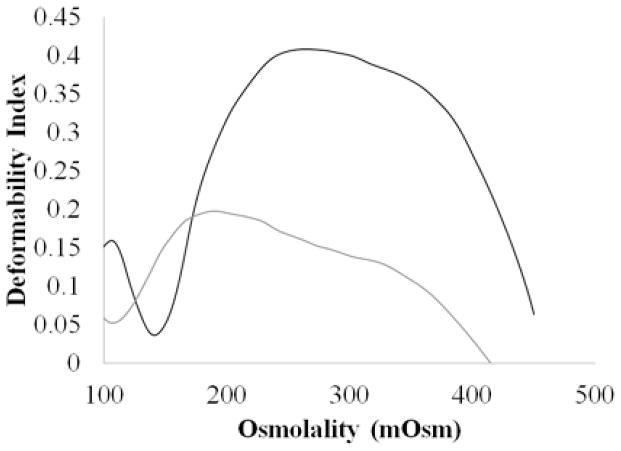
Figure 1
Figure 1
Osmotic deformability curves for healthy (black) and sickle (gray) RBCs. Healthy RBCs are much more deformable with DI Max around 290 mOsm, while dehydrated sickle RBCs are much more rigid and Osm Max much lower.
Figure 2
Figure 2
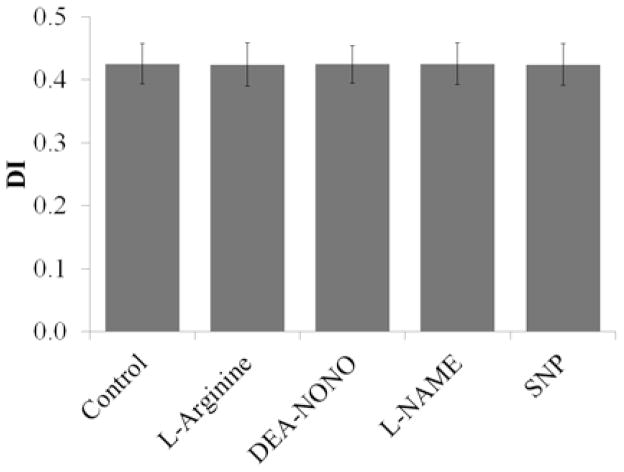
Average DI Max for healthy RBC treated with NO donors and agents that could affect nitric oxide synthase. NO donors DEA-NONOate and SNP (10 μM), NOS substrate L-arginine (3 mM) and NOS inhibitor (1 mM) were added to 1 ml fresh whole blood and incubated for 1 hour at room temperature (n=4, each trial from a different donor).
Figure 3
Figure 3
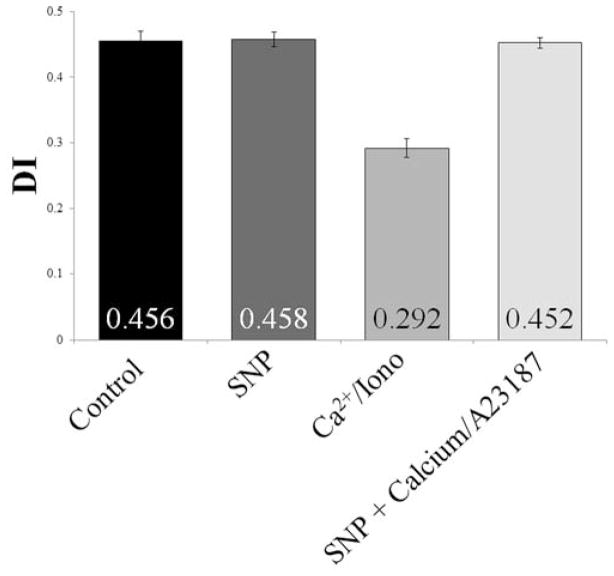
Average DI Max for healthy RBC treated with or without SNP and/or the calcium with calcium ionophore A23187. From left to right: control; +80 μM SNP; +20 μM Ca2+ +10 μM A23187; +80 μM SNP +20 μM Ca2+ +10 μM A23187 (n=3, each trials from a different donor)
Figure 4
Figure 4
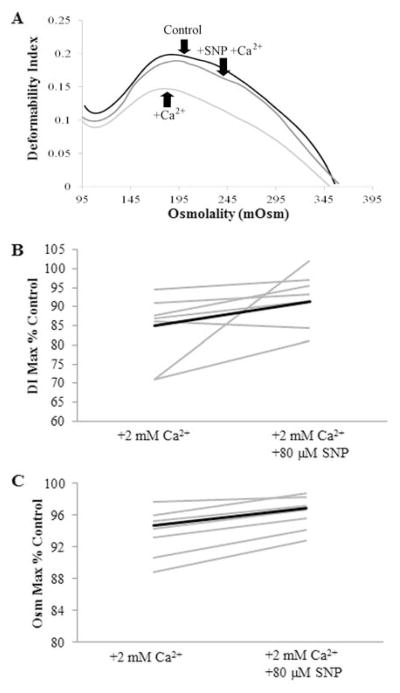
SNP effects on deformability of sickle red blood cells A. Osmotic deformability curves showing improvement in DI Max and Osm Max when sickle cells were precincubated with SNP. Sickle whole blood (black, DI Max=0.198) underwent several cycles of sickling and unsickling in the presence of 2 mM extracellular calcium (light gray, DI Max=0.147) to promote dehydration along with potential formation of irreversibly sickled cells. Samples that were pretreated with 80 μM SNP were protected from this calcium-induced dehydration (dark gray, DI Max=0.189). B. Percent control is the fraction of DI Max with Ca2+ and/or SNP to that of the control. All but one of the patients (grey) showed an increase in DI Max (p=0.036, DI Maxcalcium vs DI MaxSNP; n=7). The average (black) percent recovery of deformability loss with addition of SNP was 42.7 ± 36.7 % C. Percent control is the fraction of Osm Max with Ca2+ and/or SNP to that of the control. All of the patients’ RBC showed an increase in osmolality at DI Max when pretreated with SNP (p=0.024, Osm Maxcalcium vs Osm MaxSNP; n=8 patients). The average percent recovery in osmolality was 81.5 ± 71.1%.
Figure 5
Figure 5
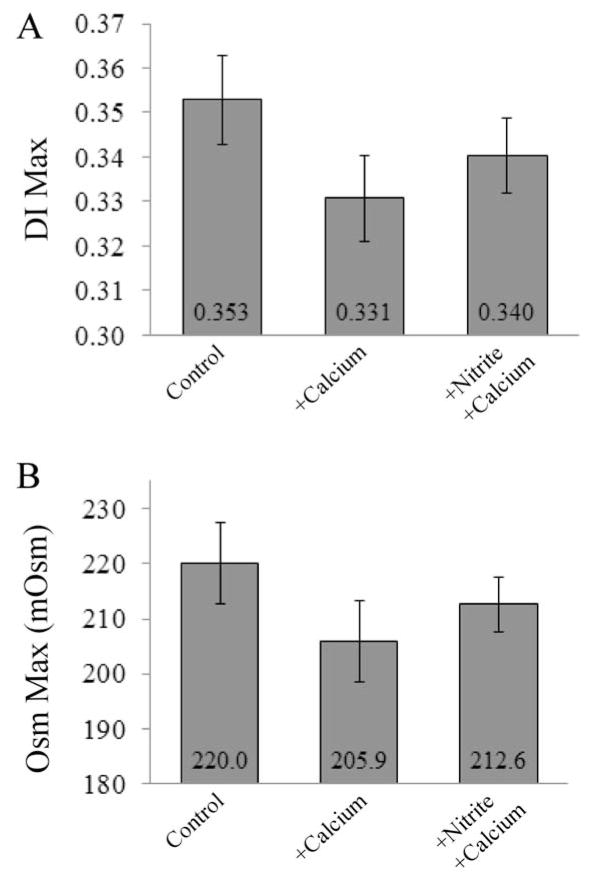
Nitrite effects on deformability and hydration of sickle red blood cells A. Average DI Max for sickled RBC treated with or without sodium nitrite (10 μM) and/or calcium chloride (2 mM). Nitrite had a small though insignificant protective effect against hypoxia-induced deformability loss (p=0.11; n=5 patients). B. Average Osm Max for sickled RBC treated with or without sodium nitrite (10 μM) and/or calcium chloride (2 mM). Nitrite had a small though insignificant protective effect against hypoxia-induced dehydration (p=0.092; n=5 patients).
Figure 6
Figure 6
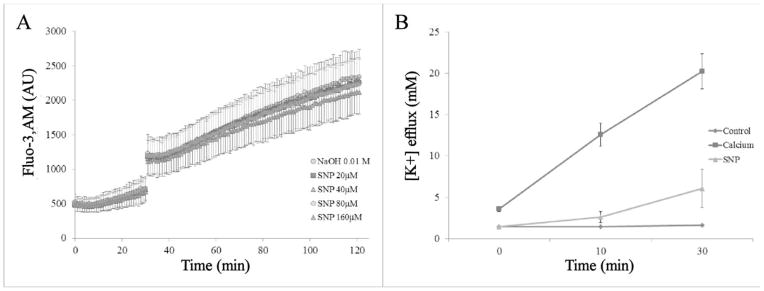
Effect of SNP on ion transport A. RBC Calcium influx in response to A23187 (5 μM) in the presence or absence of SNP: RBCs labeled with the calcium fluorophore, Fluo-3,AM, were treated with SNP at selected concentrations between 20 μM and 160 μM. Control RBCs were not treated with SNP or A23187. NaOH 0.01 M was the vehicle control for the SNP treatments. RBC Fluo-3,AM was monitored for 30 min, then A23187 was injected, and fluorescence was monitored for additional 90 min (n=3). B. Pretreating 40% Hct washed RBC (blue) with SNP (green) before addition of calcium and ionophore A23187 (red) blunted potassium efflux by 74.2±19.2% after 30 minutes (p=0.003, n=3, each trial from a different donor).
Figure 7
Figure 7
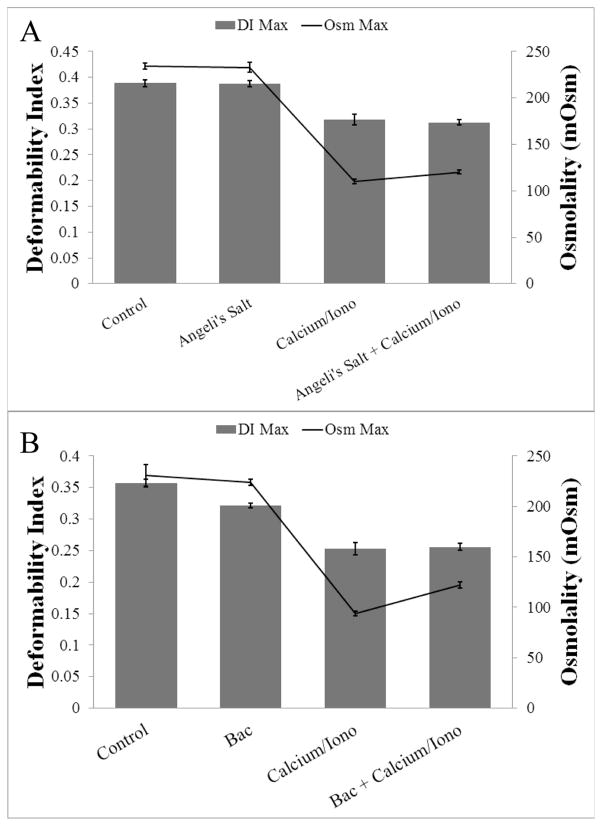
Effect of other nitrosating and oxidizing agents on calcium-induced RBC dehydration in healthy RBCs. A. RBCs were pretreated with Angeli’s Salt (100 μM) before addition of calcium chloride (20 μM) and A23187 (10 μM). Gray bar graphs show average DI Max ± standard deviation (from left to right: 0.389±0.007, 0.388±0.006, 0.318±0.010, 0.313±0.006) and black line graph shows average Osm Max ± standard deviation (from left to right (in mOsm): 234.5±3.4, 232.9±5.6, 109.9±2.6, 120.3±1.9) (n=3 donors). B. RBCs were pretreated with Bacitracin (3 mM) before addition of calcium chloride (20 μM) and A23187 (10 μM). Gray bar graphs show average DI Max ± standard deviation (from left to right: 0.357±0.006, 0.321±0.004, 0.253±0.010, 0.256±0.005) and black line graph shows average Osm Max ± standard deviation (from left to right (in mOsm): 230.9±10.7, 223.5±3.1, 94.2±2.3, 122.1±2.9) (n=3 donors).

References

    1. Bunn HF. Pathogenesis and Treatment of Sickle Cell Disease. New England Journal of Medicine. 1997;337:762–9. - PubMed
    1. Franck P, Bevers E, Lubin B, Comfurius P, Chiu D, Kamp JOd, Zwaal R, Deenen Lv, Roelofsen B. Uncoupling of the membrane skeleton from the lipid bilayer. The cause of accelerated phospholipid flip-flop leading to an enhanced procoagulant activity of sickled cells. J Clin Invest. 1985;75:183–90. - PMC - PubMed
    1. Apovo M, Beuzard Y, Galacteros F, Bachir D, Giraud F. The involvement of the Ca-dependent K channel and of the KCl co-transport in sickle cell dehydration during cyclic deoxygenation. BBA Mol Basis of Dis. 1994;1225:255–8. - PubMed
    1. Bookchin RM, Lew VL. Sickle red cell dehydration: mechanisms and interventions. Curr Opin Hematol. 2002;9:107–10. - PubMed
    1. Ferrone FA, Hofrichter J, Eaton WA. Kinetics of sickle hemoglobin polymerization: I. Studies using temperature-jump and laser photolysis techniques. Journal of Molecular Biology. 1985;183:591–610. - PubMed

Publication types